


The orangutan is one of the planet’s most distinctive and intelligent creatures. It has been observed using primitive tools, such as the branch of a tree, to hunt food and is capable of complex social behavior.
Orangutans also played a special role in humanity’s own intellectual history when, in the 19th century, Charles Darwin and Alfred Russel Wallace, codevelopers of the theory of natural selection, used observations of them to hone their ideas about evolution.
However, humanity has not repaid orangutans with kindness. The numbers of these distinctive, red-maned primates are plummeting thanks to the destruction of their habitats and illegal hunting of the species.
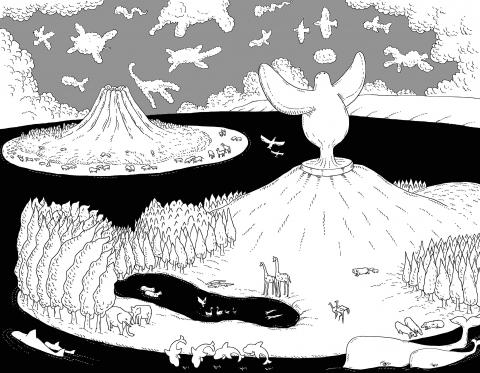
Illustration: Mountain People
Last week, an international study showed that its population in Borneo, the animal’s last main stronghold, stands between 70,000 and 100,000, less than half of what it was in 1995.
“I expected to see a fairly steep decline, but I did not anticipate it would be this large,” said one of the study’s coauthors, Serge Wich of Liverpool John Moores University.
For good measure, conservationists have said numbers are likely to fall by at least another 45,000 by 2050 thanks to the expansion of palm oil plantations, which are replacing orangutans’ forest homes.
One of the Earth’s most spectacular creatures is heading toward oblivion, along with the vaquita dolphin, the Javan rhinoceros, the western lowland gorilla, the Amur leopard and many other species whose numbers are declining dramatically.
All of these are threatened with the fate that has already befallen the Tasmanian tiger, the dodo, the ivory-billed woodpecker and the baiji dolphin — victims of humanity’s urge to kill, exploit and cultivate.
As a result, scientists have said that humanity could soon be left increasingly isolated on a planet bereft of wildlife and inhabited only by humans plus domesticated animals and their parasites.
This grim scenario will form the background to a key conference — Safeguarding Space for Nature and Securing Our Future — to be held in London on Tuesday and Wednesday next week.
The aim of the symposium is straightforward: highlight ways of establishing sufficient reserves and protected areas to halt or seriously limit the major extinction event that humanity faces.
According to one report, the number of wild animals on the planet has halved in the past 40 years as humans kill for food in unsustainable numbers and pollute or destroy habitats — and worse probably lies ahead.
Action is urgently need, scientists have said. This point was acknowledged in 2010 at a major international conference in Japan, where governments agreed to establish a network of reserves and protected seas that would, by 2020, cover 17 percent of the planet’s land surface and 10 percent of the oceans.
“With more than two years to go, we now have about 15 percent of land protected and about 7 percent of oceans,” said one of the London conference’s organizers, Mike Hoffman of the Zoological Society of London.
New reserves include the Termit Tin Toumma National Nature Reserve in Niger, home of the addax antelope and dama gazelle, both critically endangered, as well as Yaguas National Park in Peru, which is known for its manatees, river dolphins, giant otters and woolly monkey.
“The conference will assess how much these new reserves have helped conservation, examine the problems that have been encountered in setting them up and look at ways to make further improvements to ensure we meet our target of 17 percent of land and 10 percent of ocean protection by the time the next major biodiversity conference is held in China in 2020,” Hoffman said.
However, many conservationists have said that even if these goals could be achieved, they will still not halt extinctions. The focus on protecting what humans are willing to spare for conservation is unscientific, they have said. Instead, conservation targets should be determined by what is necessary to protect nature.
This point is stressed by Harvey Locke, whose organization, Nature Needs Half, takes a far bolder approach and campaigns for the preservation of fully 50 percent of the planet for wildlife by 2050.
“That may seem a lot — if you think the world is a just a place for humans to exploit — but if you recognize the world as one that we share with wildlife, letting it have half of the Earth does not seem that much,” Locke told the Observer.
The idea is supported by distinguished Harvard biologist E.O. Wilson in his most recent book, Half Earth.
“We thrash about, appallingly led, with no particular goal other than economic growth and unfettered consumption,” he wrote. “As a result, we’re extinguishing Earth’s biodiversity as though the species of the natural world are no better than weeds and kitchen vermin.”
The solution, he said, is to fill half the planet with conservation zones — although just how this division is to be decided is not made clear in his book.
In any case, simply setting aside huge chunks of land or marine areas will not save the day on its own, Hoffman said.
“We could earmark the whole of northern Canada as a wildlife reserve, but, given the paucity of animals who live in these frozen regions, that would not have a significant effect on a great many species who live elsewhere,” he said.
Locke makes a similar point: “Protecting all of Antarctica would also be an excellent idea and would certainly enhance the percentage of the world that is protected and do great things for life there. However, it would do nothing for tigers, toucans, lions and grizzly bears.”
Simply setting aside half the planet as wilderness and using the other half for giant cities and farms poses other difficulties. Pollution, poaching and climate change triggered by carbon emissions and other human-caused problems would constantly seep from the human half of the planet into the wildlife “zone.”
Instead, a far more carefully integrated pattern of wildlife areas needs to be established, one that would allow animals to move relatively easily between reserves to maintain genetic diversity between populations, conservationists say.
“We need to focus less on simply protecting single, isolated wildlife areas — which are constantly being eaten away at the edges — to more effectively buffer and integrate these core areas into wider landscapes,” said Noelle Kumpel of BirdLife International, which is also involved in next week’s conference.
Such a goal will be tricky, because, among many other reasons, animals are no great observers of human boundaries. They move out of protected areas at random and come into conflict with humans.
The problem is exemplified by the wolf, whose numbers have begun to flourish in Europe thanks to the efforts of conservationists.
Last month, the first wolf on Belgian soil made its mark by killing at least two sheep, while similar attacks by wolves in France, Germany and Finland have led to demands for culls from angry farmers.
Other animals that conservationists have succeeded in restoring in numbers in Europe — such as bears and jackals — have also caused controversy. Integrating humans and wild animals will not be easy.
One solution to be discussed at next week’s conference will be the proposal to make our cities far greener than they are at present. This would reduce the effects of the pollution that they produce, but would also raise public awareness of wildlife issues, said Daniel Raven-Ellison, a proponent of the creation of “national park cities.”
“London, for example, is a surprisingly green city,” he said. “You would only need to plant on a relatively small amount of extra land to make half its surface green. That would have important ecological effects, but it would also have an important symbolic effect and help raise awareness of the issues we face.”
Citizens of greener cities would be far more likely to engage with nature concerns and would be far more likely to extend their awareness to wildlife elsewhere in the world — to narwhals or turtles or to other threatened species, Raven-Ellison said.
“The story of plastics and the oceans provides an example of what cities can do. There has been a real reaction in places like London to the use of plastics which get into the oceans and threaten marine life. As a result, there has been a drive here to have water fountains and use less plastics. Crucially, in cities we can turn up the dial in campaigns like these,” he said.
However, other issues will be less easily dealt with. Of particular concern is Africa. The continent is still fairly rich in wildlife, but is expected to change far more drastically than any other part of the world as humanity’s growth continues throughout this century.
According to the UN’s population figures, there are about 7.5 billion men, women and children living on our planet, and this is likely to rise to about 11.2 billion by the end of the century — with virtually all of that increase happening in Africa. The continent’s population is expected to swell from 1.25 billion today to about 4.25 billion in 2100. By contrast, population growth in other continents will be relatively low.
The effects will be striking and will come as climate change also takes its toll on the continent’s ecosystems, resulting in considerable international friction.
“Africans are not likely to be happy with the non-Africans in the international community telling them where and when they should set up reserves and telling them to halt logging or farming, given the plight they will find themselves in,” one observer said.
There are two separate issues at stake with regard to protecting habitats and wildlife for the future, Sir David Attenborough told the Observer.
“First, there is the moral dimension. We have a responsibility to all these forms of life on our planet, because we have power over them,” he said. “However, there is also a practical issue. We need to ensure that we have enough life forms on Earth to ensure the planet’s health, but how many is enough? We simply do not know the answer to that question — although I think we should assume that it is a fairly large number and that they need protecting.”
On March 18, 2015, the British government announced a plan to establish the largest marine reserve in the world around the Pitcairn Islands in the South Pacific. At 834,000km2, the Pitcairn Marine Reserve will offer protection to some of the most pristine waters and coral reefs on Earth, and to a range of endangered species, including the green turtle (Chelonia mydas), which is suffering major losses in numbers because of pollution and habitat loss, and from being trapped in fishing nets.
The Western Hemisphere’s newest national reserve, Yaguas National Park in northeastern Peru’s rainforest, protects millions of hectares of wilderness. Apart from the indigenous people who live there, Yaguas is home to endangered creatures including manatees, river dolphins, giant otters and woolly monkeys. The park joins a network of reserves recently created to preserve territory in other South American countries, including Ecuador, Chile and Colombia.
The addax — also known as the screwhorn antelope — is one of the world’s most endangered species of antelope. Only a few hundred remain in the wild after the species was hunted to near extinction because of its distinctive-flavored meat.
However, the establishment of the Termit Tin Toumma reserve in Niger — where most remaining members of Addax nasomaculatus are concentrated — has raised hopes it can be preserved in the wild along with other endangered species, such as the dama gazelle.
China has announced a ban on land reclamation in coastal wetlands. In some areas, particularly in the Yellow Sea region, reclamation has caused many bird species to decline dangerously. For example, by 2014, it was believed there were fewer than 228 pairs of spoon-billed sandpipers.
The directive falls short of creating protected reserves, but has raised hopes of wildlife being helped to recover there, and that China is now viewing the issue as important.
Taiwan should reject two flawed answers to the Eswatini controversy: that diplomatic allies no longer matter, or that they must be preserved at any cost. The sustainable answer is to maintain formal diplomatic relations while redesigning development relationships around transparency, local ownership and democratic accountability. President William Lai’s (賴清德) canceled trip to Eswatini has elicited two predictable reactions in Taiwan. One camp has argued that the episode proves Taiwan must double down on support for every remaining diplomatic ally, because Beijing is tightening the screws, and formal recognition is too scarce to risk. The other says the opposite: If maintaining
India’s semiconductor strategy is undergoing a quiet, but significant, recalibration. With the rollout of India Semiconductor Mission (ISM) 2.0, New Delhi is signaling a shift away from ambition-driven leaps toward a more grounded, capability-led approach rooted in industrial realities and institutional learning. Rather than attempting to enter the most advanced nodes immediately, India has chosen to prioritize mature technologies in the 28-nanometer to 65-nanometer range. That would not be a retreat, but a strategic alignment with domestic capabilities, market demand and global supply chain gaps. The shift carries the imprimatur of Indian Prime Minister Narendra Modi, indicating that the recalibration is
Chinese Nationalist Party (KMT) Chairwoman Cheng Li-wun (鄭麗文), during an interview for the podcast Lanshuan Time (蘭萱時間) released on Monday, said that a US professor had said that she deserved to be nominated for the Nobel Peace Prize following her meeting earlier this month with Chinese President Xi Jinping (習近平). Cheng’s “journey of peace” has garnered attention from overseas and from within Taiwan. The latest My Formosa poll, conducted last week after the Cheng-Xi meeting, shows that Cheng’s approval rating is 31.5 percent, up 7.6 percentage points compared with the month before. The same poll showed that 44.5 percent of respondents
China last week announced that it picked two Pakistani astronauts for its Tiangong space station mission, indicating the maturation of the two nations’ relationship from terrestrial infrastructure cooperation to extraterrestrial strategic domains. For Taiwan and India, the developments present an opportunity for democratic collaboration in space, particularly regarding dual-use technologies and the normative frameworks for outer space governance. Sino-Pakistani space cooperation dates back to the end of the Cold War in the 1990s, with a cooperative agreement between the Pakistani Space & Upper Atmosphere Research Commission, and the Chinese Ministry of Aerospace Industry. Space cooperation was integrated into the China-Pakistan


 RSS
RSS