


Taiwan’s economy is on a roll, growing at its fastest rate in nearly two years in the fourth quarter last year thanks to strong technology exports.
However, policymakers know that Taiwan’s substantial manufacturing sector faces increasingly stiff competition from its neighbors. These competitors can undertake product assembly and manufacture electronics components more cheaply.
To avert a growth crunch, the authorities are looking to encourage higher value-added, innovation-intensive industries. Life science industries such as biotech and pharma research and development would be key to this ambition.
Taiwanese pharmaceutical companies have experienced several years of solid growth with generic production, but it is a business of razor-thin margins. Continuing the replication of products invented, designed and manufactured elsewhere will not generate the longer-term economic value, tax revenue and attractive, high-value jobs that research and development (R&D)-intensive originator companies can. Drug innovation, not generic production, holds the key to long-term economic success.
Despite Taipei’s efforts toward developing its life sciences industry, significant investment from foreign biopharmaceutical companies remains elusive.
According to research company IHS Markit, a major roadblock is intellectual property.
In its latest assessment of Taiwan, it says: “Challenges in intellectual property rights policies persist, deterring multinational companies from investing in the sector... One major issue is that many patent-infringing drugs are being approved and included in the reimbursement list.”
A recent survey by the International Research-Based Pharmaceutical Manufacturers Association found that at least 65 patent-infringing drugs have been approved for sale by Taiwanese regulators. Most were made available in the public health system.
Cheaper, generic versions of existing drugs should not, in principle, enter the market while a valid patent on the original version remains in place.
However, regulators are not currently required to notify originators when competitors seek market approval for a generic version of a patented drug. This means many generic medicines go on sale, despite potentially violating originators’ patent rights.
This widespread infringement of intellectual property rights impacts earnings by introducing price competition earlier than the patent system intends.
It also sends out a broader signal that rule of law in Taiwan is weak and that its authorities are prepared to turn a blind eye to intellectual property infringement. This not only deters R&D investment in pharmaceuticals and biotechnology, but in other sectors, too.
To bolster the environment for innovation, Taiwan is one of several nations considering a “patent linkage” system to reduce the number of generic drugs gaining marketing approval before the originators’ patent has expired.
Drafted by the Taiwan Intellectual Property Office, the plan links the patent status of a medicine and regulatory approval of generic copies to prevent approvals that infringe the original. It is currently under review by the Executive Yuan.
A patent linkage system could also boost investors’ confidence in Taiwan, particularly in the innovative life science industry. Greater investment and partnerships by these companies will encourage the creation of the higher-margin, innovation-intensive industries and the value-added jobs the government needs.
Opponents argue the move would undermine the nation’s generic drug industry, making market entry more difficult and encouraging patent holders to engage in frivolous litigation.
However, patent linkage aids generic manufacturers too. It requires innovators to keep regulators updated on the patent status of their products. Greater clarity on what is and is not patent-protected allows generic manufacturers to avoid wasting their efforts launching copied medicines that will be blocked by legal action.
While linkage mechanisms deter generic manufacturers from launching legal challenges against valid patents, Taiwan’s proposed system encourages them to contest the validity of questionable ones. As with similar schemes already implemented in South Korea and the US, generic companies are incentivized to bring validity challenges. The first successful challenger is granted a period of market exclusivity to sell their version of the drug.
Patents that should never have been granted are more likely to be revoked. In this way, patent linkage hastens the entry of price-competitive generics and ultimately discourages innovators from trying to file large numbers of low-quality applications.
Taiwan’s potential move to a patent linkage system would follow the likes of Australia, South Korea and Singapore, which suggests it is an emerging regional standard.
Ensuring the protection of intellectual property rights is fundamental for a high-income country like Taiwan as it continues its journey from a manufacturing to a knowledge economy. The new plan on patent linkage is a vital part of this journey and should be welcomed.
Jack Ellis is research associate at Geneva Network, a UK-based research organization focused on trade, health and innovative policy.
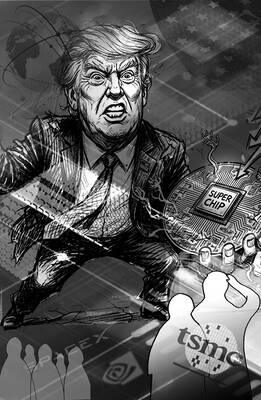
The White House’s decision to take a 9.9 percent stake in Intel Corp is looking like very shrewd business indeed. Since the government bought in at US$20.47 a share last August, the US chipmaker’s surging stock price has delivered the US a US$43 billion return. One of the reasons the investment has so far proved so sound is that the White House has made sure of it. According to The Wall Street Journal, Howard personally pushed deals on Intel’s behalf with some of the most lucrative clients imaginable. They include Nvidia Corp, the company at the heart of the AI
A single photograph can cut through a lot of noise, but it can also be used to misrepresent the truth. At the very least, it can concentrate the mind on something that requires further investigation. On Monday last week, Ma Ying-jeou Foundation CEO Tai Hsia-ling (戴遐齡) and former National Security Council secretary-general King Pu-tsung (金溥聰) held a news conference in which they showed a photograph of former foundation CEO Hsiao Hsu-tsen (蕭旭岑), now Chinese Nationalist Party (KMT) deputy chairman. In the image Hsiao is seated next to Xiamen Taiwan Businessmen Association chairman Han Ying-huan (韓螢煥). The two men were holding
I first met Professor Ray Jiing (井迎瑞) as a film and documentary student at Shih Hsin University’s (SHU) Department of Radio Television and Film in 1988. The following year, he went on to become the director of the Chinese Taipei Film Archive — forerunner of the Taiwan Film and Audiovisual Institute (TFAI). Over his eight-year tenure, Jiing rescued and restored over 200 classic Taiwanese films. In 1997, he established the Graduate Institute of Studies in Documentary and Film Archiving at Tainan National University of the Arts (TNNUA), and I joined the program in his third cohort of students. Beyond a
A recent report concerning a student who is suing his teacher posed the question in its headline: Does failing a student in two subjects constitute bullying? The college student in Chiayi County apparently sought NT$2 million (US$63,603) in state compensation, but a court dismissed the case. The first reaction of many might have been to ask: What has happened to students nowadays? Some say that teachers have lost their authority, while others say students are overindulged. Some even start reminiscing over the days when “whatever the teacher says goes.” However, the real issue might be overlooked if emotional reactions like that are the


 RSS
RSS