


On the evening of July 14, 1982, at a secret meeting at then-president Chiang Ching-kuo’s (蔣經國) spartan “Seven Seas Residence” in suburban Taipei, James R. Lilley presented Chiang with “six assurances” directly from then-US president Ronald Reagan. Lilley was the de facto US ambassador in Taipei, where he had been assigned after a year as Reagan’s top East Asia adviser on the US National Security Council.
The meeting was shrouded in secrecy — only Lilley, Chiang and his vice minister of foreign affairs Frederick Chien (錢復) were present.
The “six assurances” were the fruit of several weeks of White House deliberations on how to deal even-handedly with both Taipei and Beijing after it was disclosed that then-US secretary of state Alexander Haig had urged the US to cut off arms sales to Taiwan as the price of maintaining a strategic relationship with China.
Haig’s efforts proved disastrous to his position. he resigned on June 25, 1982, and in his memoir admits that his resignation was what ultimately made even a watered-down Taiwan arms sales communique with China possible. In fact, Reagan approved the Third Joint Communique only after he had satisfied himself that it did not compromise Taiwan’s security. Reagan wrote in his diary the day he fired Haig that “actually, the only disagreement [with Haig] was whether I made policy or the Sec. of State did.”
Haig did not approve of his president’s assurances. They were formulated by the White House and drafted by David Dean, then-chairman of the American Institute in Taiwan’s Washington office and a trusted foreign-service officer in the Department of State’s Office of Taiwan Coordination, and were presented to Taiwan three weeks after Haig’s departure.
Among the first four assurances were that the US would not allow Beijing to dictate the terms of arms supplies to Taipei; nor would the US push Taiwan to negotiate with China, much less mediate between Taipei and Beijing.
The fifth and sixth assurances were that the US would not change a “long-standing” policy regarding Taiwan’s sovereignty.
That “long-standing” policy had been concisely explained to the US Senate 12 years earlier.
“As Taiwan and the Pescadores are not covered by any existing international disposition, sovereignty over the area is an unsettled question subject to future international resolution... The United States recognized the Government of the Republic of China as legitimately occupying and exercising jurisdiction over Taiwan and the Pescadores,” the 1970 restatement of US policy on Taiwan’s “unsettled” status said.
The “unsettled” status alarmed then-president Chiang Kai-shek (蔣介石), but in 1982 it was received with relief and appreciation. Indeed, the fifth assurance, that the US had not changed its view of Taiwan’s “unsettled” status, was one which Chiang Ching-kuo had specifically sought upon learning of Washington’s secret negotiations with Beijing on arms sales to Taiwan.
However, it was the sixth of the “assurances” given by Reagan to Chiang Ching-kuo that evening which was perhaps the one that Chiang Ching-kuo valued most highly.
By 1982, Taipei was relieved, indeed delighted, by it. Then-US assistant secretary of state for East Asian affairs John Holdridge said in his memoir, Crossing the Divide, that the sixth “assurance” read: “The United States would not formally recognize China’s sovereignty over Taiwan,” a point that Holdridge ultimately made public on July 24, 1982.
Chiang Ching-kuo now appreciated that Taiwan’s “unsettled” status was crucial to the endurance of his government’s international legitimacy and indeed to Taiwan’s future identity as an Asian democracy in an international system that increasingly had acquiesced to China’s claims of legal authority over the island.
That sixth “assurance,” that the US “would not formally recognize China’s sovereignty” meant that Taiwan’s democracy would instead be built upon an international identity separate from China.
This “assurance,” in turn, rested upon the statutory mandate of that other cornerstone of US policy toward Taiwan, the 1979 Taiwan Relations Act, which stated: “Whenever the laws of the United States refer or relate to foreign countries, nations, states, governments, or similar entities, such terms shall include and such laws shall apply with respect to Taiwan.”
Thenceforth, scores of constitutional amendments and electoral reforms through the 1990s in Taiwan, and its political evolution into Asia’s most successful experiment in democratic principles, ensured that Taiwan’s future would be subject solely to the will of the Taiwanese. Reagan’s “assurances” have become the legal bedrock of the US’ continued diplomacy with Taiwan as an independent entity in world affairs.
In the 34 years since Reagan’s “six assurances,” each successive US administration has adopted them. In an April 2004 congressional hearing, then-US assistant secretary of state for East Asia James Kelly linked the sixth “assurance” to something he called “our ‘one China,’” with the Delphic explanation: “In my testimony, I made the point our ‘one China,’ and I didn’t really define it, and I’m not sure I very easily could define it. I can tell you what it is not. It is not the ‘one China’ policy or the ‘one China’ principle that Beijing suggests, and it may not be the definition that some would have in Taiwan.”
Kelly, a skilled diplomatist, took pains not to disturb the “unsettled” nature of Taiwan’s status. He pleaded with Taipei to avoid it as well.
Last month, US Congress also weighed in with robust resolutions reaffirming the “six assurances.” One passed the US House of Representatives by voice vote on May 16, and a strong bipartisan companion was introduced on May 19 in the Senate. These latest endorsements by Congress are intended to reassure President Tsai Ing-wen (蔡英文) that the US remains committed to Taiwan, and to ease domestic political pressures on her to move the needle on Taiwan’s status.
Reagan’s “six assurances,” and especially the sixth, that the US would “not formally recognize China’s sovereignty over Taiwan,” remain an essential buttress to Taiwan’s future, and with it, the future of East Asia.
Indeed, they are mainstays of the US’ future in a free and democratic Asia.
John J. Tkacik, a retired US foreign service officer who served in Taipei and Beijing, is director of the Future Asia Project at the International Assessment and Strategy Center in Alexandria, Virginia. He was the economic officer at the US Department of State’s Office of Taiwan Coordination when the “six assurances” were announced.

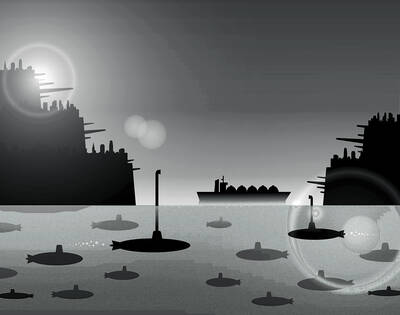
In the event of a war with China, Taiwan has some surprisingly tough defenses that could make it as difficult to tackle as a porcupine: A shoreline dotted with swamps, rocks and concrete barriers; conscription for all adult men; highways and airports that are built to double as hardened combat facilities. This porcupine has a soft underbelly, though, and the war in Iran is exposing it: energy. About 39,000 ships dock at Taiwan’s ports each year, more than the 30,000 that transit the Strait of Hormuz. About one-fifth of their inbound tonnage is coal, oil, refined fuels and liquefied natural gas (LNG),
On Monday, the day before Chinese Nationalist Party (KMT) Chairwoman Cheng Li-wun (鄭麗文) departed on her visit to China, the party released a promotional video titled “Only with peace can we ‘lie flat’” to highlight its desire to have peace across the Taiwan Strait. However, its use of the expression “lie flat” (tang ping, 躺平) drew sarcastic comments, with critics saying it sounded as if the party was “bowing down” to the Chinese Communist Party (CCP). Amid the controversy over the opposition parties blocking proposed defense budgets, Cheng departed for China after receiving an invitation from the CCP, with a meeting with
Chinese Nationalist Party (KMT) Chairwoman Cheng Li-wun (鄭麗文) is leading a delegation to China through Sunday. She is expected to meet with Chinese President Xi Jinping (習近平) in Beijing tomorrow. That date coincides with the anniversary of the signing of the Taiwan Relations Act (TRA), which marked a cornerstone of Taiwan-US relations. Staging their meeting on this date makes it clear that the Chinese Communist Party (CCP) intends to challenge the US and demonstrate its “authority” over Taiwan. Since the US severed official diplomatic relations with Taiwan in 1979, it has relied on the TRA as a legal basis for all
To counter the CCP’s escalating threats, Taiwan must build a national consensus and demonstrate the capability and the will to fight. The Chinese Communist Party (CCP) often leans on a seductive mantra to soften its threats, such as “Chinese do not kill Chinese.” The slogan is designed to frame territorial conquest (annexation) as a domestic family matter. A look at the historical ledger reveals a different truth. For the CCP, being labeled “family” has never been a guarantee of safety; it has been the primary prerequisite for state-sanctioned slaughter. From the forced starvation of 150,000 civilians at the Siege of Changchun


 RSS
RSS