


It sounds like 21st century China: a consumer’s paradise where glass skyscrapers race toward the heavens, Porsche convertibles cruise the streets and towering billboards advertise Gucci and Prada.
In fact, some believe this is a vision of North Korea’s future if the country’s rulers resolve to follow the footsteps of their neighbors to the north.
While many experts view regime collapse as the most likely — and bloody — endgame for North Korean leader Kim Jong-un’s reign, one of the most optimistic scenarios is that North Korea might instead look to China’s experience of economic reform.
“That is the inevitable road that they have to take,” said Paik Hak-soon, the director of the Center for North Korean Studies at the Sejong Institute in Seoul, who believes Kim has already embarked on a gradual path of political — as well as economic — reform reminiscent of China and Vietnam in the 1970s and 1980s.
“The die is cast. There is no way of returning,” Paik said.
Officials and academics in South Korea repeatedly evoke late Chinese leader Deng Xiaoping (鄧小平) — a charismatic pragmatist who led China out of the chaos of the Mao era and into a new period of explosive economic growth — as a potential inspiration for North Korea’s young leader.
In the late 1970s, Deng masterminded Beijing’s “reform and opening up,” a period of economic modernization that allowed hundreds of millions of Chinese to lift themselves from poverty and helped make their country the world’s second-largest economy.
Seoul’s Yonsei University political scientist Moon Chung-in said Pyongyang was only too aware of the need to embark on a similar process.
“They want to do it. They are damn smart. They think about the regime’s survival 24 hours a day, 365 days [a year],” he said.
However, Moon cautioned against outsiders pushing North Korea toward imitating China.
“If you really want to change North Korea don’t use the word change. If you really want to push North Korea in the direction of opening and reform then never use ‘opening’ and ‘reform,’” he said. “They have all the examples, all the models. But the very moment [someone says]: ‘Kim Jong-un is adopting the Deng Xiaoping model,’ they will stop. If they adopt the Deng Xiaoping model you simply say: ‘That is the Kim Jong-un model. It is a good model, it is doing well.’”
Chung Chong-wook, who was Seoul’s ambassador to Beijing from 1996 to 1998, is another for whom Chinese history provides a source of optimism. Chung said the two countries were different, but, asked if Deng could be a role model for Kim Jong-un, he replied: “I hope so.”
The former diplomat said he already saw signs that Kim was moving away from the “military-first” policy adopted by his father, former North Korean leader Kim Jong-il.
“Under Kim Jong-un of course the nuclear priority is [still] there, but the economy is also being emphasized,” Chung said. “I think that Kim Jong-un, as time goes on, will have to rely on the economy to support his legitimacy as the leader. I do not think that that will happen right away, it will be the same at least for many, many years to come. But the change, the shift is [there].”
Andrei Lankov, author of The Real North Korea: Life and Politics in the Failed Stalinist Utopia, said it was his dream to see Pyongyang follow Beijing’s footsteps and become a developmental dictatorship .
However, Lankov said Kim Jong-un would be unwise to stick too closely to Deng’s rulebook for reform.
For a start, North Korea’s leader would have to be far more repressive than the Chinese leader, who ordered the brutal Tiananmen crackdown, but nevertheless presided over a major relaxation of individual freedoms compared with the Mao era.
The staggering economic gulf between North and South Korea would likely spark a popular revolt in the North if Kim relaxed his grip, Lankov said.
“If he becomes Deng Xiaoping he is going to be killed. He needs to be a cross between Deng Xiaoping and Stalin. He has to be very trigger-happy because South Korea is so damn successful. Deng Xiaoping, yes, but significantly more repressive,” he said.
Paik said he believed Kim Jong-un had already set his country’s course toward reform and opening up, pointing to the special economic zones he had established since taking power in December 2011.
“The key word in North Korean society is change, change, change,” Paik said.
Whether Kim has already begun this transformation into a Deng with North Korean characteristics remains unclear, but many believe he ultimately has little choice.
“Kim Jong-un could become like Deng Xiaoping,” one government adviser in Seoul said. “If not he might end up like [former Romanian leader] Ceausescu.”
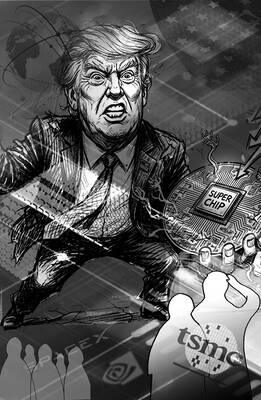
The White House’s decision to take a 9.9 percent stake in Intel Corp is looking like very shrewd business indeed. Since the government bought in at US$20.47 a share last August, the US chipmaker’s surging stock price has delivered the US a US$43 billion return. One of the reasons the investment has so far proved so sound is that the White House has made sure of it. According to The Wall Street Journal, Howard personally pushed deals on Intel’s behalf with some of the most lucrative clients imaginable. They include Nvidia Corp, the company at the heart of the AI
A single photograph can cut through a lot of noise, but it can also be used to misrepresent the truth. At the very least, it can concentrate the mind on something that requires further investigation. On Monday last week, Ma Ying-jeou Foundation CEO Tai Hsia-ling (戴遐齡) and former National Security Council secretary-general King Pu-tsung (金溥聰) held a news conference in which they showed a photograph of former foundation CEO Hsiao Hsu-tsen (蕭旭岑), now Chinese Nationalist Party (KMT) deputy chairman. In the image Hsiao is seated next to Xiamen Taiwan Businessmen Association chairman Han Ying-huan (韓螢煥). The two men were holding
I first met Professor Ray Jiing (井迎瑞) as a film and documentary student at Shih Hsin University’s (SHU) Department of Radio Television and Film in 1988. The following year, he went on to become the director of the Chinese Taipei Film Archive — forerunner of the Taiwan Film and Audiovisual Institute (TFAI). Over his eight-year tenure, Jiing rescued and restored over 200 classic Taiwanese films. In 1997, he established the Graduate Institute of Studies in Documentary and Film Archiving at Tainan National University of the Arts (TNNUA), and I joined the program in his third cohort of students. Beyond a
A recent report concerning a student who is suing his teacher posed the question in its headline: Does failing a student in two subjects constitute bullying? The college student in Chiayi County apparently sought NT$2 million (US$63,603) in state compensation, but a court dismissed the case. The first reaction of many might have been to ask: What has happened to students nowadays? Some say that teachers have lost their authority, while others say students are overindulged. Some even start reminiscing over the days when “whatever the teacher says goes.” However, the real issue might be overlooked if emotional reactions like that are the


 RSS
RSS