


The nation’s first-ever vote on whether to recall a lawmaker took place yesterday, and, not surprisingly, all the efforts to recall Chinese Nationalist Party (KMT) Legislator Alex Tsai (蔡正元) failed to achieve the objective, not because voters objected to his recall, but because of the high thresholds, showing the urgent need for revisions to the Civil Servants Election and Recall Act (公職人員選舉罷免法).
Elections in Taiwan are often treated as festivities by many, with candidates and political parties holding a variety of campaign activities, including traditional rallies, concerts and parades, while large campaign ads and posters can be seen on just about every corner across the nation.
However, it is quite different when it comes to recall campaigns. Even though election and recall are both rights granted by the Constitution, the Civil Servants Election and Recall Act prohibits any campaign activities.
Perhaps the legislators who passed this law were convinced that voters would be more eager to recall than to elect an official, that they do not need anyone to remind them when the recall vote is being held, and that they would actively research why the elected official needs to be recalled.
There is also another difference between a recall and an election.
A candidate only needs a simple majority to be elected, meaning that the candidate could be elected with only one vote if they were the only candidate in the electoral district.
However, for a recall, at least 50 percent of eligible voters in that particular electoral district must cast their votes, and among those who vote, at least 50 percent of them must vote “yes” to the recall proposal.
This is how the math works here: in the 2012 legislative election, Tsai garnered 111,260 votes in his constituency, which was 48 percent of the votes in the district. However, for the recall, at least 158,717 eligible voters in the electoral district must cast their votes, and half of those people must vote “yes.”
Therefore, election law requires more people to vote to recall Tsai than those who voted to get him elected, and while Tsai won the legislative seat with 48 percent of the vote, it would take more than 50 percent of the votes to recall him.
According to final figures from the Central Election Commission, a total of 79,303 people voted in the recall yesterday, and an overwhelming majority of those who voted — 97.22 percent, or 76,737 votes — agreed that Tsai should be recalled, yet he safely survived while taking a good nap at home. Voter turnout was only 24.98 percent, much lower than the required 50 percent.
It does not take a rocket scientist — or a Grand Justice — to figure out that this may be a Constitutional issue.
After all, election and recall are two equally important rights of the people, so why should there be different preconditions for citizens to exercise these powers? If a politician can be elected with less than 50 percent of votes, then it should be possible to recall them with less than 50 percent of votes. If a 50 percent voter turnout is required in a recall, it should also be the requirement for an election.
This was the first-ever recall proposal that made it to the polling stations in this nation’s history. It is an important step forward for Taiwan’s maturing democracy, yet the strict requirements for a recall mean that there is still a long way to go.
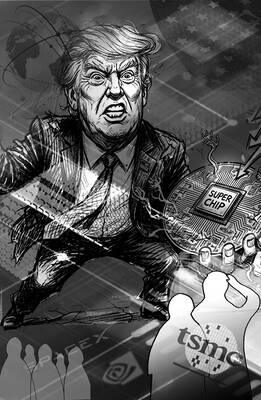
The White House’s decision to take a 9.9 percent stake in Intel Corp is looking like very shrewd business indeed. Since the government bought in at US$20.47 a share last August, the US chipmaker’s surging stock price has delivered the US a US$43 billion return. One of the reasons the investment has so far proved so sound is that the White House has made sure of it. According to The Wall Street Journal, Howard personally pushed deals on Intel’s behalf with some of the most lucrative clients imaginable. They include Nvidia Corp, the company at the heart of the AI
A single photograph can cut through a lot of noise, but it can also be used to misrepresent the truth. At the very least, it can concentrate the mind on something that requires further investigation. On Monday last week, Ma Ying-jeou Foundation CEO Tai Hsia-ling (戴遐齡) and former National Security Council secretary-general King Pu-tsung (金溥聰) held a news conference in which they showed a photograph of former foundation CEO Hsiao Hsu-tsen (蕭旭岑), now Chinese Nationalist Party (KMT) deputy chairman. In the image Hsiao is seated next to Xiamen Taiwan Businessmen Association chairman Han Ying-huan (韓螢煥). The two men were holding
I first met Professor Ray Jiing (井迎瑞) as a film and documentary student at Shih Hsin University’s (SHU) Department of Radio Television and Film in 1988. The following year, he went on to become the director of the Chinese Taipei Film Archive — forerunner of the Taiwan Film and Audiovisual Institute (TFAI). Over his eight-year tenure, Jiing rescued and restored over 200 classic Taiwanese films. In 1997, he established the Graduate Institute of Studies in Documentary and Film Archiving at Tainan National University of the Arts (TNNUA), and I joined the program in his third cohort of students. Beyond a
A recent report concerning a student who is suing his teacher posed the question in its headline: Does failing a student in two subjects constitute bullying? The college student in Chiayi County apparently sought NT$2 million (US$63,603) in state compensation, but a court dismissed the case. The first reaction of many might have been to ask: What has happened to students nowadays? Some say that teachers have lost their authority, while others say students are overindulged. Some even start reminiscing over the days when “whatever the teacher says goes.” However, the real issue might be overlooked if emotional reactions like that are the


 RSS
RSS