


The trial, conviction and suspended death sentence of Gu Kailai (谷開來), the wife of purged Chinese leader Bo Xilai (薄熙來), has called into question not only China’s legal system, but the very unity of the Chinese Communist Party (CCP) leadership.
Let us begin with the many questions raised at the trial. First, Gu claimed that she killed the British businessman Neil Heywood only to protect her son. However, given Gu’s power as Bo’s wife, she could have had someone like Heywood jailed or expelled from China at the snap of her fingers. Still, she not only admitted her guilt, but seemed to embrace it as a sort of historical necessity.
“In order to uphold the sanctity of the law,” she told the court, “I am willing to accept and calmly face whatever judgement I am given, and I also expect a fair and just judgment.”
Not since Stalin’s show trials of the 1930s has a defendant so effusively praised a judge who seemed bound to condemn her at a trial where no witness or evidence against her was presented.
The bitter irony of Gu’s high-speed trial is that she was a true believer in China’s legal system.
Indeed, following a victory in a US court, Gu, a lawyer, wrote a book in which she claimed that China provides “the fairest method of trial.”
She continued, “Chinese lawyers would not quibble over the meaning of each little word. Once they are sure that you murdered someone, you will be arrested, judged, and executed by firing squad.”
Gu was an avatar of the Maoist form of legality that China has maintained long since Mao’s death.
Having failed the entrance examination to Peking University, Gu was nonetheless granted an exception and admitted to read law soon after the Communist Party restored its law departments.
Gu was one of the first lawyers to receive her license. However, with the Tiananmen Square massacre in 1989, the authorities clamped down on the profession’s autonomy. The CCP reasserted control over every aspect of justice through a core department: the Communist Party Central Committee’s Political and Legal Affairs Committee (PLAC).
This totalitarian organ has no known address, yet it manages China’s police, prosecutors, courts and justice ministry, and appoints their leaders. All lawyers fall under its remit. Most important, all local PLAC secretaries simultaneously lead the local public-security bureau. Small wonder that the artist Ai Weiwei (艾未未) could be detained in secret, Liu Xiaobo (劉曉波) could be sentenced to 11 years in prison for starting a petition and Li Wangyang (李旺陽) could “commit suicide” while in custody.
However, even this monolithic system of control is porous. Had Wang Lijun (王立軍), the former Chongqing police commissioner and a close ally of Bo Xilai, not feared for his life and fled to the US’ consulate in Chengdu, Gu would still be helping Bo in ruling the city.
Wang is no saint. Before he became Bo’s police commissioner, he was the director of the Field Psychology Research Center, where the condemned were executed and their live organs removed.
Given his familiarity with the brutality of the Chinese system, Wang no doubt understood that, after falling out with Gu and Bo, the US consulate might be the only place he could find safety.
After all, when it came to the public-security organs, the courts and the prison system, Gu always had the final say. She acted as her husband’s adviser for cracking down on crime and corruption and was responsible for sending two people — including the PLAC secretary in Wushan County — to prison.
In fact, a few days after killing Heywood, Gu donned a major general’s uniform (which could have belonged to her father, General Gu Jingsheng), convened police officers in Chongqing and falsely claimed that she had received a secret order from the Ministry of Public Security to protect Wang’s personal safety. The uniform, perhaps, was intended to intimidate the Chongqing police.
However, in a strange and unexplained twist, Wang was whisked from the consulate to Beijing, where he presented the Party leadership with the evidence that brought about Bo’s downfall and Gu’s arrest. Revealing the skeletons in Bo’s closet also meant revealing the secret world of the “red aristocracy.” So Wang can expect no leniency at his trial, which will most likely end with a commuted death sentence and forced labor.
In order to protect this red aristocracy, the PLAC made no mention during Gu’s trial of her myriad of economic crimes. In the PLAC’s rewrite of history, Heywood was murdered so that Gu could protect her son, Bo Guagua (薄瓜瓜) and Wang did not defend China’s honor by revealing Bo’s and Gu’s criminality, but aired his stories to hostile foreign forces. Only through his punishment can popular indignation be contained.
However, this whole affair may only be a prologue because the only clear truth to emerge is that the party’s leadership is fractured. The wolves are now turning on each other.
Ma Jian is a writer. His most recent novel is Beijing Coma.
Copyright: Project Syndicate
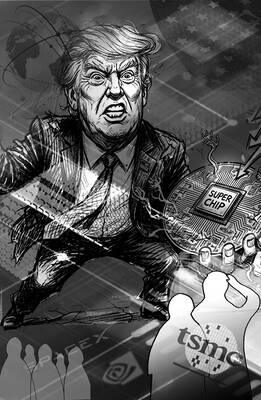
The White House’s decision to take a 9.9 percent stake in Intel Corp is looking like very shrewd business indeed. Since the government bought in at US$20.47 a share last August, the US chipmaker’s surging stock price has delivered the US a US$43 billion return. One of the reasons the investment has so far proved so sound is that the White House has made sure of it. According to The Wall Street Journal, Howard personally pushed deals on Intel’s behalf with some of the most lucrative clients imaginable. They include Nvidia Corp, the company at the heart of the AI
A single photograph can cut through a lot of noise, but it can also be used to misrepresent the truth. At the very least, it can concentrate the mind on something that requires further investigation. On Monday last week, Ma Ying-jeou Foundation CEO Tai Hsia-ling (戴遐齡) and former National Security Council secretary-general King Pu-tsung (金溥聰) held a news conference in which they showed a photograph of former foundation CEO Hsiao Hsu-tsen (蕭旭岑), now Chinese Nationalist Party (KMT) deputy chairman. In the image Hsiao is seated next to Xiamen Taiwan Businessmen Association chairman Han Ying-huan (韓螢煥). The two men were holding
I first met Professor Ray Jiing (井迎瑞) as a film and documentary student at Shih Hsin University’s (SHU) Department of Radio Television and Film in 1988. The following year, he went on to become the director of the Chinese Taipei Film Archive — forerunner of the Taiwan Film and Audiovisual Institute (TFAI). Over his eight-year tenure, Jiing rescued and restored over 200 classic Taiwanese films. In 1997, he established the Graduate Institute of Studies in Documentary and Film Archiving at Tainan National University of the Arts (TNNUA), and I joined the program in his third cohort of students. Beyond a
A recent report concerning a student who is suing his teacher posed the question in its headline: Does failing a student in two subjects constitute bullying? The college student in Chiayi County apparently sought NT$2 million (US$63,603) in state compensation, but a court dismissed the case. The first reaction of many might have been to ask: What has happened to students nowadays? Some say that teachers have lost their authority, while others say students are overindulged. Some even start reminiscing over the days when “whatever the teacher says goes.” However, the real issue might be overlooked if emotional reactions like that are the


 RSS
RSS