


The Taiwan Railway Administration’s (TRA) proposal to do away with standing-room-only tickets on Tzuchiang-class trains would be a disaster unless properly implemented — which seems unlikely.
The TRA’s idea aims to improve the quality of customer experience when traveling on the nation’s packed trains, especially on the east coast line.
It is common during peak hours, on weekends or on holidays, and on the way to popular destinations, to see Tzuchiang-class cars packed door-to-door, with passengers crammed into the aisles, sometimes leaning over seated passengers, and blocking the sections between cars.
It is difficult to move in such conditions, especially if one is carrying a bag or accompanied by children. Elderly passengers have to dodge hordes of students cannoning around, and if they’re unlucky enough to miss out on a seat, they have to stand like everybody else, despite their advanced age.
The trains are crowded and uncomfortable for many, but there is no alternative unless the TRA makes some drastic changes to accommodate the multitude of passengers that daily use the trains. These trains provide a vital transportation link for students, office and factory workers, and for weekend trippers of all kinds.
Students in Hualien, for example, have little alternative but to use trains. There are not enough buses from Hualien to the rest of Taiwan, and road links are limited, while air travel is out of the question. Trains are the only viable choice, but there are not enough trains or seats for the number of students in universities there, so they are overbooked.
The situation on the section of track between Hsinchu and Taipei is similar, but it affects a great many office workers as well. Many people live in Taoyuan, but take the train to work either in Taipei or Hsinchu every day. This inevitably results in overcrowding, because in these places, the train acts as a sort of intercity MRT system. Although there are alternative modes of transportation, they are not good ones — buses get caught in traffic jams, while the distances are too great for scooters.
The TRA set itself the goal of improving train travel by reducing crowd density on trains. However, simply banning people without seat tickets from getting on the trains is not the right way to go about this. In the absence of an intercity MRT system, the trains are the next-best thing, and, like it or not, much of Taiwan’s population has come to rely on them.
If a blanket ban on standing-only tickets were put in place, students in Hualien would have no way to get home, as it would be almost impossible to book a seat. Likewise, the multitude of commuters on the west coast would add stress on the already congested transportation network were they forced to look for alternatives.
If the TRA really wants to follow this plan, the solution is more trains, more capacity and more rides per day. How many more trains would be needed depends on the number of passengers affected by the policy. However, if the TRA wants to eventually ban standing-room-only tickets, it must add trains until everyone can be given a seat.
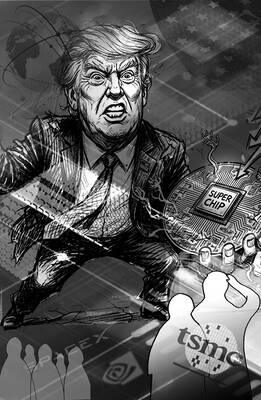
The White House’s decision to take a 9.9 percent stake in Intel Corp is looking like very shrewd business indeed. Since the government bought in at US$20.47 a share last August, the US chipmaker’s surging stock price has delivered the US a US$43 billion return. One of the reasons the investment has so far proved so sound is that the White House has made sure of it. According to The Wall Street Journal, Howard personally pushed deals on Intel’s behalf with some of the most lucrative clients imaginable. They include Nvidia Corp, the company at the heart of the AI
A single photograph can cut through a lot of noise, but it can also be used to misrepresent the truth. At the very least, it can concentrate the mind on something that requires further investigation. On Monday last week, Ma Ying-jeou Foundation CEO Tai Hsia-ling (戴遐齡) and former National Security Council secretary-general King Pu-tsung (金溥聰) held a news conference in which they showed a photograph of former foundation CEO Hsiao Hsu-tsen (蕭旭岑), now Chinese Nationalist Party (KMT) deputy chairman. In the image Hsiao is seated next to Xiamen Taiwan Businessmen Association chairman Han Ying-huan (韓螢煥). The two men were holding
I first met Professor Ray Jiing (井迎瑞) as a film and documentary student at Shih Hsin University’s (SHU) Department of Radio Television and Film in 1988. The following year, he went on to become the director of the Chinese Taipei Film Archive — forerunner of the Taiwan Film and Audiovisual Institute (TFAI). Over his eight-year tenure, Jiing rescued and restored over 200 classic Taiwanese films. In 1997, he established the Graduate Institute of Studies in Documentary and Film Archiving at Tainan National University of the Arts (TNNUA), and I joined the program in his third cohort of students. Beyond a
A recent report concerning a student who is suing his teacher posed the question in its headline: Does failing a student in two subjects constitute bullying? The college student in Chiayi County apparently sought NT$2 million (US$63,603) in state compensation, but a court dismissed the case. The first reaction of many might have been to ask: What has happened to students nowadays? Some say that teachers have lost their authority, while others say students are overindulged. Some even start reminiscing over the days when “whatever the teacher says goes.” However, the real issue might be overlooked if emotional reactions like that are the


 RSS
RSS