


When my students told me that the Council for Cultural Affairs spent NT$215 million (US$7.15 million) to produce a two-night rock musical titled Dreamers (夢想家) for the Republic of China centennial celebrations, I thought it was just a rumor and that the figure must have been exaggerated. I was absolutely shocked when I found out it was true.
Shocked, because I know how difficult it is to raise funds in the cash-strapped world of the performing arts. Investment tends to be on the anemic side. And then, all of a sudden, we turn around and see a grinning vampire in the next seat.
Sure, the production budget for an opera or musical can be huge, but this NT$215 million show only lasted two nights. With half that amount I could produce numerous performances and still have enough left over to support myself for the rest of my life.
This is why, on receiving the National Award for Arts in September, I was keen to suggest that the council only need plan for the nation’s long-term cultural policies and development, instead of holding cultural and leisure activities. It should pour its budget for arts and cultural events into the National Cultural and Arts Foundation. Then, it could provide stimuli for local artists through a thorough and objective review system for subsidies, turning them into a real cultural force for the nation.
Council for Cultural Affairs Minister Emile Sheng (盛治仁) came out fighting in defense of the show and the theater that won the bid to produce it. Sheng said it took the group about two years to prepare for it and the electricity bill for the show alone was about NT$9 million. Then there was the so-called “creativity fee” for the large design team (although this does raise the question of which show does not involve creativity). Therefore, he said, the budget was reasonable.
Sheng is talking nonsense and seems to be trying to take people in the arts and cultural sector for fools. His behavior was not like that of a cultural minister; it was more like that of the marketing director for the group that won the bid, or perhaps their accountant or treasurer.
President Ma Ying-jeou’s (馬英九) indulgence and countenancing of Sheng’s extravagant use of the cultural budget has allowed Sheng to transform cultural affairs into some kind of distasteful political propaganda. No wonder Ma is having a hard time with his re-election campaign at the moment.
The poor monitoring and supervision of these matters by legislators from both the ruling and opposition camps certainly contributes to the problem, resulting in abuse and an uneven distribution of national cultural resources. Lawmakers from the ruling camp have always toed the government line. As for those from the opposition camp, they are not going to win votes by simply complaining about the situation in the media. The nation’s arts and cultural groups must look beyond their political affiliations and take the matter into their own hands.
Hopefully lawmakers from both camps can investigate the musical’s budget and deal with any misconduct that may have taken place. Otherwise, those on the legislative floor may have a hard time winning votes as they seek re-election.
Tseng Dau-hsiong is a winner of the 2011 National Award for Arts.
Translated by Eddy Chang
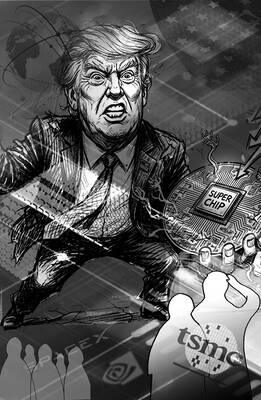
The White House’s decision to take a 9.9 percent stake in Intel Corp is looking like very shrewd business indeed. Since the government bought in at US$20.47 a share last August, the US chipmaker’s surging stock price has delivered the US a US$43 billion return. One of the reasons the investment has so far proved so sound is that the White House has made sure of it. According to The Wall Street Journal, Howard personally pushed deals on Intel’s behalf with some of the most lucrative clients imaginable. They include Nvidia Corp, the company at the heart of the AI
A single photograph can cut through a lot of noise, but it can also be used to misrepresent the truth. At the very least, it can concentrate the mind on something that requires further investigation. On Monday last week, Ma Ying-jeou Foundation CEO Tai Hsia-ling (戴遐齡) and former National Security Council secretary-general King Pu-tsung (金溥聰) held a news conference in which they showed a photograph of former foundation CEO Hsiao Hsu-tsen (蕭旭岑), now Chinese Nationalist Party (KMT) deputy chairman. In the image Hsiao is seated next to Xiamen Taiwan Businessmen Association chairman Han Ying-huan (韓螢煥). The two men were holding
I first met Professor Ray Jiing (井迎瑞) as a film and documentary student at Shih Hsin University’s (SHU) Department of Radio Television and Film in 1988. The following year, he went on to become the director of the Chinese Taipei Film Archive — forerunner of the Taiwan Film and Audiovisual Institute (TFAI). Over his eight-year tenure, Jiing rescued and restored over 200 classic Taiwanese films. In 1997, he established the Graduate Institute of Studies in Documentary and Film Archiving at Tainan National University of the Arts (TNNUA), and I joined the program in his third cohort of students. Beyond a
A recent report concerning a student who is suing his teacher posed the question in its headline: Does failing a student in two subjects constitute bullying? The college student in Chiayi County apparently sought NT$2 million (US$63,603) in state compensation, but a court dismissed the case. The first reaction of many might have been to ask: What has happened to students nowadays? Some say that teachers have lost their authority, while others say students are overindulged. Some even start reminiscing over the days when “whatever the teacher says goes.” However, the real issue might be overlooked if emotional reactions like that are the


 RSS
RSS