


Is Taiwan the ‘Titanic’?
Two consecutive editorials (“Racing down a slippery slope,” Feb. 18, page 8, and “Caution, there is danger ahead,” Feb. 19, page 8) give a stern warning against President Ma Ying-jeou’s (馬英九) China policy toward China.
In spite of bad weather, poor light and hazardous road conditions, “Ma is practically driving at 200kph.”
At such a speed, his license should be suspended indefinitely by the Control Yuan and/or the legislature.
Ma is like “a blind man not afraid of guns” and “a man eating hastily and breaking his bowl,” in Taiwanese sayings.
Ma should realize that the “one China” route is much more hazardous than the old Beiyi (北一) Road between Taipei and Yilan, because the former must pass through the Taiwan Strait, which was once called the “Black Water River” (黑水溝) — with many unknowns including strong currents and severe typhoons.
It is a well-known fact that Ma has seldom kept his campaign promises and pledges. It must be pointed out that he is rebellious to his alma maters. He graduated from Jianguo (建國, meaning National Construction) High School, but his policy is auxiliary to China (附中, Normal University Auxiliary High School); he graduated from National Taiwan University (台大, meaning Taiwan Large), but he makes Taiwan small (台小); and he graduated from Harvard (哈佛, meaning admiring Buddha), but he admires China (哈中).
Unless Ma and his followers immediately make a U-turn away from the route to “one China” with the “1992 consensus,” Taiwan, which has been known as “the unsinkable carrier,” will become the Titanic of the Taiwan Strait.
CHARLES HONG
Columbus, Ohio
CCP hypocritical on rebels
Almost a hundred years ago, the people of China toppled the last dynasty of China. The Qing Dynasty faced numerous natural disasters, famine, corruptions, internal unrest and foreign invasions that the government could not deal with properly.
In 21st-century Tunisia and various other Northern African states, many parallels can be seen. Egypt faced widespread youth unemployment, low wages, high crime, government corruption and social injustice that were all comparable to late 19th and early 20th-century China.
Today’s China is a highly polarized society in which the extremely wealthy and poor communities intermingle in many megacities. There is no doubt that corruption and oppression rage in China unbeknownst to most people on the outside of the “Great Firewall” of China, but judging from the recent crackdown on dissent across China, one can clearly draw a picture of an oppressive regime that is mobilizing its forces to quell its people.
The question is, why?
During the earlier days of the Chinese Communist Revolution (and even today), historical rebels were lauded instead of denounced as traitors. These were heroes of an earlier time who stood against oppressive regimes, such as Li Zicheng (李自成), who toppled the last Ming emperor. These figures were promoted to foster anti-monarchy sentiment and served as powerful propaganda for communist China.
Yet today, Chinese authorities not only downplay the North African revolutionaries’ success, but openly put down those who support the “Jasmine Revolution.” A contradiction arises when a government supports revolution, yet punishes its own people who try to emulate such examples. Here, China’s government has again shown its true colors, and hopefully this time, the people of China will see it for themselves.
JEN-CHIEH WU
Hsinchu

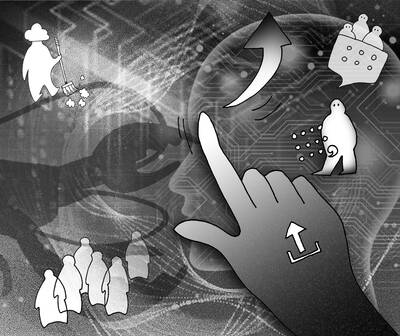
Weeks into the craze, nobody quite knows what to make of the OpenClaw mania sweeping China, marked by viral photos of retirees lining up for installation events and users gathering in red claw hats. The queues and cosplay inspired by the “raising a lobster” trend make for irresistible China clickbait. However, the West is fixating on the least important part of the story. As a consumer craze, OpenClaw — the AI agent designed to do tasks on a user’s behalf — would likely burn out. Without some developer background, it is too glitchy and technically awkward for true mainstream adoption,
On Monday, the day before Chinese Nationalist Party (KMT) Chairwoman Cheng Li-wun (鄭麗文) departed on her visit to China, the party released a promotional video titled “Only with peace can we ‘lie flat’” to highlight its desire to have peace across the Taiwan Strait. However, its use of the expression “lie flat” (tang ping, 躺平) drew sarcastic comments, with critics saying it sounded as if the party was “bowing down” to the Chinese Communist Party (CCP). Amid the controversy over the opposition parties blocking proposed defense budgets, Cheng departed for China after receiving an invitation from the CCP, with a meeting with
Chinese Nationalist Party (KMT) Chairwoman Cheng Li-wun (鄭麗文) is leading a delegation to China through Sunday. She is expected to meet with Chinese President Xi Jinping (習近平) in Beijing tomorrow. That date coincides with the anniversary of the signing of the Taiwan Relations Act (TRA), which marked a cornerstone of Taiwan-US relations. Staging their meeting on this date makes it clear that the Chinese Communist Party (CCP) intends to challenge the US and demonstrate its “authority” over Taiwan. Since the US severed official diplomatic relations with Taiwan in 1979, it has relied on the TRA as a legal basis for all
A delegation of Chinese Nationalist Party (KMT) officials led by Chairwoman Cheng Li-wun (鄭麗文) is to travel to China tomorrow for a six-day visit to Jiangsu, Shanghai and Beijing, which might end with a meeting between Cheng and Chinese President Xi Jinping (習近平). The trip was announced by Xinhua news agency on Monday last week, which cited China’s Taiwan Affairs Office (TAO) Director Song Tao (宋濤) as saying that Cheng has repeatedly expressed willingness to visit China, and that the Chinese Communist Party (CCP) Central Committee and Xi have extended an invitation. Although some people have been speculating about a potential Xi-Cheng


 RSS
RSS