


Eva Joly does not look like Europe’s most successful fraud prosecutor, the scourge of French boardrooms for decades. She is more than half an hour late as she sweeps into a cafe in Montparnasse from a cold, wet, gray Paris morning. Her eyes smile over natty, red-rimmed spectacles as she introduces herself in quiet tones, holding on to a handshake throughout, and apologizes for her delayed arrival.
Now a leading figure in the French Green party and a member of the European Parliament, Joly is expected to run for president next year. To many she remains best known for her extraordinary eight-year investigation into the oil multinational Elf in the 1990s. It rocked France’s political, judicial and corporate elites as the unwavering Joly peeled away layers of fraud — from initial questions about a Gabonese subsidiary to myriad allegations of fraud and corruption at the highest level.
For her pains, Joly had to spend long periods shadowed by bodyguards after threats were made against her. Her successes caused such a stir that the director Claude Chabrol loosely based his film A Comedy of Power (L’ivresse du Pouvoir) on her battles with the French establishment.
Despite her 67 years, she is bristling with the same drive and determination, underpinned by a rare blend of political zeal and a lawyer’s attention to detail.
“I am not getting away from combating fraud,” she says. “This is why I am going into politics. It’s another way of fighting fraud in the interests of ordinary people, trying to prevent the oligarchy taking all the power and all the money ... We have been living in a kind of collective illusion that this is how the world is — that the poor shall always be poor, ordinary people shall be squeezed to the benefit of a kind of oligarchy.”
Polemical and incendiary asides follow thick and fast. She talks about Joseph Cassano, the former financial engineering executive at bailed-out US insurer American International Group (“What kind of good does he do humanity? None.”); WikiLeaks (“It shows it is possible to tell people what really happened. This is prevention of fraud.”); of the late Nigerian dictator Sani Abacha (“He laundered millions and he used London. The banks that received this money are getting away with it.”); and of the UK’s non-dom tax arrangements for the super-rich (“This is a serious hole in European tax cooperation.”).
Her late arrival means much of the interview must be carried out in a taxi as she races across Paris to catch a train to Brussels, where she is campaigning for tougher EU action against tax havens. Later in the week she will fly to Tunisia to offer advice on how a new regime might track down the assets of former Tunisian president Zine al-Abidine Ben Ali, who fled amid popular uprising and corruption allegations last month.
While her focus now is increasingly returning to France and the political arena, recent years have seen Joly’s attentions extend to Iceland, where she was recruited to advise the government’s special prosecutor, Olafur Hauksson, on criminal investigations triggered by the tiny country’s spectacular financial meltdown in the autumn of 2008.
So large and far-reaching are allegations of fraud and corruption that the investigation has been described as the largest white-collar crime inquiry ever attempted. Much of the suspect behavior took place in London, and may have been unwittingly financed by hundreds of thousands of UK retail depositors, who rushed to set up online deposit accounts with Icelandic banks four years ago. The Serious Fraud Office (SFO) is working closely with Hauksson’s team.
This inquiry is one subject on which Joly is circumspect, because of her professional involvement. She does, however, express a hope that the SFO will not lose interest as it faces pressure to cut costs. Plans to save money by merging the SFO and other agencies into a new economic crime agency concern Joly.
“I think it’s a scandal. What sort of society are we creating? All over the world, the powerful don’t want economic crime investigation,” she says.
Some of her most swingeing analysis is reserved for the Britain’s failure to tame the forces in London’s financial sector.
“Your political and business elites are asking for sacrifice, asking to close down public services — you are cutting the number of public sector jobs by 400,000. Why don’t your politicians have the courage to recover taxes in order to be able to pay for the schools, the teachers, the hospitals? To me, tax is civilization. It is the basis of your social contract,” she says.
The decision by British Secretary of State for Justice Kenneth Clarke to delay implementing the Bribery Act, passed in the dying days of the Labour government, enrages Joly.
“We have been waiting for that how long? Twenty years?” she says.
Contrary to claims by Confederation of British Industry boss John Cridland that the act was “not fit for purpose,” Joly insists it would merely bring Britain into line with standards elsewhere in Europe.
If Joly sometimes sounds like a revolutionary firebrand, she says it was not always so.
“I used to be a very lawful citizen thinking that the laws were good and that if they were applied correctly that there was a kind of direction of the world, that people were taking care. Then 15 years ago I started to understand that it’s not true, that it’s a kind of theater that we were all fooled, and that there are a lot of crooks out there,” she says.
Despite living and working in France for decades, her perspective remains self-consciously that of an outsider. Norwegian by birth, she came to France, aged 20, as an au pair called Gro Farseth. To initial family disapproval, she fell in love and married the eldest son of the family that employed her, Pascal Joly, and settled in her adopted country using her middle name, Eva, which is easier to pronounce in French.
She initially took secretarial work to help support her husband through medical school, but went on to take night classes in law. This laid the ground for a steady rise up the French legal ladder and she became a magistrate at the age of 38. She later became one of the first people not to have attended the prestigious Ecole Nationale d’Administration to break into the profession’s senior ranks.
“I thought that if I told people [what I knew] — writing books, giving interviews — the world would change. I thought it was only because people didn’t know. And then I think the most terrible thing is that, even when things are said, they don’t change. Then I thought that I must become a politician and really express these concerns. I’ve been doing a lot of things in my life and I can interconnect knowledge from different sectors,” she says.
When the taxi pulls up at the Gare du Nord, the interview ends. The African-French driver unloads Joly’s suitcase from the boot, clasps her hand, says he is an admirer of her activism and wishes her well: “Bon courage. Bon courage.”
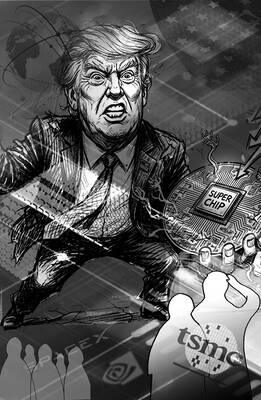
The White House’s decision to take a 9.9 percent stake in Intel Corp is looking like very shrewd business indeed. Since the government bought in at US$20.47 a share last August, the US chipmaker’s surging stock price has delivered the US a US$43 billion return. One of the reasons the investment has so far proved so sound is that the White House has made sure of it. According to The Wall Street Journal, Howard personally pushed deals on Intel’s behalf with some of the most lucrative clients imaginable. They include Nvidia Corp, the company at the heart of the AI
A single photograph can cut through a lot of noise, but it can also be used to misrepresent the truth. At the very least, it can concentrate the mind on something that requires further investigation. On Monday last week, Ma Ying-jeou Foundation CEO Tai Hsia-ling (戴遐齡) and former National Security Council secretary-general King Pu-tsung (金溥聰) held a news conference in which they showed a photograph of former foundation CEO Hsiao Hsu-tsen (蕭旭岑), now Chinese Nationalist Party (KMT) deputy chairman. In the image Hsiao is seated next to Xiamen Taiwan Businessmen Association chairman Han Ying-huan (韓螢煥). The two men were holding
I first met Professor Ray Jiing (井迎瑞) as a film and documentary student at Shih Hsin University’s (SHU) Department of Radio Television and Film in 1988. The following year, he went on to become the director of the Chinese Taipei Film Archive — forerunner of the Taiwan Film and Audiovisual Institute (TFAI). Over his eight-year tenure, Jiing rescued and restored over 200 classic Taiwanese films. In 1997, he established the Graduate Institute of Studies in Documentary and Film Archiving at Tainan National University of the Arts (TNNUA), and I joined the program in his third cohort of students. Beyond a
A recent report concerning a student who is suing his teacher posed the question in its headline: Does failing a student in two subjects constitute bullying? The college student in Chiayi County apparently sought NT$2 million (US$63,603) in state compensation, but a court dismissed the case. The first reaction of many might have been to ask: What has happened to students nowadays? Some say that teachers have lost their authority, while others say students are overindulged. Some even start reminiscing over the days when “whatever the teacher says goes.” However, the real issue might be overlooked if emotional reactions like that are the


 RSS
RSS