


Last year, when Jonathan Smith was still the president of Earth911.com, a Web site dedicated to recycling, he said he would often board a plane after a speaking engagement or a day of meetings with a dead cellphone in hand.
With limited recharging options available, “it was really frustrating,” he said. “Having access to a working port or finding an open plug during layovers at the airport was just too unpredictable.”
Hoping to solve his problem, Smith bought a portable solar charger he could prop up in the window of a plane.
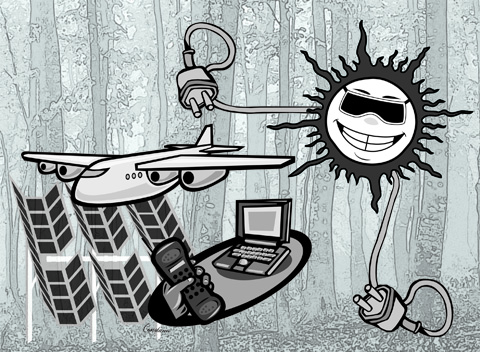
“I’d plug it into my phone and when we landed, I was ready to go again,” he said.
The charger meshed well with his environmental values, of course. Still, “when I first started using solar to charge my devices,” he said, “it was out of convenience.”
In fact, Smith is one of a growing number of business travelers who, out of practicality or concern for the environment, use portable renewable energy devices — primarily portable solar panels, but also hand-cranked electricity generators known as dynamos or freeplay devices — to power up their electronics when they work in places that offer little or no access to electricity.
“Basically, this technology makes our work possible,” said John Poulsen, a tropical ecologist who investigates logging’s effects on animal populations in the forests of central Africa.
Often, data collection takes Poulsen as much as 38.6km from the nearest road.
“The research we do requires being in the forest for two to three weeks at a time. And if we had to go back to the village every two or three days for batteries, we just couldn’t do it,” he said.
Generally speaking, portable renewable energy devices cannot power large equipment, like desktop computers or printers. But they can generate enough electricity to operate laptops, satellite telephones, movie and still cameras, sound-recording equipment, GPS equipment and camp lighting, said Stuart Cody, owner of Automated Media Systems in Allston, Massachusetts. The company customizes portable solar arrays and battery backup systems for business travelers and adventurers.
The devices have improved significantly since they were first introduced in the mid-1990s. That was about the time the tree kangaroo conservation program, administered by the Woodland Park Zoo in Seattle, began using portable solar power at its field sites in Papua New Guinea.
“Initially, we got panels that didn’t work very well,” said Lisa Dabek, the zoo’s director of field conservation.
Now, the solar panels used to power laptops, navigation devices and satellite phones “are much smaller and much more portable,” she said.
The organization uses this technology for reasons that have as much to do with practicality as with environmental concerns. Fuel-powered generators, Dabek said, are “very heavy. And to hike uphill with them for two days is not really an option.”
Moreover, generators “make a lot of noise that would scare away the tree kangaroos,” she said.
Cody said users should be realistic about how much power portable solar panels could create.
“People who are starting from scratch don’t realize that solar panels don’t always put out a consistent stream of energy,” he said. “The sun comes and goes. There’s a shadow that reduces the current flow.”
As a result, Cody suggested using the devices to charge internal or external batteries, rather than to run electronics directly.
“Here’s an analogy,” he said, likening a battery to a water storage tank. “You have a little water pump pumping a small, constant stream of water in a tank. Without that tank, you couldn’t have a shower.”
The occasional intermittence of these devices’ energy supply can be a drawback. But for some users, they are literally lifesavers.
“We have lions and elephants nearby here,” said Martin Graber, a doctor and international development consultant who works in the Narok district of southwest Kenya.
Graber uses a solar-powered lantern in the clinics he helped to develop.
“We have a new clinic that has no electricity at present,” he said recently. “There was a young man who came in who had a finger almost entirely amputated. We used the light from the lantern to take care of his finger.”
Graber said he also used the lanterns when he goes to the outhouse at night.
“I want to make sure there are no animals,” he said.
Smith, who has become chief executive of Blue Legacy International, an environmental nonprofit group that develops Web films to “focus attention on water issues around the world,” used his portable charger in July to power his Twitter posts when he and a colleague became stranded in the middle of Tonle Sap lake in Cambodia, one of the world’s largest bodies of fresh water.
Because Smith had a solar charger, “we were able to get someone to send us another boat,” he said. “And we were able to save a day of filming.”
Taking these devices on airplanes poses no difficulties, a spokeswoman for the Transportation Security Administration, Lara Uselding, said in an e-mail message.
The only exceptions are larger storage batteries that contain “liquid coolant, lubricants, etc,” she said.
They fall under the hazardous materials designation and are not allowed on planes. (Those batteries should be shipped as hazardous materials.)
“I’ve never had any trouble going through airport security with these chargers,” said Smith, adding that security personnel were often intrigued by the devices.
“When you find these devices that are innovative and socially responsible,” he said, “it’s fantastic.”
Business travelers who work in remote locations “have this very real necessity that’s solved by these renewable devices, and it enables us to practice what we preach.”
KMT Chairwoman Cheng Li-wun’s (鄭麗文) recent visit to Beijing and her upcoming visit to Washington will serve as a high-level test of her diplomatic mettle. In Beijing, Cheng was received with symbolic gestures, a warm reception, and high-level access. In Washington, she will receive far less pomp and far sharper questions about the KMT’s vision for the future of Taiwan. Her challenge will be to persuade Washington that the KMT’s engagement with China can coexist with strong deterrence. Cheng’s April 7-12 visit to mainland China coincided with an intense period of conflict in Iran. Despite the strategic significance of Cheng’s trip,
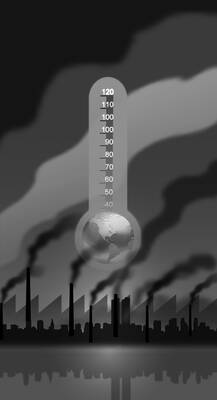
The closure of the Strait of Hormuz has sent the vast Asian chemicals industry into a tailspin. Deprived of the likes of Qatari natural gas and Saudi Arabian oil, the region’s fertilizer and plastics plants are slowing production or even shutting down. Everywhere except China, that is. In petrochemicals, China is unique. As well as a traditional industry that uses oil and gas as feedstock, it has parallel output that relies on its abundant domestic coal. Unsurprisingly, India and other regional powers want to copy and paste the Chinese method. This would not be easy — or climate friendly. The
US President Donald Trump recently repeated his claim that “Taiwan stole America’s chip industry,” reigniting public debate on the issue. As a former Taiwanese minister of economic affairs and an entrepreneur deeply involved in semiconductor supply chain development, I feel a responsibility to clarify this misunderstanding. From the perspective of global industrial evolution and the economic principle of comparative advantage, such a statement appears overly simplistic and risks obscuring the essence of the issue. The rise of Taiwan’s semiconductor industry was not built on “replacing America,” but rather emerged as a result of countries pursuing different development paths within the
The Presidential Office on Saturday reiterated that Taiwan is a sovereign, independent nation after US President Donald Trump said that Taiwan should not “go independent.” “We’re not looking to have somebody say: ‘Let’s go independence because the United States is backing us,’” Trump said in an interview with Fox News aired on Friday. President William Lai (賴清德) on Monday said that the Republic of China (ROC) — Taiwan’s official name — and the People’s Republic of China (PRC) are not subordinate to each other. Speaking at an event marking the 40th anniversary of the establishment of the Democratic Progressive Party (DPP), Lai said


 RSS
RSS