


Less than a month after President Ma Ying-jeou (馬英九) and his administration took office, the Chinese Nationalist Party (KMT) legislative caucus demanded that the Cabinet conduct a thorough examination of staffers from the former Democratic Progressive Party (DPP) government, with Premier Liu Chao-hsiuan (劉兆玄) promising to come up with an appropriate response to fulfill public expectations.
This was followed by the Cabinet’s order for all ministries to replace officials who cling to the “old mindset” — an apparent reference to the old administration. One official who rejected the KMT administration’s move to purge career civil servants was then deputy secretary-general of the Cabinet Chen Mei-ling (陳美伶), who refused an unexpected transfer to another civil post and chose to retire.
The way the Ma administration has treated the civil service system since its accession to power highlights a serious problem: Even though Taiwan has experienced two transfers of power, the administration still questions the mindset and party loyalties of the nation’s civil servants. The public should pay attention to the possible “chilling effect” that this might have: Civil servants could become obsequious, afraid to speak their mind and assume responsibility for fear of being a target of criticism after a transition of power.
Although the KMT had earlier ruled as an authoritarian party-state regime, it did undertake a complete privatization of the civil service system. It cannot be denied that the DPP also made some changes as to who was employed as civil servants after taking power in 2000 and that better approaches could have been adopted. These are mistakes that the DPP made and we should examine where the party went wrong. Although there was some friction between the administration and the civil service system during its eight years in power, the DPP did put the system on the right path to “nationalization.”
As ruling parties change in a democratic regime, political appointees also come and go. However, career civil servants are different. These are the people that protect a nation’s interests. They are human resources that the nation has cultivated for a long time — an important asset as well as the backbone of the country. These people should not be tainted by any political party nor purged.
Civil officials or public servants play a significant role in a democratic political system. No matter how many times power changes hands or the Cabinet is reshuffled, a solid network of professional civil servants could contribute to government stability. As Taiwan has been through two major power transitions, the majority of civil officials have experienced working under different political parties in power. They are well acquainted with what democracy means and have a strong association with the country. For them, the transfer of power is a democratic norm. Their loyalties lie not with any political party, but with the public. The nation has outstanding civil servants and I cannot understand how those in power can be so hardhearted as to make this group of workers afraid that they might be replaced any time.
The nation has made amazing progress in democracy, but there is still much room for improvement. This is why the DPP has been devoted to pushing forward a new political culture. To end this vicious conflict between the pan-blue and pan-green camps and bring real peace to society, a new political culture should be a goal that all Taiwanese strive for.
A new political culture involves establishing a professional, stable, worry-free and non-partisan civil service system. Public servants should be the backbone of the country instead of a tool for political maneuvering. A ruling party can be replaced, and so can the president. However, professional civil servants and systems should remain fixed to ensure consistency and continuity within the administrative system. Civil officials who assume responsibility for their duties and focus on serving public and national interests are excellent civil servants. They are not a product of the outdated mindsets left behind from the last government, nor should they be scapegoats for the impotence of the current government.
The civil service system is a network of professionals that works on equal division of labor and cooperation. It should not be affiliated with either the pan-green camp or the pan-blue camp. Purging career civil officials will undermine not only their morale but also government stability.
We truly hope that the Ma administration will stop these purges immediately and make this outdated political thinking a thing of the past. Regardless of which party rules in the future, the highest respect should be shown to the civil service system. The promotion of a new political culture following the transfer of power should begin with respecting the professional skills of our civil servants.
Ing-wen Tsai is the Chairperson of the Democratic Progressive Party.
TRANSLATED BY TED YANG
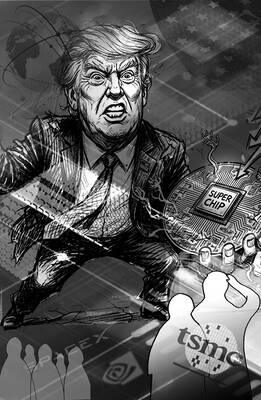
The White House’s decision to take a 9.9 percent stake in Intel Corp is looking like very shrewd business indeed. Since the government bought in at US$20.47 a share last August, the US chipmaker’s surging stock price has delivered the US a US$43 billion return. One of the reasons the investment has so far proved so sound is that the White House has made sure of it. According to The Wall Street Journal, Howard personally pushed deals on Intel’s behalf with some of the most lucrative clients imaginable. They include Nvidia Corp, the company at the heart of the AI
A single photograph can cut through a lot of noise, but it can also be used to misrepresent the truth. At the very least, it can concentrate the mind on something that requires further investigation. On Monday last week, Ma Ying-jeou Foundation CEO Tai Hsia-ling (戴遐齡) and former National Security Council secretary-general King Pu-tsung (金溥聰) held a news conference in which they showed a photograph of former foundation CEO Hsiao Hsu-tsen (蕭旭岑), now Chinese Nationalist Party (KMT) deputy chairman. In the image Hsiao is seated next to Xiamen Taiwan Businessmen Association chairman Han Ying-huan (韓螢煥). The two men were holding
I first met Professor Ray Jiing (井迎瑞) as a film and documentary student at Shih Hsin University’s (SHU) Department of Radio Television and Film in 1988. The following year, he went on to become the director of the Chinese Taipei Film Archive — forerunner of the Taiwan Film and Audiovisual Institute (TFAI). Over his eight-year tenure, Jiing rescued and restored over 200 classic Taiwanese films. In 1997, he established the Graduate Institute of Studies in Documentary and Film Archiving at Tainan National University of the Arts (TNNUA), and I joined the program in his third cohort of students. Beyond a
A recent report concerning a student who is suing his teacher posed the question in its headline: Does failing a student in two subjects constitute bullying? The college student in Chiayi County apparently sought NT$2 million (US$63,603) in state compensation, but a court dismissed the case. The first reaction of many might have been to ask: What has happened to students nowadays? Some say that teachers have lost their authority, while others say students are overindulged. Some even start reminiscing over the days when “whatever the teacher says goes.” However, the real issue might be overlooked if emotional reactions like that are the


 RSS
RSS