


On Friday, the Chinese Nationalist Party (KMT) revoked Minister of National Defense Lee Jye's (
The reason cited by the KMT's Evaluation and Disciplinary Committee is a perfect illustration of the party's confusion when it comes to prioritizing loyalty to the country versus that to the party.
The KMT's move comes at a critical time, when it has a good chance of regaining the presidency after eight years of DPP rule. While the action against Lee may have helped consolidate and unify the party's hardliners, it will do little -- and could even alienate -- moderates and non-partisan voters.
From the KMT's perspective, Lee committed a grievous sin by saying he would "only listen" to the ruling party. The KMT blasted him for "seriously jeopardizing military ethics" and for "fawning" over the DPP government. Such statements reflect fundamental misconceptions that just highlight how out of touch the KMT is with the times.
The KMT logic dictates that since the party helped found the "Republic of China," the nation and the party are one and the same. Consequently, although the KMT is now the opposition party and the DPP has the right to govern on behalf of the people, it is wrong for Lee, as a government official, to follow the instructions of the DPP government and put them ahead of party interests.
The KMT seems to have overlooked the fact that this nation belongs to the people and the power resides in the people, not the KMT -- regardless of whether the nation is called the "Republic of China," the "Republic of China on Taiwan," or the "Republic of Taiwan."
The people gave executive power to Chen Shui-bian (
The KMT's backward mentality makes one highly suspicious and skeptical of any proposal to form a "joint government" composed of members from different political parties.
If government officials from different parties decided to listen only to their own parties whenever there is a clash of opinions, not only would the chairman of the opposition party be essentially allowed to wield powers comparable to those of the president, but the operation of the entire government would come to a standstill.
Almost all KMT members who have held posts in the DPP government have at one time or another faced allegations of "betraying" their party. Witness what happened to Tang Fei (
The tension is worst when the post is related to security and the military. The friction between Lee and his party simply built up over time.
First was the standoff between the DPP government and the pan-blue camp over the special budget for arms purchases. This was followed by several incidents in which members of the military were sanctioned or punished for acting in opposition to the president and the government. The removal of the late dictator Chiang Kai-shek's (
In the absence of affiliation with any political party, Lee will at last be able to perform his job impartially without any strings attached. How bad can that possibly be?
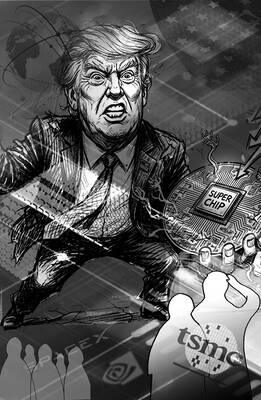
The White House’s decision to take a 9.9 percent stake in Intel Corp is looking like very shrewd business indeed. Since the government bought in at US$20.47 a share last August, the US chipmaker’s surging stock price has delivered the US a US$43 billion return. One of the reasons the investment has so far proved so sound is that the White House has made sure of it. According to The Wall Street Journal, Howard personally pushed deals on Intel’s behalf with some of the most lucrative clients imaginable. They include Nvidia Corp, the company at the heart of the AI
A single photograph can cut through a lot of noise, but it can also be used to misrepresent the truth. At the very least, it can concentrate the mind on something that requires further investigation. On Monday last week, Ma Ying-jeou Foundation CEO Tai Hsia-ling (戴遐齡) and former National Security Council secretary-general King Pu-tsung (金溥聰) held a news conference in which they showed a photograph of former foundation CEO Hsiao Hsu-tsen (蕭旭岑), now Chinese Nationalist Party (KMT) deputy chairman. In the image Hsiao is seated next to Xiamen Taiwan Businessmen Association chairman Han Ying-huan (韓螢煥). The two men were holding
I first met Professor Ray Jiing (井迎瑞) as a film and documentary student at Shih Hsin University’s (SHU) Department of Radio Television and Film in 1988. The following year, he went on to become the director of the Chinese Taipei Film Archive — forerunner of the Taiwan Film and Audiovisual Institute (TFAI). Over his eight-year tenure, Jiing rescued and restored over 200 classic Taiwanese films. In 1997, he established the Graduate Institute of Studies in Documentary and Film Archiving at Tainan National University of the Arts (TNNUA), and I joined the program in his third cohort of students. Beyond a
A recent report concerning a student who is suing his teacher posed the question in its headline: Does failing a student in two subjects constitute bullying? The college student in Chiayi County apparently sought NT$2 million (US$63,603) in state compensation, but a court dismissed the case. The first reaction of many might have been to ask: What has happened to students nowadays? Some say that teachers have lost their authority, while others say students are overindulged. Some even start reminiscing over the days when “whatever the teacher says goes.” However, the real issue might be overlooked if emotional reactions like that are the


 RSS
RSS