


President Chen Shui-bian's (
I believe that most Taiwanese have never contemplated whether the DPP administration has turned the judiciary into an independent tool different from the judiciary run by the KMT party-state and whether the judiciary really is able to resist political forces. The profound questions of whether the judiciary can remain independent or whether it will dance to the tune of the pan-blue camp or the pro-blue camp media outlets are important issues that we have to give serious thought to.
Chao's case highlights that the power struggle within the DPP has intensified. Not only are the four DPP "heavyweights," Vice President Annette Lu (
Let's leave aside which political faction Kuo belongs to within the DPP. Kuo used to be the right-hand man of former DPP chairman Hsu Hsin-liang (許信良). But when Hsu received financial aid from former KMT chairman and presidential candidate Lien Chan (連戰) to campaign in 2000 to split the DPP vote in the presidential election but still suffered a crushing defeat, Kuo felt where the wind was blowing and abandoned Hsu to join the DPP's Justice Alliance faction. In other words, rather than saying that Kuo is one of Chen's proteges, it would be more correct to say that he bends with the wind.
The question at issue, however, is not whether or not Kuo is an unprincipled and fickle politician. What we should be discussing are his recent suggestions. Kuo wants Chen to relinquish his hold on military power and the DPP to hold a presidential primary for the 2008 presidential elections ahead of time, in effect bringing about a transfer of power.
Kuo has also suggested that the DPP's four heavyweights jointly make major national decisions and resolve internal party disputes, adding that all important decisions should be made collectively. The problem is that the president's power is clearly stated in the Constitution and cannot simply be transferred. Even if the DPP chooses a presidential candidate for 2008, he or she will not be able to usurp the power of the incumbent president. More importantly, apart from the pan-blue camp being overcome by joy if Chen does become a lame duck ahead of time, it will not bring any advantage to the pan-green camp.
That is why the four DPP heavyweights have jointly issued a statement expressing their full support for Chen and asked the DPP legislative caucus to unite and remain calm. They have also called for firm support for Chen so that he can effectively lead the nation. DPP legislators across faction lines have also said that they will help the central leadership to consolidate. Although the two opposing forces within the DPP will not necessarily reach a consensus on this issue, nine non-governmental localization organizations held a joint press conference to denounce the behavior of some pan-green politicians seeking political gain amid the recent scandals. They called on supporters to back the president and his top leadership.
Clearly, pan-green supporters have already passed judgment. Acting Kaohsiung Mayor Yeh Chu-lan (葉菊蘭) has come forward to condemn the "political vultures" within the DPP. Ng Chiau-tong (黃昭堂), chairman of the World United Formosans for Independence (台獨聯盟), has also urged Taiwanese to unite in support of Chen. In short, just as Senior Adviser to the President Peng Ming-min (彭明敏) has said, "Chen has to hang in there and continue on with his national duties and reforms, for he has run out of other options." The pan-green camp has now come to an agreement and will not fall into the trap orchestrated by the pan-blues. The DPP must also seek to root out those attempting to incite conflict. While the pan-blue camp is portraying KMT Chairman Ma Ying-jeou (馬英九) as an impeccable politician and chipping away at Chen's image, pro-green camp organizations are now poised to turn the tables.
With the political scene in a shambles, pan-green supporters have once again demonstrated their wisdom and refused to lose their cool, for they are aware that they have a historical mission ahead of them. Will Taiwan return to the hands of an alien regime? Will they sit idly by as China and the pan-blues perform their "Eventual Unification Symphony" and put an end to Taiwan's democratization and localization?
It is our choice but future generations will not be able to escape it. The question of whether we want to support Chen or get rid of him must be considered against this background. Only then will we be able to take our destiny in our own hands without being confused by others. This must be our overriding concern.
Chin Heng-wei is the editor-in-chief of Contemporary Monthly magazine.
Translated by Daniel Cheng
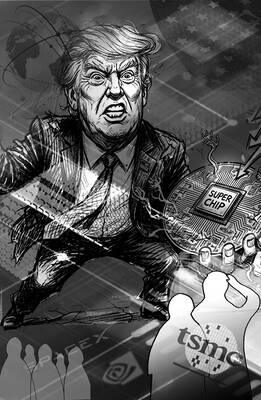
The White House’s decision to take a 9.9 percent stake in Intel Corp is looking like very shrewd business indeed. Since the government bought in at US$20.47 a share last August, the US chipmaker’s surging stock price has delivered the US a US$43 billion return. One of the reasons the investment has so far proved so sound is that the White House has made sure of it. According to The Wall Street Journal, Howard personally pushed deals on Intel’s behalf with some of the most lucrative clients imaginable. They include Nvidia Corp, the company at the heart of the AI
A single photograph can cut through a lot of noise, but it can also be used to misrepresent the truth. At the very least, it can concentrate the mind on something that requires further investigation. On Monday last week, Ma Ying-jeou Foundation CEO Tai Hsia-ling (戴遐齡) and former National Security Council secretary-general King Pu-tsung (金溥聰) held a news conference in which they showed a photograph of former foundation CEO Hsiao Hsu-tsen (蕭旭岑), now Chinese Nationalist Party (KMT) deputy chairman. In the image Hsiao is seated next to Xiamen Taiwan Businessmen Association chairman Han Ying-huan (韓螢煥). The two men were holding
I first met Professor Ray Jiing (井迎瑞) as a film and documentary student at Shih Hsin University’s (SHU) Department of Radio Television and Film in 1988. The following year, he went on to become the director of the Chinese Taipei Film Archive — forerunner of the Taiwan Film and Audiovisual Institute (TFAI). Over his eight-year tenure, Jiing rescued and restored over 200 classic Taiwanese films. In 1997, he established the Graduate Institute of Studies in Documentary and Film Archiving at Tainan National University of the Arts (TNNUA), and I joined the program in his third cohort of students. Beyond a
A recent report concerning a student who is suing his teacher posed the question in its headline: Does failing a student in two subjects constitute bullying? The college student in Chiayi County apparently sought NT$2 million (US$63,603) in state compensation, but a court dismissed the case. The first reaction of many might have been to ask: What has happened to students nowadays? Some say that teachers have lost their authority, while others say students are overindulged. Some even start reminiscing over the days when “whatever the teacher says goes.” However, the real issue might be overlooked if emotional reactions like that are the


 RSS
RSS