


Each day at 4pm, the trawlers come back, alive with giant bass, mackerel and squirming eels, at the end of a food chain that links family dinner tables to poisons in the sea.
Besides mercury which can damage the brains of fetuses and young children and can affect healthy adults, there are PCBs, dioxins and flame retardants with unknown long-term effects.
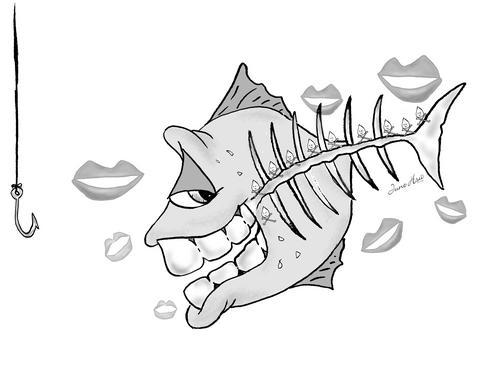
It is the same from ancient Mediterranean towns like Sete to big city docks in Asia, America's Gulf ports, or harbors in seemingly pristine Nordic waters. Industrial waste permeates every ocean.
Although rich in omega-3 fatty acids vital to the heart and brain, many fish contain toxins that build up over time in the human body.
And as this paradox worsens, scientists express alarm at what they call inadequate government warnings, lax attitudes toward fishing industries, and insufficient data to assess the risks.
The problem is that authorities are caught between wanting to inform the public while not damaging consumer confidence in a healthy food source, says Sandrine Blanchemanche, a sociologist with France's prestigious National Institute for Agronomic Studies.
"People overreact to these things, so you have to be careful," she said. "You don't want large numbers giving up the benefits of fish while you damage the whole fishing sector for no reason."
But marine biologists, toxicologists and physicians interviewed on three continents share an all but unanimous view: Better public knowledge is essential.
Jane Hightower, a San Francisco internist whose 2002 study of mercury in her patients brought the issue to wide public attention, said she is still uncovering what she calls shocking new evidence.
"We are just starting to realize as physicians the effects of this chemical soup we live in," she said. "We really have to ask, why are we poisoning ourselves?"
She called some areas especially troubling because of contamination trapped by ocean currents.
"The Mediterranean is a toilet that no one has bothered to flush," Hightower said.
The crisis transcends borders. Three-quarters of fish eaten in America and Europe are imported, often from countries with no controls. Authorities on both sides of the Atlantic make only minimal spot checks.
"Pollution is a worldwide problem, and our fish comes from around the world," said Kate Mahaffey, toxins expert at the US Environmental Protection Agency (EPA). "No one is immune."
With contaminants in fish, she warned, "there is a very narrow range between levels with no effects, subtle effects and severe effects."
At its extreme, Mahaffey said, mercury poisoning causes an illness similar to cerebral palsy.
"As we find out more and more about mercury, we see health effects that have not been taken into account," she said. Studies continue into the impact of PCBs and dioxins, she added. "We just don't know."
Specialists accuse commercial fishing interests of minimizing the threat and using their political clout to oppose broader studies or warning labels.
Industry associations routinely reject such charges. But most of the world's catch comes from independent small fishermen and trawlers which easily evade international control.
"Information is scarce, and there is little interest in getting more," said Sergi Tudela, a Worldwide Fund for Wildlife (WWF) fisheries expert based in Barcelona, Spain.
Governments tend to be more preoccupied with protecting national quotas against efforts to curb catches and preserve fish stocks, and are reluctant to spend the large sums necessary to test adequate samples in open waters.
Even when data is convincing, experts say, action falls short. Despite the clear risk from such long-lived large fish as swordfish, shark and types of tuna, public warnings are often not spelled out.
Smaller fish rich in fat can also be hazardous, although they are seldom flagged. Norwegian researchers say Baltic Sea herring carry up to 10 times as much contaminant as salmon.
A growing trend toward fish-farming adds new dangers, according to the specialists. Some European operators still feed Baltic herring and other suspect cheap fish to farmed salmon, they say.
Most experts laud the work of the EPA's Mahaffey who in April published a study of 1,709 American women. She found blood mercury concentrations were seven times higher among women who ate at least nine fish or shellfish meals a month than among those who ate no seafood at all.
Mahaffey calculated that more than 300,000 babies born each year in the US "may have been exposed in utero to methyl mercury concentrations higher than those considered to be without increased risk of adverse neurodevelopmental effects."
Hightower likened the fight to post alerts at fish counters and on some canned tuna to the controversy over warning labels on tobacco.
"These conflict of interest issues have been with us forever," she said. "It always comes down to science versus industry. People have a right to know and the right to ignore. That is informed consent."
California's Proposition 65 enforces labeling of potential risks, but warnings are less clear in other states and absent entirely in most other countries.
The EU offers guidelines to consumers on a complex Web site, but policy is left to its 25 member states. Britain and France, among others, set recommendations. But none posts warnings.
There's far too little data on which to base advisories, said Daniel Cossa, senior marine scientist at Ifremer, the official French agency for oceanic studies.
In a 1994 paper, he demonstrated that methyl mercury has permeated the world's oceans and that 5 percent of it ended up in fish.
About half of the mercury occurs naturally, he said. But the rest, along with PCBs and dioxins, comes from factories and other dumping. He urged governments to keep a closer watch.
A decade later, Cossa said in an interview that very little monitoring is done. "It is a matter of resources," he said. "We don't have them."
Last April, the US Food and Drug Administration finally coordinated its warnings on fish with more stringent EPA guidelines. But Vas Aposhian, a University of Arizona toxicologist, quit the FDA's advisory panel, charging that its advisories fell short of the risk and that not enough controls were in place.
"The FDA is falling down on its job of protecting young women and children," he said from Tucson.
He said FDA inspectors spot-check only a tiny sampling of fish imported into the US.
Twenty percent of seafood consumed in America is canned tuna, a cheap source of protein, Aposhian said. He said some panel members wanted albacore tuna on the list of fish to avoid but industry pressure blocked them. Instead, the FDA sanctioned six ounces a week of albacore.
After the FDA announced its new guidelines, Richard Wiles of the Environmental Working Group, an advocacy and investigative organization, told the <
In Europe, other specialists offered a similar analysis, noting that a salade nicoise or a tuna sandwich were common campus fare.
David Acheson, FDA director of food safety, said, "We have to make decisions with data and resources we have, and we do a lot."
But, he added, "As a scientist, I would love to have more data."
The FDA warns consumers off shark, swordfish, king mackerel and tilefish. It advises no more than 12 ounces a week, or two average meals, of fish low in mercury, including salmon, light canned tuna, pollock (in fish sticks) and shrimp.
In Brussels, EU spokeswoman Catherine Bunyan echoed Acheson's remarks. Although authorities regard fish safety as vital and checks are made, she said, all food must be monitored with limited resources.
She noted recent warnings by the EU's Rapid Alert System, including cadmium found in swordfish from Indonesia and high levels of mercury in swordfish from Ghana.
Environmentalists argue that rather than demonstrating a security network, such cases suggest many more tainted fish enter the EU undetected.
Dangerous pockets of pollution go unnoticed, said WWF's Marek Esmark in Norway. Fish is too important to be cut from diets, she said, but consumers must know their risks.
"Eat your fish," she concluded, "but insist on labeling."
Tudela wishes the industry would help scientists restore confidence in their catch, but said small fleets don't take the long view.
"It'd be nice if they checked for contaminants, but that's not the real world. That's science fiction," Tudela said.
In Sete, the conflicts are apparent along the ancient docks. Trawler crews rush to pile their fish into bins for "la criee," a colorful old-style fish auction.
"Nothing is wrong with our fish -- it's all perfectly healthy," said Tony Courtesol, skipper of the 170-tonne Antoine Rachel, summarizing the view of a dozen fishermen interviewed.
But Claude Alzieu, a specialist in pollutants at Sete's Ifremer station, took a different view.
"I'm ready to believe what the fishermen say," he put it, "but we should really know for sure. Even if it were sure, it is normal to keep checking. The truth is we just don't have enough evidence.
The cancelation this week of President William Lai’s (賴清德) state visit to Eswatini, after the Seychelles, Madagascar and Mauritius revoked overflight permits under Chinese pressure, is one more measure of Taiwan’s shrinking executive diplomatic space. Another channel that deserves attention keeps growing while the first contracts. For several years now, Taipei has been one of Europe’s busiest legislative destinations. Where presidents and foreign ministers cannot land, parliamentarians do — and they do it in rising numbers. The Italian parliament opened the year with its largest bipartisan delegation to Taiwan to date: six Italian deputies and one senator, drawn from six
When Chinese President Xi Jinping (習近平) sits down with US President Donald Trump in Beijing on Thursday next week, Xi is unlikely to demand a dramatic public betrayal of Taiwan. He does not need to. Beijing’s preferred victory is smaller, quieter and in some ways far more dangerous: a subtle shift in American wording that appears technical, but carries major strategic meaning. The ask is simple: replace the longstanding US formulation that Washington “does not support Taiwan independence” with a harder one — that Washington “opposes” Taiwan independence. One word changes; a deterrence structure built over decades begins to shift.
Recently, Taipei’s streets have been plagued by the bizarre sight of rats running rampant and the city government’s countermeasures have devolved into an anti-intellectual farce. The Taipei Parks and Street Lights Office has attempted to eradicate rats by filling their burrows with polyurethane foam, seeming to believe that rats could not simply dig another path out. Meanwhile, as the nation’s capital slowly deteriorates into a rat hive, the Taipei Department of Environmental Protection has proudly pointed to the increase in the number of poisoned rats reported in February and March as a sign of success. When confronted with public concerns over young
China has long given assurances that it would not interfere in free access to the global commons. As one Ministry of Defense spokesperson put it in 2024, “the Chinese side always respects the freedom of navigation and overflight entitled to countries under international law.” Although these reassurances have always been disingenuous, China’s recent actions display a blatant disregard for these principles. Countries that care about civilian air safety should take note. In April, President Lai Ching-te (賴清德) canceled a planned trip to Eswatini for the 40th anniversary of King Mswati III’s coronation and the 58th anniversary of bilateral diplomatic


 RSS
RSS