


Thanks to the Olympic gold medals won by Taiwanese athletes in Athens, the people of Taiwan can now believe that our nation is capable of winning internationally. The feeling of always ranking second is very frustrating.
After experiencing how sweet victory tastes after Taiwan's sports achievements, what will we do next? Minister of the National Council on Physical Fitness and Sports Chen Chuan-show (陳全壽) promised President Chen Shui-bian (陳水扁) in person that Taiwan's goal is to win seven gold medals at the 2008 Beijing Olympics. Based on our big population, stable economy, broad-based education and benign climate conditions, it is without doubt that Taiwan has the ability to win at least seven gold medals. Many small and medium-sized countries around the world perform better than we do. Taiwan had performed poorly in previous Olympic Games; if we want others to respect us, we must first possess the fundamental will to win.
Earning a gold medal in the Olympics is not easy for a country. There are three principle requirements: A large number of participants, a strategic cultivation program and sufficient funds. The making of a professional athlete doesn't simply come by diligent practicing and training, but also requires athletic talent; thus, the more people participate in sports, the more likely it is that quality sports potential can be singled out.
Furthermore, participating in sports activities needs opponents as well as applause to stimulate excitement and a sense of competition. Taiwan's former education system overemphasized intellectual development. This has caused Taiwan's young generation to be weak physically. On top of this, computer technology, wealth and insufficient sports facilities combine to reduce the number of people taking part in sports.
There are two approaches to winning prizes: One is choosing the right sports categories, and the other is strategically cultivating athletes. If our ultimate goal is to win gold medals, it would be wise to select sports categories that best suit the Taiwanese physique.
Nevertheless, regarding our national situation, we should challenge others by also going for sports categories that attract a wider audience and participants. A systematic cultivation of athletes requires a graded training and competition program, which will facilitate the process of chasing medals.
The auxiliary measures such as sports nutrition, coaches and training facilities all cost money; therefore, they should be integrated with sports funds to give athletes a friendly training environment. Nevertheless, it is not ideal to use money as an incentive for athletic excellence.
Though it may seem cost effective to give out rewards of only some NT$100 million to medal winners and have our national flag hoisted in the international sports arena, it in fact degrades the essence of sports by making it a marketable commodity rather than an activity for developing the body.
Today, Taiwan's situation in the international society is charged with danger. We cannot display our national flag and sing our national anthem. Therefore, apart from taekwondo, archery and baseball, we must find some other sports categories that can better summon group cooperation, give a boost to the morale, touch the public's hearts and stir up national dialogues. I think soccer would be a good choice since it is a sport that invigorates people's passion and strengthens national identity.
I dream of one day, maybe after 12 years, we will be able to enter the top 32 in international soccer. By that time, the international support we receive will definitely outweigh competition through military armaments.
Lin Wan-yi is a professor of the department of social work at National Taiwan University.
TRANSLATED BY LIN YA-TI
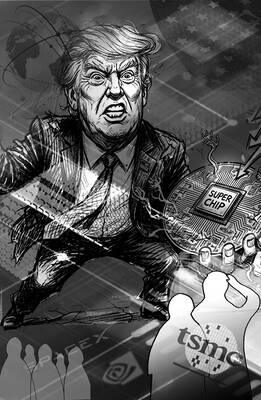
The White House’s decision to take a 9.9 percent stake in Intel Corp is looking like very shrewd business indeed. Since the government bought in at US$20.47 a share last August, the US chipmaker’s surging stock price has delivered the US a US$43 billion return. One of the reasons the investment has so far proved so sound is that the White House has made sure of it. According to The Wall Street Journal, Howard personally pushed deals on Intel’s behalf with some of the most lucrative clients imaginable. They include Nvidia Corp, the company at the heart of the AI
A single photograph can cut through a lot of noise, but it can also be used to misrepresent the truth. At the very least, it can concentrate the mind on something that requires further investigation. On Monday last week, Ma Ying-jeou Foundation CEO Tai Hsia-ling (戴遐齡) and former National Security Council secretary-general King Pu-tsung (金溥聰) held a news conference in which they showed a photograph of former foundation CEO Hsiao Hsu-tsen (蕭旭岑), now Chinese Nationalist Party (KMT) deputy chairman. In the image Hsiao is seated next to Xiamen Taiwan Businessmen Association chairman Han Ying-huan (韓螢煥). The two men were holding
I first met Professor Ray Jiing (井迎瑞) as a film and documentary student at Shih Hsin University’s (SHU) Department of Radio Television and Film in 1988. The following year, he went on to become the director of the Chinese Taipei Film Archive — forerunner of the Taiwan Film and Audiovisual Institute (TFAI). Over his eight-year tenure, Jiing rescued and restored over 200 classic Taiwanese films. In 1997, he established the Graduate Institute of Studies in Documentary and Film Archiving at Tainan National University of the Arts (TNNUA), and I joined the program in his third cohort of students. Beyond a
A recent report concerning a student who is suing his teacher posed the question in its headline: Does failing a student in two subjects constitute bullying? The college student in Chiayi County apparently sought NT$2 million (US$63,603) in state compensation, but a court dismissed the case. The first reaction of many might have been to ask: What has happened to students nowadays? Some say that teachers have lost their authority, while others say students are overindulged. Some even start reminiscing over the days when “whatever the teacher says goes.” However, the real issue might be overlooked if emotional reactions like that are the


 RSS
RSS