


Over 70 percent of the world's nations recognize Mongolia as an independent, sovereign state. Taiwan should conform to international practice, modifying the ROC's territorial claims to "Outer Mongolia" accordingly.
In 1953 the ROC legislature passed a resolution revoking the Sino-Soviet Friendship Treaty of August 1945. In that treaty, the ROC had agreed to recognize Mongolian independence if the Mongolian people voted in favor of it in a referendum. A referendum was duly held in October 1945, with the electorate voting overwhelmingly for independence. The ROC, therefore, recognized Mongolia in January 1946.
Treaties forming alliances can be unilaterally annulled by one of the signatory states, but articles involving changes to territorial sovereignty are permanently binding; under international law, they can't be rescinded unilaterally. They have to be redefined through bilateral negotiations.
The treaty's provisions regarding Mongolia's sovereignty therefore still apply and the question about "Outer Mongolia" isn't simply whether it is recognized by the ROC. It is a matter of fact that Mongolia has already been recognized by a majority of nations in the world, including the PRC. It entered the UN in 1961.
The ROC regards the public Mongolian referendum to have been flawed and therefore invalid. But that claim would only be valid if found to be true under internationally prescribed legal procedures.
The ROC Constitution should also be in tune with international practice, including the application of international law. Given that the Constitution's definition of "existing national boundaries" is vague, it is overly subjective to say with certainty that the boundaries of the ROC encompass "Outer Mongolia." It will take an amendment to the Constitution by the Legislative Yuan or interpretation of it by the Judicial Yuan to obtain an unequivocal answer. Given that the language is unclear, the claim that it is unconstitutional to remove "Outer Mongolia" from ROC territory is questionable.
Furthermore, altering the regions covered by the laws governing cross-strait relations involves neither territorial claims nor the national status. It's hard to say that such a move conflicts with the vague wording of Article 4 of the Constitution. Moreover, the language of the amendment merely clarifies the region of implementation. The territory covered by the Constitution wouldn't be changed.
Given that the Constitution does not clearly delineate ROC territory, it is not appropriate for us to give "clear recognition," ie, to use formal language to declare officially that the ROC recognizes "Outer Mongolia." We can only give gradual, quiet recognition to the sovereign independence of Mongolia in practice. This would involve, for example, issuing visas in line with policies for foreigners to people from Mongolia who wish to enter Taiwan, signing bilateral treaties, inviting the Mongolian head of state to visit and exchanging envoys. Like clear recognition, quiet recognition will have the legal consequence of diplomatic recognition. There are numerous precedents in the practice of international law for quietly adopting a gradual approach.
Mongolia is recognized by the international community as a sovereign, independent nation. In terms of international politics and international law, it is insulated against any territorial claims of the PRC or the ROC. We should therefore accept international reality by giving diplomatic recognition to Mongolia in a pragmatic manner and facing up to the tasks of amending the Constitution and other related laws. The people should expect no less.
Chen Lih-torng is a professor in the Graduate Institute of the Law of the Sea at National Taiwan Ocean University.
Translated by Ethan Harkness
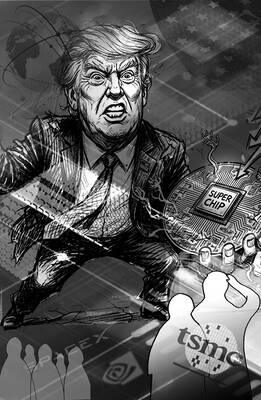
The White House’s decision to take a 9.9 percent stake in Intel Corp is looking like very shrewd business indeed. Since the government bought in at US$20.47 a share last August, the US chipmaker’s surging stock price has delivered the US a US$43 billion return. One of the reasons the investment has so far proved so sound is that the White House has made sure of it. According to The Wall Street Journal, Howard personally pushed deals on Intel’s behalf with some of the most lucrative clients imaginable. They include Nvidia Corp, the company at the heart of the AI
A single photograph can cut through a lot of noise, but it can also be used to misrepresent the truth. At the very least, it can concentrate the mind on something that requires further investigation. On Monday last week, Ma Ying-jeou Foundation CEO Tai Hsia-ling (戴遐齡) and former National Security Council secretary-general King Pu-tsung (金溥聰) held a news conference in which they showed a photograph of former foundation CEO Hsiao Hsu-tsen (蕭旭岑), now Chinese Nationalist Party (KMT) deputy chairman. In the image Hsiao is seated next to Xiamen Taiwan Businessmen Association chairman Han Ying-huan (韓螢煥). The two men were holding
I first met Professor Ray Jiing (井迎瑞) as a film and documentary student at Shih Hsin University’s (SHU) Department of Radio Television and Film in 1988. The following year, he went on to become the director of the Chinese Taipei Film Archive — forerunner of the Taiwan Film and Audiovisual Institute (TFAI). Over his eight-year tenure, Jiing rescued and restored over 200 classic Taiwanese films. In 1997, he established the Graduate Institute of Studies in Documentary and Film Archiving at Tainan National University of the Arts (TNNUA), and I joined the program in his third cohort of students. Beyond a
A recent report concerning a student who is suing his teacher posed the question in its headline: Does failing a student in two subjects constitute bullying? The college student in Chiayi County apparently sought NT$2 million (US$63,603) in state compensation, but a court dismissed the case. The first reaction of many might have been to ask: What has happened to students nowadays? Some say that teachers have lost their authority, while others say students are overindulged. Some even start reminiscing over the days when “whatever the teacher says goes.” However, the real issue might be overlooked if emotional reactions like that are the


 RSS
RSS