


One of the many imponderable issues of the forthcoming US presidential election is the Saddam Hussein question, to bomb or not to bomb, to sanction or not to sanction, to try and overthrow him or to accept the status quo. Already advisers to George Bush are letting it be known that a toughening of the effort to depose him is high on the candidate's agenda. Hanging like an albatross around Bush's neck is the widespread sentiment that when his father as president led the defeat of Iraq in the Gulf War he had a sword at the throat of Saddam Hussein and failed to use it. At the end of the war President George Bush allowed Saddam to withdraw his forces from Kuwait and southern Iraq with half of his Republican Guard intact. Within days he was using these to savagely repress rebellions by Iraq's Shiite Muslim and Kurdish peoples. Will Bush Junior feel he has to be tougher than tough with Saddam to erase this stain on the family record? Or will he surprise everyone as his father did when he inherited the Nicaraguan imbroglio from Ronald Reagan? Then, despite all his predecessor's rhetoric about the dire threat of Nicaragua's Sandinistas to the very security of the US itself, he quickly made up his mind to close down US military support for the opposition Contras. What had been a sacred cause to the Republican right quickly vanished into the mists of history. As his father had the inconsequential Sandinistas in perspective, will George Bush Junior reduce Saddam Hussein to his proper size?
US policy with Iraq is in a cul de sac. Every three days on average, US and British aircraft take off to bomb Iraq. The Pentagon says more than 280,000 sorties have been flown in the near decade since no-flight zones were imposed on Saddam in the north and south of the country. The targets are mainly military but, inevitably, given the policy of flying higher than 2800m there are regular reports of civilian casualties. Amnesty International will soon be issuing a report critical of the US and Britain for not obeying the Geneva Conventions on the rules of war.
Sanctions first imposed by Security Council decree in April 1991 remain fully in place. Britain and the US resist any attempt to dilute them. The people of Iraq once reasonable prosperous have been reduced to penury. Well over half a million Iraqi children have died as a result, say UNICEF. A former US Secretary of Defense, Robert McNamara, is reported to have called these sanctions "a weapon of mass destruction."
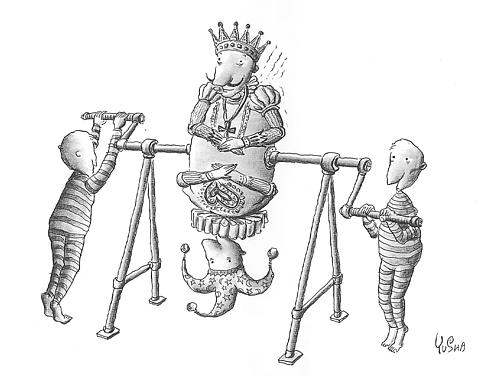
Where does such a policy lead? The Republican hard-liners seem only to be thrashing around in their attempts to toughen it to the point where it might provide the coup de grace. One line is to beef up the Iraqi opposition with arms and training, although its past record of achievement has been unremarkable. Another as Robert Zoellick, a Bush advisor, has argued, is to slowly take away pieces of his territory.... As the allies successfully did in the north with the Kurdish enclave so they should use their air power to carve out an autonomous entity for the Shiites in the south.
This begs the question: if 10 years of continuous warfare has not toppled Saddam why should such relatively marginal increments to policy deliver his head on a plate? Why, anyway, does the US want Saddam's total capitulation? Because, it is argued, they fear Iraq's development of weapons of mass destruction.
This is thinking that can't see wood for trees. When the UN inspection system was working, it had a remarkable record of disarming Iraq. As President Bill Clinton has conceded, the UN arms inspectors found and destroyed more Iraqi weapons of mass destruction than were destroyed during all the days of intensive bombardment during the days of the Gulf War. To the outside world's surprise, the inspectors discovered that Iraq was on the threshold of building a nuclear weapon. Later defections by high ranking Iraqi officials have also revealed the advanced state of Iraq's biological weapons program.
Inspections may have been suspended but the relentless pressure of sanctions continue. As long as they remain in place, Saddam cannot buy the where-with-all to re-start his nuclear and biological weapons programs. (He may be able to make small quantities of biological weapons with materials he has at hand, but he has a limited ability to make them useable and deliverable.
Moreover, his military machine has never recovered from the damage brought about by the allied onslaught of 10 years ago. Iraq has no significant airforce or navy. His army's tank and armored car ranks are decimated and what remains is antiquated. He probably has no working rockets and, even if he has, their range is derisory.
America and Britain have a problem. Perhaps it is they don't know when they've won. They've confused getting rid of Saddam, a nice option if you can easily do it, with the central must issue of containing Iraq's aggressive military prowess. On the latter there can be little debate that they have Saddam pretty well cornered.
Which brings us back to the long-suffering innocents of Iraq. Do they have to be bottled up too? It cannot be beyond the wit of the Security Council to devise a sanctions regime that allows civilian reconstruction without re-building the military might of Iraq. The argument over so-called `dual use' items, for example chlorine that can be used either for the water supply or for building chemical weapons, is taken too far. Of course, chlorine, computers, machine tools and even bedsteads can have military uses. But as long as Iraq is not supplied with the kind of state-of-the-art fighting equipment that Reagan, Thatcher and Mitterand happily sold him large quantities of before the Gulf War, there are enormous limits on what he can do. He will certainly not have the power to do what he did to Iran, much less than to the allied coalition in the Gulf War. To win a war with America, or even hurt it badly, a country needs more than the odd home made weapon of mass destruction.
Whoever wins the US election should do a `Nicaragua': open the windows, clear the air. Ten years on it's time for a major change of tactics. Victors should not keep grinding away. The new American president should stand up and announce: `we won the war, we discovered and dismantled most of the weapons, now we want to help re-build Iraq and give its children a positive future. There is only one thing we will not do this time round: sell it the guns to start another war.' A policy such as this would, I suspect, have no trouble winning the votes of all the members of the Security Council, and being universally enforced, as well as admired.
What began on Feb. 28 as a military campaign against Iran quickly became the largest energy-supply disruption in modern times. Unlike the oil crises of the 1970s, which stemmed from producer-led embargoes, US President Donald Trump is the first leader in modern history to trigger a cascading global energy crisis through direct military action. In the process, Trump has also laid bare Taiwan’s strategic and economic fragilities, offering Beijing a real-time tutorial in how to exploit them. Repairing the damage to Persian Gulf oil and gas infrastructure could take years, suggesting that elevated energy prices are likely to persist. But the most
Taiwan should reject two flawed answers to the Eswatini controversy: that diplomatic allies no longer matter, or that they must be preserved at any cost. The sustainable answer is to maintain formal diplomatic relations while redesigning development relationships around transparency, local ownership and democratic accountability. President William Lai’s (賴清德) canceled trip to Eswatini has elicited two predictable reactions in Taiwan. One camp has argued that the episode proves Taiwan must double down on support for every remaining diplomatic ally, because Beijing is tightening the screws, and formal recognition is too scarce to risk. The other says the opposite: If maintaining
Chinese Nationalist Party (KMT) Chairwoman Cheng Li-wun (鄭麗文), during an interview for the podcast Lanshuan Time (蘭萱時間) released on Monday, said that a US professor had said that she deserved to be nominated for the Nobel Peace Prize following her meeting earlier this month with Chinese President Xi Jinping (習近平). Cheng’s “journey of peace” has garnered attention from overseas and from within Taiwan. The latest My Formosa poll, conducted last week after the Cheng-Xi meeting, shows that Cheng’s approval rating is 31.5 percent, up 7.6 percentage points compared with the month before. The same poll showed that 44.5 percent of respondents
India’s semiconductor strategy is undergoing a quiet, but significant, recalibration. With the rollout of India Semiconductor Mission (ISM) 2.0, New Delhi is signaling a shift away from ambition-driven leaps toward a more grounded, capability-led approach rooted in industrial realities and institutional learning. Rather than attempting to enter the most advanced nodes immediately, India has chosen to prioritize mature technologies in the 28-nanometer to 65-nanometer range. That would not be a retreat, but a strategic alignment with domestic capabilities, market demand and global supply chain gaps. The shift carries the imprimatur of Indian Prime Minister Narendra Modi, indicating that the recalibration is


 RSS
RSS