


Academia Sinica President Lee Yuan-tseh
Therefore, academics and the media have started arguing about the role of Taiwan's intellectuals, as well as the principle of acade-mic neutrality. It is difficult to have a rational discussion, since everyone has their own political stance.
However, when it comes to politics, we have seldom stepped back and considered why intellectuals and academic circles need to be "neutral" and when the principle should be applied. Lee's choice has given us a chance to rethink these issues and to clarify the interactions between politics, society, citizens and professionals.
The idea of segregating intellectuals and academics from the political realm basically emerged with the modernist thinking of scientism and logical positivism after the Enlightenment. Politics has gradually become a kind of professional field, the exclusive arena of trained political figures, especially in a country with mature party politics.
Intellectuals and scholars follow the same mode of thinking, limiting themselves within increasingly narrow disciplinary walls. Human nature and society are divided into numerous compartments and politics happens to be one of them.
Such a modernist understanding has been strongly criticized by Marxists and viewed with suspicion by post-modernists. The possibility of certain citizens being excluded from politics is even less acceptable under the classical ideal of a civil state.
All of us have families, jobs and skills. But these are not enough. Each of us is also a "citizen." Citizen means a "political person," whether at the community or national level -- and as such we all have the responsibility to participate in politics. The elite from each and every profession should care about and participate in politics.
Politics should not interfere in professional work, but politics must accept the involvement of all professionals. Only after they have done their citizen's duty can professionals -- including intellectuals and scholars -- become complete human beings. Otherwise, each will only be half a person.
The duties of a citizen go far beyond simply casting a ballot. Ideally, all political offices should be assumed in rotation by citizens from different fields, as is indeed the case in performing military service.
Military service and public office are two most important duties of a citizen. We do not deprive a citizen of his or her duties and abilities on the basis of profession. But it is interesting to note that while people in Taiwan can accept lawyers and physicians participating in politics, our impressions of academic neutrality and purity often tend to negate the function of intellectuals and academics.
If one day Lee Yuan-tseh assumes the premier's office, we should see this as an example of a responsibility every able citizen should shoulder. We should not negate his original profession and reputation just because he has taken up that position. There is no problem of mutual exclusion and contradiction here, just like in the case of military service.
Politics should not be a "profession" in the first place. Otherwise, it would be indistinguishable from "administration." Political office is not an exclusive right of bureaucrats. One of the reasons for Taiwan's political chaos has been the confusion between politics and administration. To change this, we need to liberate politics from the mold of a professional field and return it to the citizenry.
When "black gold" reigns in the country's social and political development, when gangsters and money-politicians are seen stumping alongside candidates, when the sincerity, ethics, and basic values of an election have become twisted, how can an intellectual remain silent in the name of academic neutrality? What message are they supposed to deliver?
We need to reflect on whether people who claim academic neutrality are using the same scrupulous attitude in judging the challenges and destruction facing Taiwan's social values during the election. How are we to leave a set of standards for the next generation?
On the surface, this election is about choosing a president and a vice president. But it is really about choosing a set of values, moral standards and a national image.
Perhaps no one can be a perfect personality in realpolitik, but when it comes to key measures of character common to all human understanding, we should allow no laxity. Such measures transcend ethnicity, party boundaries and individual prefer-ences. This is what intellectuals should safeguard and champion.
In a campaign brimming with lies, betrayals, smears and abuse of power, with the various ethnic and partisan positions, irrational rumors are enough to eclipse the conscience of the intelligentsia.
How can a responsible citizen flow with the tides and allow such trends to erode the very foundation of basic social and human values?
Chen Chi-nan is a professor and dean of the College of Humanities and Social Sciences at National Chiao Tung University.
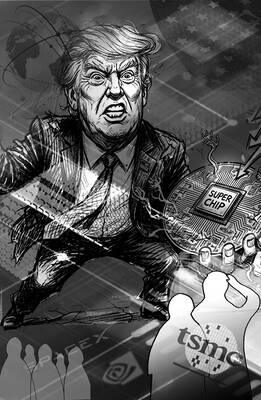
The White House’s decision to take a 9.9 percent stake in Intel Corp is looking like very shrewd business indeed. Since the government bought in at US$20.47 a share last August, the US chipmaker’s surging stock price has delivered the US a US$43 billion return. One of the reasons the investment has so far proved so sound is that the White House has made sure of it. According to The Wall Street Journal, Howard personally pushed deals on Intel’s behalf with some of the most lucrative clients imaginable. They include Nvidia Corp, the company at the heart of the AI
A single photograph can cut through a lot of noise, but it can also be used to misrepresent the truth. At the very least, it can concentrate the mind on something that requires further investigation. On Monday last week, Ma Ying-jeou Foundation CEO Tai Hsia-ling (戴遐齡) and former National Security Council secretary-general King Pu-tsung (金溥聰) held a news conference in which they showed a photograph of former foundation CEO Hsiao Hsu-tsen (蕭旭岑), now Chinese Nationalist Party (KMT) deputy chairman. In the image Hsiao is seated next to Xiamen Taiwan Businessmen Association chairman Han Ying-huan (韓螢煥). The two men were holding
I first met Professor Ray Jiing (井迎瑞) as a film and documentary student at Shih Hsin University’s (SHU) Department of Radio Television and Film in 1988. The following year, he went on to become the director of the Chinese Taipei Film Archive — forerunner of the Taiwan Film and Audiovisual Institute (TFAI). Over his eight-year tenure, Jiing rescued and restored over 200 classic Taiwanese films. In 1997, he established the Graduate Institute of Studies in Documentary and Film Archiving at Tainan National University of the Arts (TNNUA), and I joined the program in his third cohort of students. Beyond a
A recent report concerning a student who is suing his teacher posed the question in its headline: Does failing a student in two subjects constitute bullying? The college student in Chiayi County apparently sought NT$2 million (US$63,603) in state compensation, but a court dismissed the case. The first reaction of many might have been to ask: What has happened to students nowadays? Some say that teachers have lost their authority, while others say students are overindulged. Some even start reminiscing over the days when “whatever the teacher says goes.” However, the real issue might be overlooked if emotional reactions like that are the


 RSS
RSS