


"The earthquake moved around picking kacak buildings out for destruction," Oktay Ekinci, chairman of the Architects Association of Turkey, said when he was interviewed after the Izmit earthquake killed 15,000 people in Turkey. His comment, unfortunately, fits Taiwan perfectly.
"Kacak" means "contraband" -- buildings built without permits or architectural plans and which do not conform to building regulations. They are erected in places where they should not be, such as riverbanks; they are not built with the requisite amounts of cement and steel.
In Turkey, more than half of all buildings belong to this category, built in violation of construction regulations.
The casualty count for Tuesday's earthquake, horrific as it is, is less than that in Turkey.
But the type of selective collapse of certain buildings here in Taiwan is nevertheless identical. Except for some old and decrepit buildings, those "sole collapsed" buildings on our streets by and large had problems of poor design and construction.
In the case of the buildings constructed by Han Construction Corp in Yunlin County, the reasons that led to the collapses were poor quality steel and cement. Even more shocking, empty cooking oil drums were found in the pillars of those buildings. When these defective Taiwan "kacak" buildings were picked out for destruction, it makes more sense to say it is a human-made rather than a natural disaster.
Turkish builders are often people with political connections who put profit above safety, and the cronyism and corruption of the government are the main reasons for the existence of "kacak" buildings. As a Turkish columnist commented: "Corruption kills people, not earthquakes."
In Taiwan, those who died in the "kacak" buildings are also the victims of the corruption and cronyism prevalent in Taiwan's government as well. How could construction licenses have been granted to these builders who apparently violated construction regulations? Corruption and a lazy government could be the problem.
Construction regulations released by the Ministry of the Interior (內政部) are clearly stated in the articles on Regulations Against Earthquakes (建築物耐震設計規定). But many are unenforced.
Tuesday's earthquake revealed the serious defects in Taiwan's construction industry and bureaucracy. What we can and should do now is follow the work done in Japan: increase quality control in the construction industry and enhance efforts to fight against government and industry corruption. Just as in Turkey, until cronyism is ended, there will be many problems in Taiwan, some ending in tragedy.
Shen Fu-hsiung is a member of the Legislative Yuan.
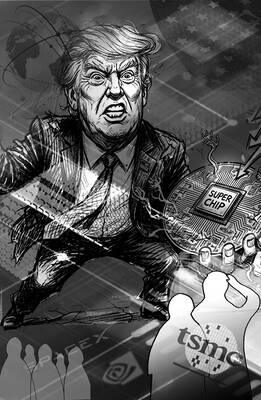
The White House’s decision to take a 9.9 percent stake in Intel Corp is looking like very shrewd business indeed. Since the government bought in at US$20.47 a share last August, the US chipmaker’s surging stock price has delivered the US a US$43 billion return. One of the reasons the investment has so far proved so sound is that the White House has made sure of it. According to The Wall Street Journal, Howard personally pushed deals on Intel’s behalf with some of the most lucrative clients imaginable. They include Nvidia Corp, the company at the heart of the AI
A single photograph can cut through a lot of noise, but it can also be used to misrepresent the truth. At the very least, it can concentrate the mind on something that requires further investigation. On Monday last week, Ma Ying-jeou Foundation CEO Tai Hsia-ling (戴遐齡) and former National Security Council secretary-general King Pu-tsung (金溥聰) held a news conference in which they showed a photograph of former foundation CEO Hsiao Hsu-tsen (蕭旭岑), now Chinese Nationalist Party (KMT) deputy chairman. In the image Hsiao is seated next to Xiamen Taiwan Businessmen Association chairman Han Ying-huan (韓螢煥). The two men were holding
I first met Professor Ray Jiing (井迎瑞) as a film and documentary student at Shih Hsin University’s (SHU) Department of Radio Television and Film in 1988. The following year, he went on to become the director of the Chinese Taipei Film Archive — forerunner of the Taiwan Film and Audiovisual Institute (TFAI). Over his eight-year tenure, Jiing rescued and restored over 200 classic Taiwanese films. In 1997, he established the Graduate Institute of Studies in Documentary and Film Archiving at Tainan National University of the Arts (TNNUA), and I joined the program in his third cohort of students. Beyond a
A recent report concerning a student who is suing his teacher posed the question in its headline: Does failing a student in two subjects constitute bullying? The college student in Chiayi County apparently sought NT$2 million (US$63,603) in state compensation, but a court dismissed the case. The first reaction of many might have been to ask: What has happened to students nowadays? Some say that teachers have lost their authority, while others say students are overindulged. Some even start reminiscing over the days when “whatever the teacher says goes.” However, the real issue might be overlooked if emotional reactions like that are the


 RSS
RSS