


Frown-inducing accusations have been flying in a trademark dispute between Wal-Mart and a company owned by a French family over US commercial rights to the ubiquitous yellow symbol for happiness. Both parties say they expect victory when the US Patent and Trademark Office rules on the case this summer.
Wal-Mart, the world's largest retailer, says the yellow face has long personified its price-reducing policy, while SmileyWorld, the London-based company that first registered rights to the symbol decades ago, says its globally established business is at risk.
"A prehistoric man probably invented the smiley face in some cave, but I certainly was the first to register it as a trademark," said Franklin Loufrani, 63, who says he initially registered the design with French trademark authorities in October 1971. "When it comes to commercial use, registration is what counts."
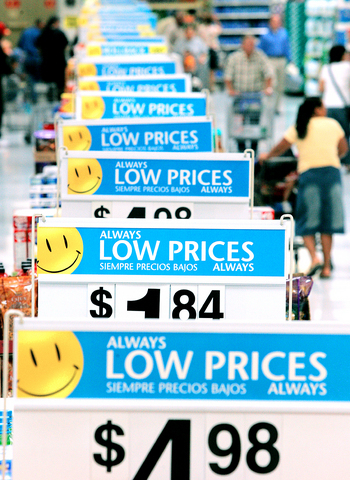
PHOTO: AP
Unlike most countries in Europe and Asia, however, the US operates under a system in which being the first to register a trademark carries less weight than being the first to exploit a symbol commercially, said Burkhart Goebel, the global head of intellectual property practice at Lovells law firm.
"We may live in the era of globalization, but trademarks are still rooted in territoriality," Goebel said. "A trademark filed in one country has almost no impact in another."
Marc Ackerman, a New York-based partner at the White & Case law firm and a specialist in US trademark law, said, "Here in the US, we consider how heavily a trademark is used, and that would give SmileyWorld a big uphill battle."
The most widely credited claim for inventing the smiley face is held by Harvey Ball for the smiley yellow button he made for the State Mutual Life Assurance Company of America in Massachusetts in 1963. Ball, a graphic artist, was paid US$45 to create a button intended to cheer employees during a rocky merger with an out-of-town company, according to his 2001 obituary in The Worcester Telegram & Gazette.
Although irked by reports that Loufrani claimed to invent the smiley, Ball never attempted to trademark the symbol or commercially exploit it.
Loufrani, however, built a business from royalties collected on the symbol, which he claimed to have trademarked in 98 countries, for use in a wide range of product categories. Loufrani said SmileyWorld won a case in June 2005 against the use of a smiley face on the home page of AOL France.
The battle with Wal-Mart was touched off when SmileyWorld filed for a US trademark in 1997 for the exclusive right to commercial use and licensing of the term "smiley" in conjunction with the face logo. SmileyWorld's original application, which tried to trademark the smiley face itself, was rejected by the US patent office because of the design's widespread use, according to the company's lawyer, Steven Baron.
To Wal-Mart, which has photographs of smiley faces in its stores dating back to 1996, Loufrani is a trademark troll registering the symbol in as many product categories as possible.
"They are applying for rights over the smiley face in product categories that include animal semen," John Simley, a Wal-Mart spokesman, said. "It shows they are trying to trademark everything they possibly can."
Wal-Mart lodged a notice of opposition to SmileyWorld's trademark application and then filed a separate application to trademark the smiley face in relation to retail services.
In response, SmileyWorld filed a notice of opposition to Wal-Mart's application on the grounds that its own attempt to trademark the face had been rejected. To overcome objections that the smiley face is within the public domain, Wal-Mart asserts a long history of "prior use" in retail services, Simley said.
That a happy face can cause such rancor should be no surprise, said Tom Blackett, group deputy chairman of Interbrand, a branding consulting firm based in London.
"This dispute shows how much value companies put in symbols," he said. "In the era of distinctive trademarks like the Nike swoosh, companies will go a long way to defend their perceived territory."
With legal fees topping half a million US dollars, the Wal-Mart dispute is the most costly SmileyWorld has ever faced.
SmileyWorld was also awarded 2,500 euros (US$3,125) last March in a case in a French court against French retailer Pier Import.

CREDIT-GRABBER: China said its coast guard rescued the crew of a fishing vessel that caught fire, who were actually rescued by a nearby Taiwanese boat and the CGA Maritime search and rescue operations do not have borders, and China should not use a shipwreck to infringe upon Taiwanese sovereignty, the Coast Guard Administration (CGA) said yesterday. The coast guard made the statement in response to the China Coast Guard (CCG) saying it saved a Taiwanese fishing boat. The Chuan Yu No. 6 (全漁6號), a fishing vessel registered in Keelung, on Thursday caught fire and sank in waters northeast of Diaoyutai Islands (釣魚台). The vessel left Keelung’s Badouzih Fishing Harbor (八斗子漁港) at 3:35pm on Sunday last week, with seven people on board — a 62-year-old Taiwanese captain surnamed Chang (張) and six

RISKY BUSINESS: The ‘incentives’ include initiatives that get suspended for no reason, creating uncertainty and resulting in considerable losses for Taiwanese, the MAC said China’s “incentives” failed to sway sentiment in Taiwan, as willingness to work in China hit a record low of 1.6 percent, a Ministry of Labor survey showed. The Directorate-General of Budget, Accounting and Statistics (DGBAS) also reported that the number of Taiwanese workers in China has nearly halved from a peak of 430,000 in 2012 to an estimated 231,000 in 2024. That marked a new low in the proportion of Taiwanese going abroad to work. The ministry’s annual survey on “Labor Life and Employment Status” includes questions respondents’ willingness to seek employment overseas. Willingness to work in China has steadily declined from

The Legislative Yuan’s Finance Committee yesterday approved proposed amendments to the Amusement Tax Act (娛樂稅法) that would abolish taxes on films, cultural activities and competitive sporting events, retaining the fee only for dance halls and golf courses. The proposed changes would set the maximum tax rate for dance halls and golf courses at 50 and 20 percent respectively, with local governments authorized to suspend the levies. Article 2 of the act says that “amusement tax shall be levied on tickets sold or fees charged by amusement places, facilities or activities” in six categories: “Cinema; professional singing, story-telling, dancing, circus, magic show, acrobatics
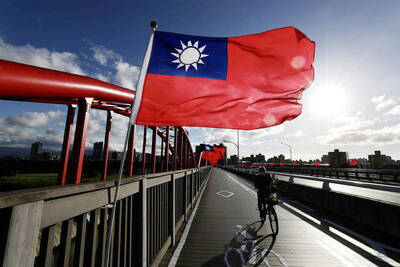
INFLATION UP? The IMF said CPI would increase to 1.5 percent this year, while the DGBAS projected it would rise to 1.68 percent, with GDP per capita of US$44,181 The IMF projected Taiwan’s real GDP would grow 5.2 percent this year, up from its 2.1 percent outlook in January, despite fears of global economic disruptions sparked by the US-Iran conflict. Taiwan’s consumer price index (CPI) is projected to increase to 1.5 percent, while unemployment would be 3.4 percent, roughly in line with estimates for Asia as a whole, the international body wrote in its Global Economic Outlook Report published in the US on Monday. The figures are comparatively better than the IMF outlook for the rest of the world, which pegged real GDP growth at 3.1 percent, down from 3.3 percent


 RSS
RSS