


When Hong Kong martial arts stars Bruce Lee and Jackie Chan first started out, they both worked with producer Raymond Chow.
Chow, a diminutive, soft-spoken 78-year-old, said he knew he had a potential star on his hands when he saw Lee perform kung fu on a Hong Kong television variety show.
He signed him up in 1971.
"Facing you on the screen, you feel his presence is very strong, very powerful," Chow said in an interview at his Golden Harvest film studios.
Chow's second big star is much different.
While Lee showed the world that Chinese kung fu masters are lean, mean fighting machines, Jackie Chan turned martial arts into a dance-like comedy routine. Chan signed with Golden Harvest in 1979.
Chow said the perennial question of which star would win in a duel was unfair.
"Jackie Chan won't fight you. He thinks if we're making a movie together, we should do it in a friendly way," he said.
"He is a very kind, happy person. He likes to spend happy times with everyone all the time," Chow said.
Savvy, sensitivity
Chow, a bespectacled former journalist and sports fan, doesn't have the big presence of a movie mogul. But what he doesn't radiate in star power, he makes up for with cultural savvy and sensitivity that has helped a stable of actors on the way to global stardom.
He's a unique product of the times, a bilingual and bicultural intellectual born in British-ruled Hong Kong in 1927, educated in Shanghai, and eager to introduce Chinese culture to the West.
Chow was born to a nationalistic father wary of British colonial influences. Following his father's wishes, Chow completed his secondary and university studies in Shanghai.
The producer said he shared Lee's nationalistic feelings, which found their way into their movies.
In The Chinese Connection, set during a period when Shanghai was occupied by foreign countries, Lee plays a character who tries to avenge the killing of his kung fu instructor by a Japanese gang.
The character also smashes a sign that says "No Chinese or dogs allowed" with a kick.
Lee felt "every Chinese should know about these things," Chow said.
Chow said Lee, who died of an edema, or swelling of the brain, at age 32 in 1973, was just being himself.
Patriotism also proved to be good business as Lee's films made him a box-office wonder and a national hero at the same time.
Before moving to films, Chow worked at the full spectrum of English-language news outlets -- including United Press, which later became United Press International, the New York Times and Voice of America.
He entered the movie business as a publicist for the famed Shaw Brothers studios. After more than a decade in the industry, when his employer shifted to television, Chow set up his own company, Golden Harvest.
Thirty-five years after its founding, Golden Harvest has risen from startup to a movie powerhouse that counts among its stars the biggest Chinese names in the business.
Chow introduced Chan to the Western world by leveraging the fame of top Hollywood names.
He gave Western audiences their first glimpse of Chan in the Hollywood film, The Big Brawl. In The Cannonball Run, 1981, Chow stacked the cast with big stars like Burt Reynolds, Roger Moore and Dean Martin and inserted Chan.
At 78, Chow walks at a slackened pace, but still puts in a full-day's work and remains mentally sharp, speaking slowly but articulately.
The conference room where he was speaking is decorated with Golden Horse awards -- the Chinese-speaking world's equivalent of Oscars.
Success in his own right
Chow hasn't just banked on his two biggest stars but has achieved commercial success in his own right.
Among Golden Harvest's biggest successes is the cartoon-inspired Teenage Mutant Ninja Turtles, which became one of the top-grossing films in North America in 1990, making over US$130 million.
But these days Golden Harvest has shifted its focus to the cinema operation business.
Chow says he has doubts about the staying power of Chinese-themed movies like martial arts extravaganzas, suggesting that the future of Hong Kong movies lies in tapping the huge potential of the vast China market.
He argued that Western audiences may have trouble accepting the gravity-defying, wall-scaling abilities of Chinese kung fu characters.
"In the end there are cultural differences ... [but] they may find it refreshing to watch one [a Chinese movie] occasionally," he said.
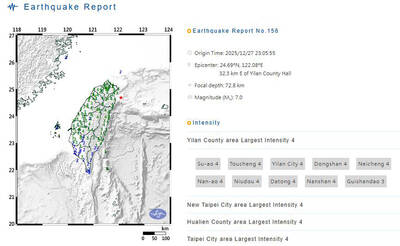
A magnitude 7.0 earthquake struck off Yilan at 11:05pm yesterday, the Central Weather Administration (CWA) said. The epicenter was located at sea, about 32.3km east of Yilan County Hall, at a depth of 72.8km, CWA data showed There were no immediate reports of damage. The intensity of the quake, which gauges the actual effect of a seismic event, measured 4 in Yilan County area on Taiwan’s seven-tier intensity scale, the data showed. It measured 4 in other parts of eastern, northern and central Taiwan as well as Tainan, and 3 in Kaohsiung and Pingtung County, and 2 in Lienchiang and Penghu counties and 1
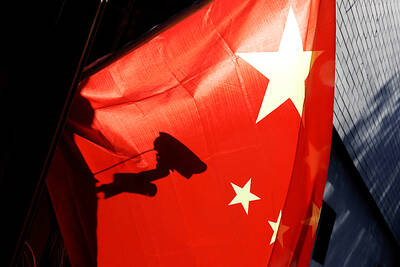
FOREIGN INTERFERENCE: Beijing would likely intensify public opinion warfare in next year’s local elections to prevent Lai from getting re-elected, the ‘Yomiuri Shimbun’ said Internal documents from a Chinese artificial intelligence (AI) company indicated that China has been using the technology to intervene in foreign elections, including propaganda targeting Taiwan’s local elections next year and presidential elections in 2028, a Japanese newspaper reported yesterday. The Institute of National Security of Vanderbilt University obtained nearly 400 pages of documents from GoLaxy, a company with ties to the Chinese government, and found evidence that it had apparently deployed sophisticated, AI-driven propaganda campaigns in Hong Kong and Taiwan to shape public opinion, the Yomiuri Shimbun reported. GoLaxy provides insights, situation analysis and public opinion-shaping technology by conducting network surveillance
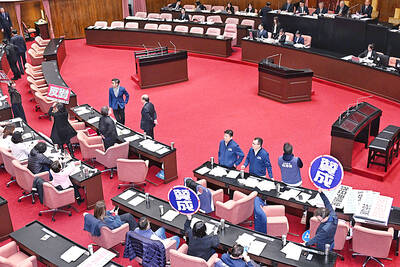
‘POLITICAL GAME’: DPP lawmakers said the motion would not meet the legislative threshold needed, and accused the KMT and the TPP of trivializing the Constitution The Legislative Yuan yesterday approved a motion to initiate impeachment proceedings against President William Lai (賴清德), saying he had undermined Taiwan’s constitutional order and democracy. The motion was approved 61-50 by lawmakers from the main opposition Chinese Nationalist Party (KMT) and the smaller Taiwan People’s Party (TPP), who together hold a legislative majority. Under the motion, a roll call vote for impeachment would be held on May 19 next year, after various hearings are held and Lai is given the chance to defend himself. The move came after Lai on Monday last week did not promulgate an amendment passed by the legislature that
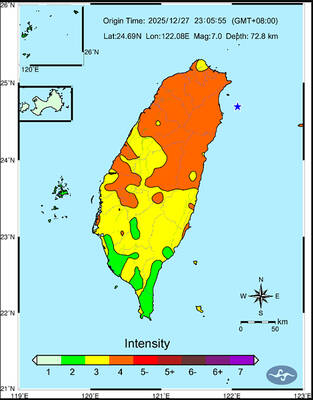
AFTERMATH: The Taipei City Government said it received 39 minor incident reports including gas leaks, water leaks and outages, and a damaged traffic signal A magnitude 7.0 earthquake struck off Taiwan’s northeastern coast late on Saturday, producing only two major aftershocks as of yesterday noon, the Central Weather Administration (CWA) said. The limited aftershocks contrast with last year’s major earthquake in Hualien County, as Saturday’s earthquake occurred at a greater depth in a subduction zone. Saturday’s earthquake struck at 11:05pm, with its hypocenter about 32.3km east of Yilan County Hall, at a depth of 72.8km. Shaking was felt in 17 administrative regions north of Tainan and in eastern Taiwan, reaching intensity level 4 on Taiwan’s seven-tier seismic scale, the CWA said. In Hualien, the


 RSS
RSS