


A magnitude 7.0 earthquake struck off Taiwan’s northeastern coast late on Saturday, producing only two major aftershocks as of yesterday noon, the Central Weather Administration (CWA) said.
The limited aftershocks contrast with last year’s major earthquake in Hualien County, as Saturday’s earthquake occurred at a greater depth in a subduction zone.
Saturday’s earthquake struck at 11:05pm, with its hypocenter about 32.3km east of Yilan County Hall, at a depth of 72.8km.
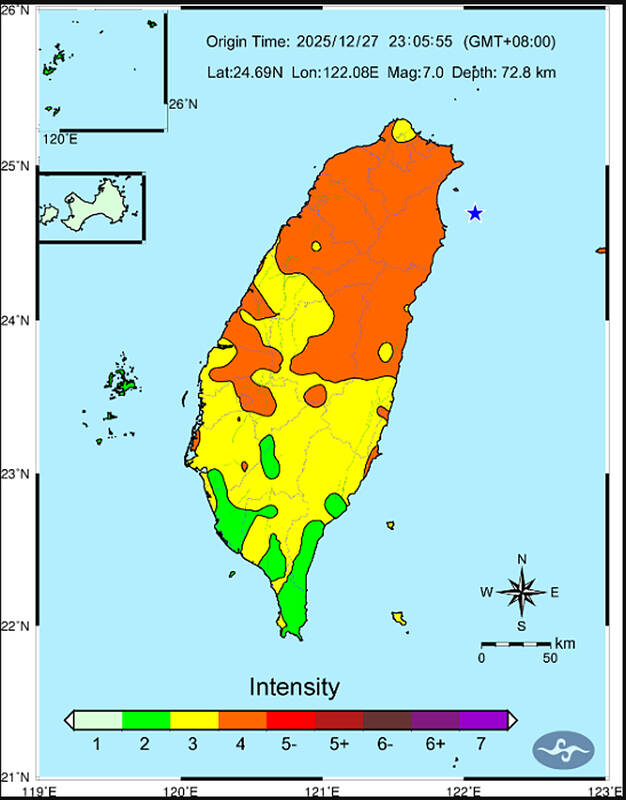
Photo courtesy of the Central Weather Administration
Shaking was felt in 17 administrative regions north of Tainan and in eastern Taiwan, reaching intensity level 4 on Taiwan’s seven-tier seismic scale, the CWA said.
In Hualien, the shaking lasted 21 seconds, while in Taipei, New Taipei City, Hsinchu, Taoyuan and Miaoli it lasted about 10 seconds, said Chen Da-yi (陳達毅), a section chief at the CWA’s Seismological Center.
Data on the CWA Web site showed that one aftershock struck yesterday at 00:45am, with a magnitude of 4.7 at a depth of about 60.8km.
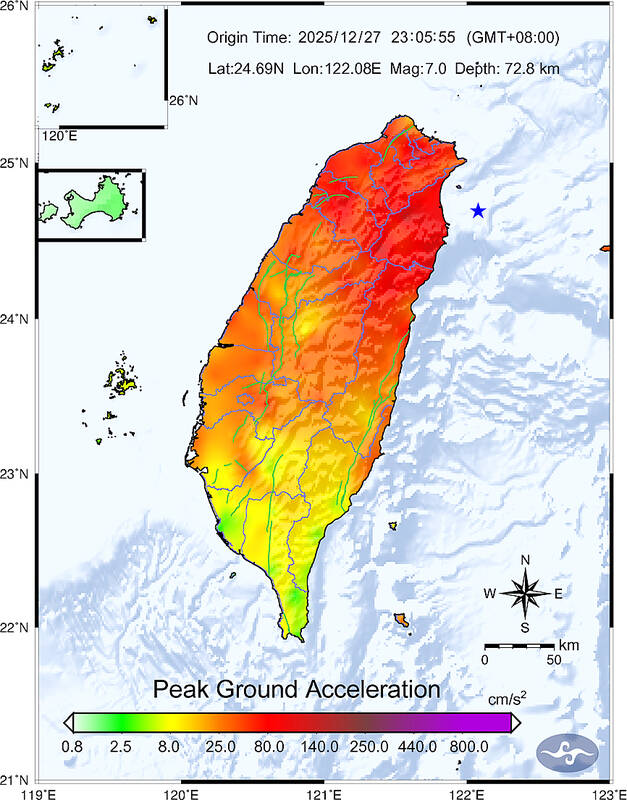
Photo courtesy of the Central Weather Administration
The other occurred at 10:55am with a magnitude of 3.8 a depth of about 66.5km.
The difference from last year’s Hualien quake, which was followed by frequent aftershocks, is due to depth and tectonic setting, CWA Seismological Center director Wu Chien-fu said.
The Hualien quake was a shallow fault-zone event, occurring at 15.5km deep, while Saturday’s Yilan quake was a subduction-zone earthquake caused by the Philippine Sea Plate subducting northward beneath the Eurasian Plate, Wu said.
Such deep earthquakes generate fewer aftershocks and weaker surface shaking, he added.
Wu cautioned residents to remain alert, as aftershocks in the magnitude 5.5 to 6.0 range are still possible over the coming week.
The quake was among the strongest to hit Taiwan in the past few decades, following the magnitude 7.3 earthquake in Nantou County in 1999 and last year’s Hualien quake, the CWA said.
As Saturday’s quake occurred offshore and at significant depth, it was widely felt and shook for a long duration, but was less likely to cause severe damage, it said.
Damage from the quake was largely repaired across northern Taiwan by yesterday, with authorities reporting only minor incidents and no injuries.
Taoyuan International Airport Corp (桃園國際機場公司) said lightweight ceiling debris that fell in waiting lounge areas C1, C5 and C7, and at baggage carousel areas in Terminal 2 has been cleared, adding that two passengers were struck by falling materials, but no one was injured.
Repairs have been completed, and airport operations remain normal, it said.
The Hsinchu Science Park Administration said some companies in the Yilan, Longtan and Hsinchu parks evacuated staff.
Power and water supplies at the Hsinchu park area remained normal, although elevator malfunctions were reported at two buildings, with repairs under way, it said.
The earthquake caused a fault at Yilan County’s Dongao (東澳) substation, leading to a power outage affecting 3,465 households, but power was restored in about 10 minutes, the county government said.
Fallen rocks were reported on a slope along the access road to Cingshuei Geothermal Park (清水地熱公園), but traffic resumed after clearance work, it said.
The Taipei City Government said it received 39 incident reports, all classified as minor.
Cases included nine gas leaks, 14 water outages and leaks, one damaged traffic signal, six instances of minor building damage, two wall collapses, and two cases of people temporarily trapped in elevators.
The New Taipei City Government reported six incidents, including falling tiles, a water pipeline rupture, ground cracking, groundwater seepage and a landslide, with no casualties.
The Taoyuan Fire Department said it received one report of people trapped in an elevator, an incident that was resolved without injury.
Taiwan Semiconductor Manufacturing Co (TSMC, 台積電), the world’s largest foundry service provider, yesterday said that global semiconductor revenue is projected to hit US$1.5 trillion in 2030, after the figure exceeds US$1 trillion this year, as artificial intelligence (AI) demand boosts consumption of token and compute power. “We are still at the beginning of the AI revolution, but we already see a significant impact across the whole semiconductor ecosystem,” TSMC deputy cochief operating officer Kevin Zhang (張曉強) said at the company’s annual technology symposium in Hsinchu City. “It is fair to say that in the past decade, smartphones and other mobile devices were
US-CHINA SUMMIT: MOFA welcomed US reassurance of no change in its Taiwan policy; Trump said he did not comment when Xi talked of opposing independence US President Donald Trump yesterday said he has not made a decision on whether to move forward with a major arms package for Taiwan after hearing concerns about it from Chinese President Xi Jinping (習近平). Trump’s comments on Taiwan came as he flew back to Washington after wrapping up critical talks in which both leaders said important progress was made in stabilizing US-China relations even as deep differences persist between the world’s two biggest powers on Iran and Taiwan. “I will make a determination,” Trump said, adding: “I’ll be making decisions. But, you know, I think the last thing we need right
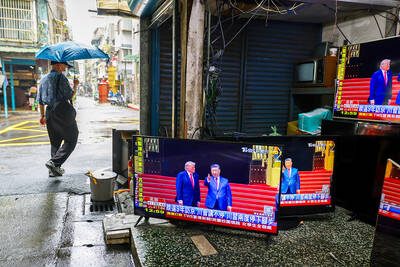
TAIWAN ISSUE: US treasury secretary Scott Bessent said on the first day of meetings that ‘it wouldn’t be a US-China summit without the Taiwan issue coming up’ There were no surprises on the first day of the summit between US President Donald Trump and Chinese President Xi Jinping (習近平), the Mainland Affairs Council (MAC) said yesterday, as the government reiterated that cross-strait stability is crucial to the Asia-Pacific region, as well as the world. As the two presidents met for a highly anticipated summit yesterday, Chinese state media reported that Xi warned Trump that missteps regarding Taiwan could push their two countries into “conflict.” Trump arrived in China with accolades for his host, calling Xi a “great leader” and “friend,” and extending an invitation to visit the White House
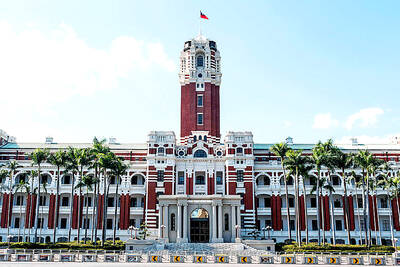
SECURITY: Taipei presses the US for arms supplies, saying the arms sales are not only a reflection of the US security commitment to Taiwan but also serve as a mutual deterrent against regional threats Taiwan is committed to preserving the cross-strait “status quo” and contributing to regional peace and stability, the Presidential Office said yesterday. “It is an undeniable fact that the Republic of China is a sovereign and independent democratic nation,” Presidential Office spokeswoman Karen Kuo (郭雅慧) reiterated, adding that Beijing has no right to claim sovereignty over Taiwan. The statements came after US President Donald Trump warned against Taiwanese independence. Trump wrapped up a state visit to Beijing on Friday, during which Chinese President Xi Jinping (習近平) had pressed him not to support Taiwan. Taiwan depends heavily on US security backing to deter China from carrying


 RSS
RSS