


Germany's only pay TV broadcaster, Premiere World, whose channels of hard and softcore pornographic films have come under fire from guardians of public morals, has announced a device which the company says forms "an effective and innovative" youth protection in digital television.
Regardless of such criticism, the loss-making Kirch Group's digital platform regards the popularity of sex programs as a locomotive to boost subscriptions and increase pay-per-view revenues.
A study, Youth Protection -- Practice and Acceptance carried out by Professor Bernd Schorb, of Leipzig University and Helga Theunert of the Institute for Media Pedagogical Research and Practice disclosed that 86 percent of Premiere World subscribers consider the technical locking device as "a useful youth protection instrument."
The authors of the study, commissioned by the ALM, a working committee of Germany's state media watchdogs, found to the delight of the Kirch Group that the device formed "a basis for youth protection in digital media."
Operated via the Munich group's d-box, the decoder required for reception of pay TV, the device blocks the transmission signal of the program unless unlocked by a PIN number, in theory known only to adults in the household.
The Munich group's Beta Research division developed the PIN coding system as one answer to the outcry against Premiere World's sex channels, Beate Uhse TV, and the pay-per-view "Blue Movie," classified as threats to young people's morals. According to Germany's state media contract, "real pornography" is banned on German television, without actually defining the term, leaving vast loopholes in media regulations.
In a first reaction from Premiere World, the platform's managing director Ferninard Kayser said "the study confirms our technical pathfinding role in youth protection questions. Through time slot blocking, we have instigated the most effective of all possible youth protection instruments."
At the same time, Kayser called for removal of all slot time programming restrictions for movies classified as youth threatening.
The state media treaty stipulates that such films cannot be shown for age groups 16 before 10pm or 18 before 11pm. But new regulations for pay TV now enable Premiere World to air such restricted films during day and prime time hours provided the set-top blocking device is used.
But in order for the preventative system to be effective, cooperation from the parents is needed to prevent children from discovering the PIN number, which the study said was usually the case. It revealed that a fifth of 14 and 15 age groups were able to operate pay TV, while 40 percent of 16-year-olds had the know-how.
Premiere World also has a separate PIN number for the pay-per-view code which can call up movies on eight channels of the platform.
State media authorities have ruled out any change in the programming slot restrictions for porno films, since the protection device alone is insufficient to protect young people from moral corruption, according to Norbert Schneider, chairman of the state media authority's Directors Conference.
Beate Uhse TV went on the air last March with a "high quality erotic" movie channel on media tycoon Leo Kirch's pay TV platform.
The program includes traditional erotic classics from the Beate Uhse company's video library of international soft and hardcore movies and product from its Swiss partner Erotik Media, which holds the TV rights to more than 3,000 films.
Beate Uhse TV took over the "Blue Channel" slot, which was put on pay-per-view for a DM20 viewing fee.
The death of Beate Rotermund, the company's owner, at the age of 81 last Monday, July 16, in a Zurich hospital, is not expected to affect Premiere World. The former World War II pilot in the German air force founded Beate Uhse AG using her maiden name after the war and built it up into Europe's largest sex shop retailer.
Her unexpected death, which the Flensburg-based company did not disclose until two days later, however did have ramifications regarding the company's shares listed on the Frankfurt exchange.
Market regulations require prompt disclosure of the death of any important company executive that could affect stock prices. In Beate Uhse AG's case, its shares dropped eight percent before her death was made public. The Federal Supervisory Office for Securities (BaWe) is reportedly investigating for possible illegal insider trading.

‘NO SECURITY RISK’: The Railway Bureau reassured the public that the technicians’ activities were limited to technical guidance and did not involve sensitive systems The Railway Bureau yesterday said it had invited eight Chinese technicians to assist with an airport MRT construction project. The bureau issued the confirmation after an Internet user said Chinese nationals had entered the construction zone of Taiwan Taoyuan International Airport’s Terminal 3 project. They asked why “individuals from an enemy state” were allowed access to such a major national infrastructure project, which raised serious concerns over Taiwan’s industrial safety, sensitive systems and information security. The bureau’s Northern Region Engineering Branch Office said subcontractor Taiwan Handle Industrial Co (台灣手把工業) of the Taoyuan airport MRT’s “Contract No. CU05 Project A14 Station Civil, MEP &

The National Chungshan Institute of Science and Technology yesterday showcased its locally developed variants of the Vision 60 robotic patrol dog, which it plans to deploy on the nation’s outlying territories in the South China Sea. The variants were produced under the Joint Lab project — created by the institute and domestic companies — and assembled with domestically produced motors, lenses and artificial intelligence (AI) systems alongside licensed tech from the US, Missile and Rocket Systems Research Division deputy director Jen Kuo-kang (任國光) told the media event at a military base in Taipei’s Dazhi (大直) area. Taiwan has built up its strengths
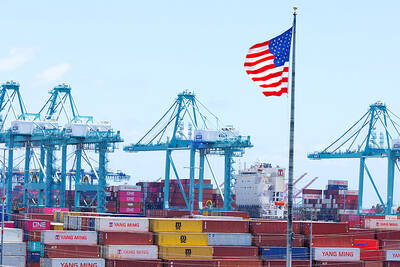
NOT IMMEDIATE: Taiwan has a chance to appeal the proposed 10 percent tariff before it starts, while other countries face a 12.5 percent tariff from the trade office Taiwan is among 60 economies determined by the US to have failed to impose or enforce a ban on the importation of goods produced with forced labor, according to a notice released on Tuesday by the Office of the US Trade Representative (USTR), which proposed imposing an additional 10 percent or more tariff on them. The USTR in a statement said that following an investigation, it had determined under Section 301 of the Trade Act of 1974 that the failure of the 60 economies to impose and effectively enforce a prohibition on the importation of goods produced with forced labor is
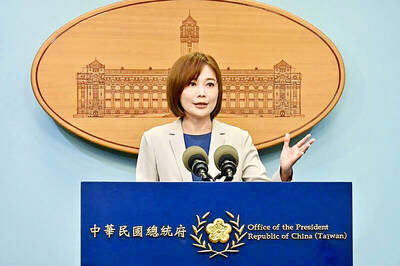
TIT-FOR-TAT: The US allegedly revoked the visa of a Chinese national working at Xinhua News Agency in the US in response to Beijing’s expulsion of Vivian Wang The Presidential Office yesterday condemned China for expelling a New York Times correspondent from Beijing following the newspaper’s interview with President William Lai (賴清德), saying the move highlighted Beijing’s suppression of press freedom and its threat to international news media. Taiwan has noted a series of recent incidents in which Beijing used similar tactics to “threaten and pressure international media outlets and journalists,” Presidential Office spokeswoman Karen Kuo (郭雅慧) said in a statement. “This concerns not only press freedom and freedom of expression, but also the safety of journalists, and Taiwan and relevant partners are paying close attention to the situation,” she


 RSS
RSS