

Shares in Taiwan plunged 3.2 percent yesterday, extending their losing streak to six consecutive sessions as concerns over the outlook for US artificial intelligence (AI) investment and technology regulation fueled another wave of selling in global semiconductor stocks.
The benchmark TAIEX fell 1,374.19 points to close at 41,574.72, on turnover of NT$926.024 billion (US$28.17 billion), Taiwan Stock Exchange (TWSE) data showed.
The TAIEX tends to take its cues from US technology stocks, leaving it vulnerable to spillover from Wall Street volatility. Overnight, the Philadelphia Semiconductor Index fell 3.13 percent.
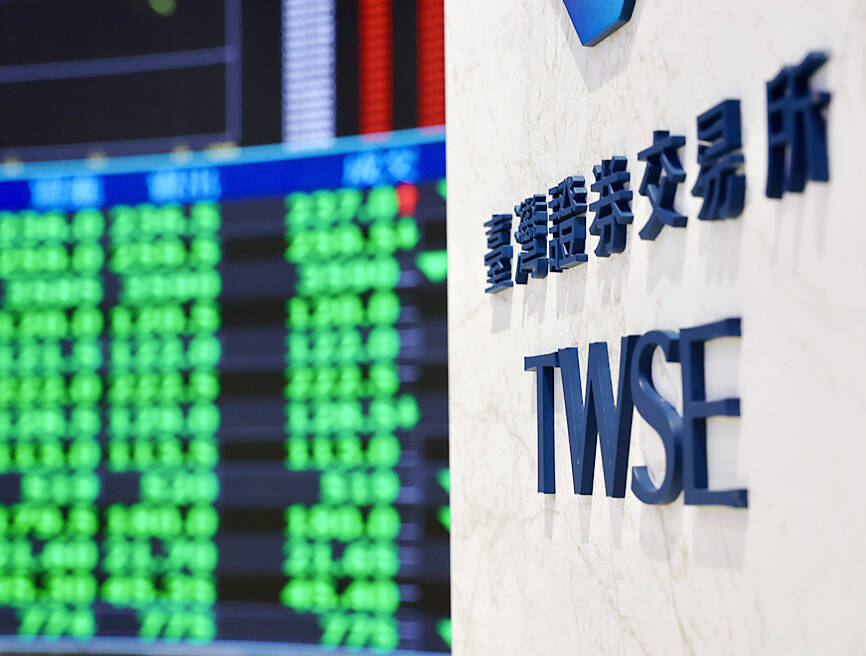
Photo: CNA
Investors are reassessing the outlook for AI infrastructure investment following the US midterm elections on Tuesday, amid concerns that shifts in technology policy and regulatory priorities could slow the industry’s expansion, UOB Asset Management Taiwan Co (大華銀投信) fund manager Kuo Hsiu-cheng (郭修誠) said.
Investors are also concerned that incoming US state governments could slow data center construction through tighter environmental reviews and regulatory requirements, Kuo said.
Taiwan is vulnerable to such concerns because of its central role in the global AI supply chain, which spans wafer foundries, advanced manufacturing processes, advanced packaging, AI servers and high-speed transmission technologies.
However, the AI industry’s golden era is only beginning, Kuo said, cautioning against interpreting recent market turbulence as the end of its longer-term growth prospects.
Foreign institutional investors sold a net NT$102.46 billion in Taiwanese shares yesterday, while proprietary dealers recorded net sales of NT$43.53 billion.
Domestic investment trusts bought a net NT$22.532 billion.
The TWSE said Taiwanese shares had shown greater resilience than several other major markets during the recent global selloff.
The TAIEX had fallen 13.8 percent as of Wednesday from a recent high compared with a 29.83 percent decline in the Philadelphia Semiconductor Index and a 37.64 percent drop in South Korea’s KOSPI, the exchange said.
Japan’s Nikkei 225 and Hong Kong’s Hang Seng Index have declined 14.06 percent and 14.48 percent respectively, it added.
Still, Fubon Securities Investment Services Co (富邦投顧) cautioned investors against rushing to buy the dip, warning that market volatility could remain elevated as global investors navigate multiple uncertainties.
The market turmoil has spilled over into the foreign-exchange market, with the New Taiwan dollar losing NT$0.398 against the US dollar in just four trading sessions this month and approaching the NT$33 mark. It closed at NT$32.876 against the greenback in Taipei trading yesterday.
Foreign-exchange traders said continued foreign fund outflows were likely to keep the local currency under pressure.
Expectations of further US interest-rate hikes and renewed uncertainty surrounding the conflict in the Middle East have also supported the US dollar, adding pressure on the NT dollar, traders said.

‘ON SCHEDULE’: Chief executive officer Rick Tsai said that TSMC ‘remains our most important partner’ as MediaTek seeks to meet robust customer demand Chip designer MediaTek Inc (聯發科) yesterday said it has secured a second customer for its customized artificial intelligence (AI) accelerator for data centers, while volume production of a second-generation chip for an existing customer is on track for early 2028, potentially easing market concerns about possible delays. This is a new customer and, crucially, not from China, MediaTek said. The remarks were meant to dismiss speculation that ByteDance Ltd (字節跳動), the parent company of TikTok, was the second customer for MediaTek’s new customized AI application-specific integrated circuit (ASIC) business. “It is on track, on schedule. We understand there is some noise about the

SPILLOVER: With foreign capital continuing to leave the market, traders expect the NT dollar, which fell NT$0.168, to face further depreciation pressure, an analyst said Taiwanese stocks yesterday plunged 3.59 percent, with the TAIEX recording its seventh-largest single-day point loss, while the New Taiwan dollar slid to a more than 18-month low against the US dollar, as a global technology sell-off and accelerating foreign fund withdrawals battered local financial markets. The benchmark TAIEX fell 1,612.6 points to close at 43,307.54, with turnover reaching NT$928.058 billion (US$28.33 billion) and more than 1,000 listed stocks declining. Concerns over returns on massive artificial intelligence (AI) investments have triggered a global retreat from technology shares, particularly US chipmakers, while uncertainty surrounding US midterm elections has added to investor caution. In Asia, the

US chipmaking giant Nvidia is ordering its data center partners to scale back work with Chinese customers, the Financial Times reported yesterday. Nvidia’s cloud computing customers must sell at least 51 percent of their services to non-Chinese companies, the FT reported, citing five people with knowledge of the matter. The new rules only affect future contracts and not existing agreements, the report said. Nvidia neither confirmed nor denied the report, but said in a statement that “datacenters and clouds built on American chips are the foundation that American model and application makers need to compete worldwide.” “Longstanding US policy encourages every cloud to build
OUTLOOK: Tech stocks worldwide have come under selling pressure ever since last month, and Taiwan’s stock market is not expected to be spared, an analyst said The TAIEX is expected to face heavy downward pressure today after American depositary receipts of contract chipmaker Taiwan Semiconductor Manufacturing Co (TSMC, 台積電) on Friday plunged 5.95 percent, tracking a broader sell-off in US tech stocks on Wall Street amid concerns over massive artificial intelligence (AI) spending. Disappointing sales at some US technology companies spurred the worst drop for stocks since June, with the tech-heavy NASDAQ Composite Index falling 2.86 percent on Friday, while the Philadelphia Semiconductor Index plunged 7.20 percent and the S&P 500 fell 1.8 percent, breaching its 100-day moving average. Chipmaker Intel Corp and social media firm


 RSS