

The TAIEX is expected to face heavy downward pressure today after American depositary receipts of contract chipmaker Taiwan Semiconductor Manufacturing Co (TSMC, 台積電) on Friday plunged 5.95 percent, tracking a broader sell-off in US tech stocks on Wall Street amid concerns over massive artificial intelligence (AI) spending.
Disappointing sales at some US technology companies spurred the worst drop for stocks since June, with the tech-heavy NASDAQ Composite Index falling 2.86 percent on Friday, while the Philadelphia Semiconductor Index plunged 7.20 percent and the S&P 500 fell 1.8 percent, breaching its 100-day moving average.
Chipmaker Intel Corp and social media firm Reddit Inc fell 29 percent and Sandisk Corp, a chipmaker that has been one of the great beneficiaries of the AI capital-spending boom, dropped 13 percent.
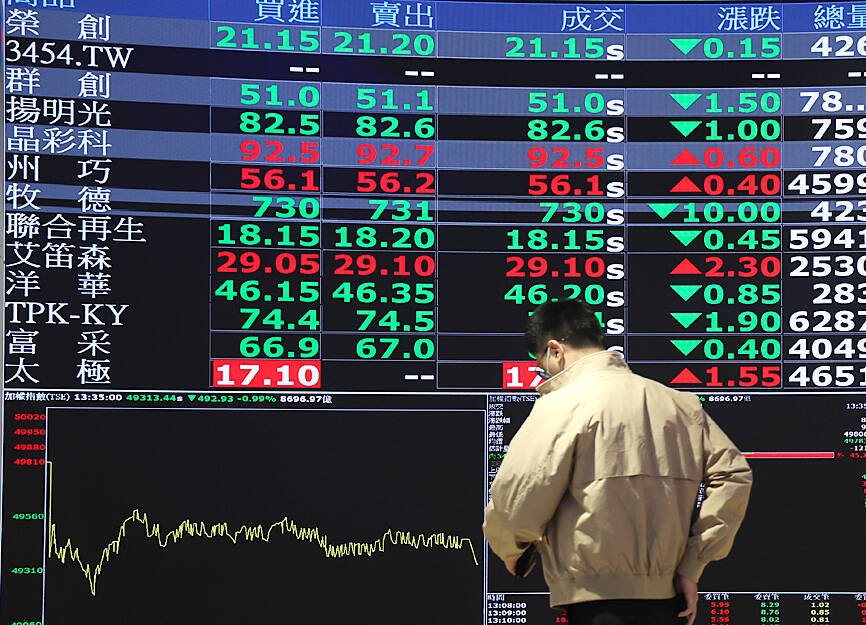
Photo: CNA
Market sentiment remained clouded by concerns over heavy AI spending and growing fears that major cloud service providers might struggle to generate comfortable sales from their massive investments in AI infrastructure, Taishin Securities Investment Advisory Co (台新投顧) chief strategy officer Tony Huang (黃文清) said on Saturday.
Tech stocks worldwide have come under heavy selling pressure since the beginning of last month, and Taiwan’s stock market is unlikely to be spared, particularly as large-cap electronics stocks such as TSMC have been targeted by investors, Huang said.
On Friday, the TAIEX plunged 1,156.50 points, or 2.49 percent, to close at 45,211.83, breaking below the key technical support level of about 45,300 points, which coincides with its 120-day moving average, leaving the benchmark index technically more vulnerable.
Following the latest sell-off in the US market, TAIEX futures also came under pressure, falling 867 points, or 1.91 percent, to 44,433 on Friday, while TSMC futures lost 3.66 percent.
However, the TAIEX appeared relatively resilient compared with the Philadelphia Semiconductor Index and the South Korean market, where memory suppliers such as Samsung Electronics Co and SK Hynix Inc account for a significant share of market activity, Huang said.
More importantly, AI development has not slowed, as major cloud service providers Meta Platforms Inc, Alphabet Inc, Amazon.com Inc and Microsoft Corp have maintained their commitments to substantial spending on AI infrastructure, he said.
Taiwan Stock Exchange’s statistics showed that foreign institutional investors were largely net sellers of Taiwanese shares last month, recording net sales of NT$994.3 billion (US$30.61 billion), by reducing their holdings in major tech stocks such as TSMC, chip designer MediaTek Inc (聯發科) and power management solutions provider Delta Electronics Inc (台達電).
Global markets face additional uncertainty from the upcoming US midterm elections tomorrow and a planned initial public offering by AI safety and research company Anthropic PBC later this month, factors that have prompted large funds to pull money out of Asian markets, analysts said.
Investors would be watching whether the TAIEX will hold above Friday’s intraday low of 44,726 points or record further losses, they added.
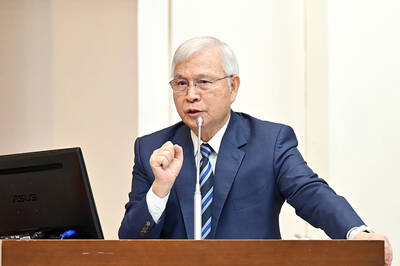
RESERVES ADEQUATE: The central bank governor rejected claims that Taiwan was facing a cash shortage, saying that its financial system had ample savings The New Taiwan dollar’s 3 percent fall this year despite record exports and a widening trade surplus stems from foreign investors cashing in on the local stock market’s technology-driven rally and moving funds overseas, central bank Governor Yang Chin-long (楊金龍) told lawmakers yesterday. The NT dollar has become one of Asia’s weakest-performing major currencies this year. Foreign investors have reaped substantial gains from Taiwan’s surging stock market, prompting them to sell shares and rebalance their portfolios, Yang told a meeting of the legislature’s Finance Committee in Taipei. Their withdrawals have added to downward pressure on the NT dollar, offsetting support

The artificial intelligence (AI) supercycle should last for more than two decades, former Intel Corp chief executive officer Pat Gelsinger told an event in Taipei yesterday, dismissing fears of an AI bubble amid mounting skepticism over massive infrastructure investments. “We do see that there will be periods of disruption, correction, etc. So, we do not think of it as an AI bubble,” Gelsinger, who is a general partner at Playground Global LLC, said at the US venture capital firm’s second annual Taiwan Deep Tech Summit. However, “we’ll have some speed bumps as different areas and different technology disruptions occur along it,” Gelsinger

Chinese automakers outsold Japanese rivals in Europe for the first time over a full quarter, underscoring how quickly brands like BYD Co (比亞迪) and Chery Automobile Co (奇瑞汽車) are gaining ground in the region. Registrations of Chinese-branded cars roughly doubled from a year earlier in the three months through September to make up 12.7 percent of total sales across the region, led by hybrids, according to market researcher Dataforce. That has put them ahead of Japanese manufacturers, including Toyota Motor Corp, at 11.9 percent. The advance accelerated at the end of the quarter. Chinese brands’ European share jumped to a record 14.5

A US cruise ship on an around-the-world voyage that touted its cabins as floating homes suspended its three-year journey in Cambodia due to fuel costs, forcing hundreds of passengers to disembark. The MV Odyssey set sail two years ago on a voyage to the seven continents marketed as combining long-term living at sea with global travel. Its operator had offered to “make the Odyssey your permanent home,” with the purchase price of a suite for the lifetime of the vessel starting at about US$230,000. For now, it is docked at the Cambodian port of Sihanoukville on the Gulf of Thailand, with no


 RSS