

A US cruise ship on an around-the-world voyage that touted its cabins as floating homes suspended its three-year journey in Cambodia due to fuel costs, forcing hundreds of passengers to disembark.
The MV Odyssey set sail two years ago on a voyage to the seven continents marketed as combining long-term living at sea with global travel. Its operator had offered to “make the Odyssey your permanent home,” with the purchase price of a suite for the lifetime of the vessel starting at about US$230,000.
For now, it is docked at the Cambodian port of Sihanoukville on the Gulf of Thailand, with no certain departure date.
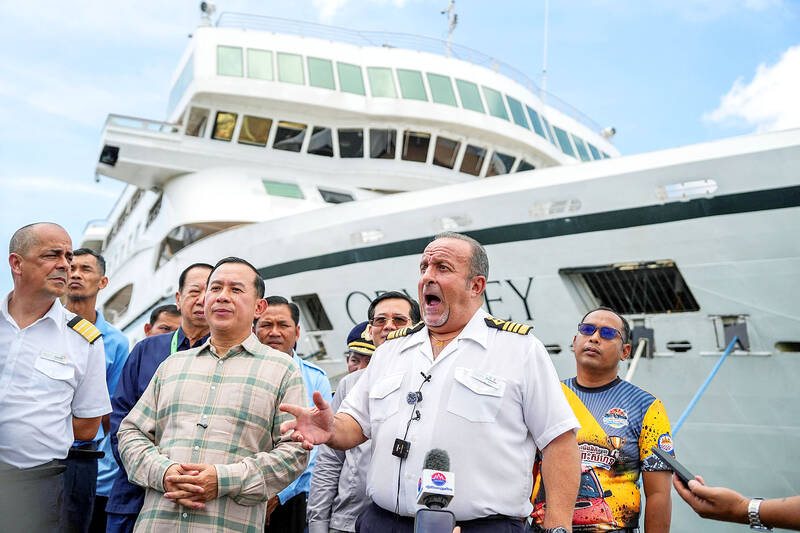
Photo: Reuters
The ship has been carrying 203 passengers, mostly Americans, along with 156 crew members, according to Cambodian officials.
It has a 650-passenger capacity.
Its Florida-based operator, Villa Vie Residences, said monthly fuel expenses per cabin that historically averaged US$1,800 have reached an estimated US$6,000 to US$8,000 in parts of Asia due to the war in Iran.
The company said it sought to reduce fuel consumption by slowing the itinerary and spending more time in port, but was unable to offset the surging costs.
Traffic has been curtailed in the Strait of Hormuz since the war in Iran began, squeezing supplies of all kinds of petroleum-based fuels, especially in Southeast Asia, and sharply increasing prices.
“We have been unable to continue carrying the resulting operating losses,” Villa Vie Residences said in a statement on Tuesday. “Passing the full increase on to residents is not a realistic solution. Our focus now is on supporting residents, crew, and employees” while it tries to restructure.
“The company is working with residents to coordinate disembarkation and identify temporary living arrangements,” it said.
However, some passengers said they received no support and had to make their own arrangements after being given seven hours notice on Tuesday to disembark. Some were devastated and expressed hope a new company could rescue the venture so life at sea can continue.
Paul and Lynn Montoya, a retired couple from Wyoming, said they bought a window cabin and had expected to sail for years. They boarded the ship 17 months ago in Panama.
Paul praised the concept of residential cruising, but said the shipowner lacked the expertise to make the business financially sustainable.
While rising fuel costs had been cited publicly as the reason for the suspension, he said the company had already been struggling.
Changes to the itinerary, unreliable Internet access and declining food quality had pushed many residents to leave the ship in the past few months, he said.
Lynn said that residents were repeatedly asked to contribute additional money for fuel and other expenses, including a fresh call to raise funds for fuel to get out of Cambodia.
She said the crew members were also not paid.
“We were tired of every two to four weeks being asked for money for fuel, money for everything,” she said.
“We had hopes, but they just kept sinking further and further into the hole through mismanagement,” she added.
The company could not immediately be contacted for comment.
Yet for some, even the financial and logistical turmoil could not outweigh the extraordinary experience of traveling the world and living at sea.
Carol Larson, 69, and her sister Crystal Lavering, 72, occupied separate cabins aboard the ship for 18 months. The siblings, from California, described the suspension as heartbreaking, and hoped the cruise would be resuscitated.
“I hope there is a movement for the residents to buy the ship and I am hoping that goes through because it’s a dream to live on the ship and I don’t want it to end,” Larson said.
Lavering said her health improved during her time on the ship and that she did not need to use a cane to walk anymore.
“You come to this ship to live ... it’s just sad that it’s all over,” she said.
Larson bought her cabin for US$120,000, paid in installments, in addition to monthly maintenance fees, under a plan that had promised the possibility of living aboard for up to 15 years.
She blamed US President Donald Trump for the ship’s woes as fuel costs spiked due to the Iran war, in addition to poor management.
However, she said she did not regret her investment.
“Because it was a start-up company, I believe that it was a risk. From the very first day, I said to myself that if it lasts a year, I can walk away and feel like I got my money’s worth... I still feel that way. I feel blessed to have been part of the experiment of residential cruising,” she said.
The ship arrived in Sihanoukville on Oct. 23 and was scheduled to depart on Wednesday, according to a statement from Long Dimanche, the deputy governor of Preah Sihanouk.
The ship’s operator has not yet publicly confirmed any date of departure.
Built in 1993 and operated under different names by several cruise lines before being becalmed by the COVID-19 pandemic in 2020, the Odyssey was bought by Villa Vie Residences in 2023.
Its current cruise, originally intended to last three-and-a-half years, began in October 2024 in Belfast, where the ship had been refitted. A second cruise had been tentatively scheduled to end in August 2030.
The Odyssey is not the first cruise ship Sihanoukville has hosted in crisis.
In February 2020, the MS Westerdam was allowed to dock in Cambodia after being turned away at five ports in other nations because of fears of COVID-19, which just a month earlier had started to spread from China.
It carried 1,455 passengers, more than 600 of them US citizens.
After being stranded at sea for two weeks, then-Cambodian prime minister Hun Sen allowed it to dock for what he said were humanitarian reasons.
Cambodia won plaudits as passengers were welcomed ashore and arrangements were made for them to fly home.

The US Department of the Treasury proposed a rule on Thursday to crack down on US high-tech investments such as supercomputing and artificial intelligence (AI) in China, Russia, North Korea and other “countries of concern.” The US government has been working for years to deny China and other adversaries investments that could help them boost their military power. That program began in 2023 when then-US president Joe Biden signed an executive order putting restrictions on outbound US investments in sectors such as semiconductors, quantum computing and AI going into China. The Treasury later established the Outbound Investment Security Program. In December last year,

Softbank Group Corp chief executive officer Masayoshi Son chose locations in Malaysia for US$50 billion in technology investments, Malaysian Prime Minister Anwar Ibrahim said, an outlay that would accelerate the billionaire’s global bet on artificial intelligence (AI) infrastructure. Anwar said he had a videoconference with Son on Tuesday, during which the Japanese tech investor said he had picked regions in the Southeast Asian country for projects including data centers. “He said he had chosen Sarawak — Kuching — and Peninsular Malaysia to expand investment in what would be among the largest investments in the region, worth US$50 billion,” Anwar said in a

The artificial intelligence (AI) supercycle should last for more than two decades, former Intel Corp chief executive officer Pat Gelsinger told an event in Taipei yesterday, dismissing fears of an AI bubble amid mounting skepticism over massive infrastructure investments. “We do see that there will be periods of disruption, correction, etc. So, we do not think of it as an AI bubble,” Gelsinger, who is a general partner at Playground Global LLC, said at the US venture capital firm’s second annual Taiwan Deep Tech Summit. However, “we’ll have some speed bumps as different areas and different technology disruptions occur along it,” Gelsinger
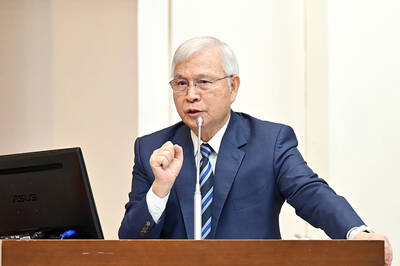
RESERVES ADEQUATE: The central bank governor rejected claims that Taiwan was facing a cash shortage, saying that its financial system had ample savings The New Taiwan dollar’s 3 percent fall this year despite record exports and a widening trade surplus stems from foreign investors cashing in on the local stock market’s technology-driven rally and moving funds overseas, central bank Governor Yang Chin-long (楊金龍) told lawmakers yesterday. The NT dollar has become one of Asia’s weakest-performing major currencies this year. Foreign investors have reaped substantial gains from Taiwan’s surging stock market, prompting them to sell shares and rebalance their portfolios, Yang told a meeting of the legislature’s Finance Committee in Taipei. Their withdrawals have added to downward pressure on the NT dollar, offsetting support


 RSS