

The US is expected to hold off announcing new tariffs on China and other trading partners until after next week’s summit between Chinese President Xi Jinping (習近平) and US President Donald Trump, according to people familiar with the matter, a delay that could preserve such a threat as leverage in the negotiations.
While the reason for the postponement is unclear, Trump has repeatedly used tariff warnings to press trading partners for concessions. The administration had intended to release a trade report on alleged excess capacity before the meeting that would recommend a 7.5 percent tariff on Chinese goods, Bloomberg previously reported.
It is also uncertain whether the final tariff rate would change from the previously expected level, which would restore Trump’s second-term duties on China to about 20 percent, which Beijing has previously said is consistent with its trade truce with Washington.
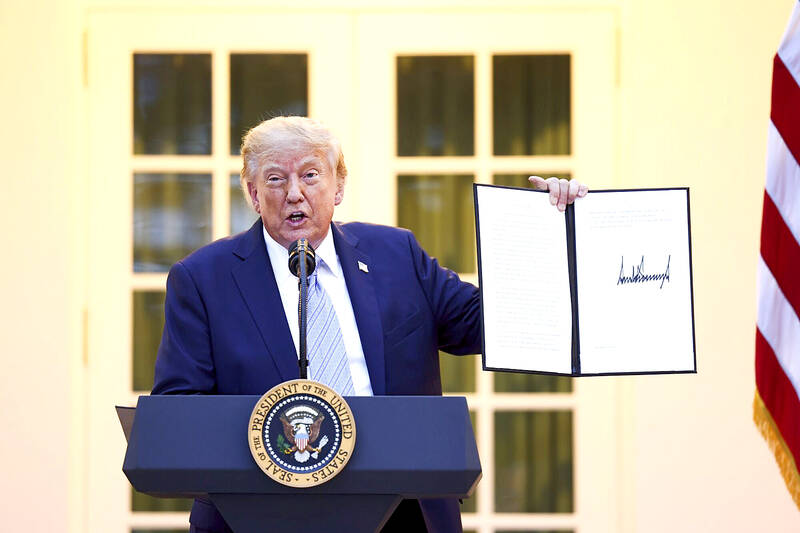
Photo: Bloomberg
US and Chinese negotiators are set to meet over the weekend to discuss any agreements ahead of Xi’s state visit. The trip would be Xi’s first to the US since 2023, when he met former president Joe Biden during a visit that included attending the APEC summit in San Francisco.
In March, the Trump administration launched an investigation into more than a dozen major trading partners under Section 301 of the Trade Act of 1974 over excess capacity concerns. Those expected levies, along with already-implemented duties related to forced labor, are set to eventually bring rates closer to Trump’s country-specific tariffs that were overturned by the Supreme Court earlier this year.
The Office of the US Trade Representative and the White House did not respond to requests for comment. Inside US Trade first reported the delay.
China has previously signaled that it could take action if US tariffs exceed prevailing levels when the trade truce was struck.
“Capacity issues should be viewed in a comprehensive and fair manner, and should not be used as a pretext for protectionism,” Huang Ling, a spokesperson for China’s Ministry of Commerce, said late last month. “We will continue to closely follow and comprehensively assess subsequent US moves, and reserve the right to take all necessary measures.”
“A key question for the US team is how much it might be willing and able to leverage tariff threats to push China for stronger import and export commitments. Chinese exporters’ resilience to Washington’s hefty tariffs through 2025 is likely to blunt that leverage,” economist Nicole Gorton-Caratelli said.
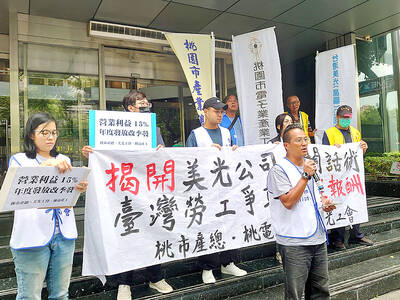
UNION DETERMINATION: Rejecting an offer for a one-time payout as an attempt to influence opinion, the union said a strike at the memory chip manufacturer is possible The Micron Taiwan workers’ union yesterday rejected a one-time payout unveiled by US-based Micron Technology Inc last week, saying it wants a long-term mechanism under which employees would share 15 percent of the company’s operating profits. While the union and the company are still in talks over the dispute, the reward package was proposed unilaterally by the employer without reaching an agreement with the union, union head Jerry Lin (林哲瑞) told reporters. Lin said he suspected the company was seeking to influence public opinion with the move. On Friday last week, Micron announced a reward package under which employees in Taiwan would receive
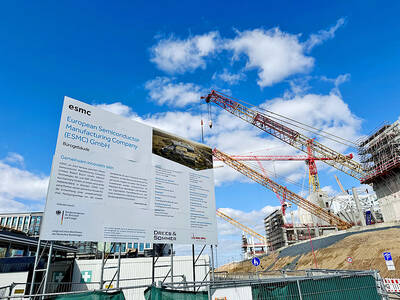
BUILDER’s RITES: The topping out ceremony is held when a project being built has its highest point laid out, a sure sign that TSMC’s European project is making solid progress A “topping out” ceremony was held on Monday at a plant under construction in Germany by Taiwan Semiconductor Manufacturing Co (TSMC, 台積電), indicating that the fab is progressing as planned and within budget, the head of a joint-venture company in charge of the project said. A topping out ceremony is the construction milestone of laying the final beam or structural piece at the highest point of a building, and it honors the construction crew, architects and engineers. European Semiconductor Manufacturing Co (ESMC) president Christian Koitzsch said that about 2,000 workers from 106 countries are working around the clock at the site in

SOME CUSHION: Taiwan’s GDP is forecast to grow more than 11 percent this year, so the economy should be able to absorb the impact of a rate hike, an expert said With domestic inflation topping the 2 percent alert level for a fourth consecutive month last month and several major central banks around the world raising their key interest rates, Taiwan’s central bank is facing growing pressure to raise rates at its quarterly policymaking meeting on Thursday, economists said. At its June meeting, the central bank left interest rates unchanged for the ninth consecutive quarter, with the discount rate at 2 percent. Central Bank Governor Yang Chin-long (楊金龍) had said that the bank maintained a somewhat hawkish stance, with two board directors voicing support for a rate hike at the meeting. Cathay United

APPEAL: Any agreement to produce advanced memory such as HBM or DRAM could run into opposition from Seoul as those technologies are sensitive, sources said South Korea’s SK Hynix Inc is in talks with Intel Corp about a deal that would see it manufacture memory chips on US soil for the first time, three people familiar with the discussions said. Under one potential scenario, SK Hynix would lease part of Intel’s long-planned chipmaking facility in Ohio, they said. Under another scenario, it could form a venture with Intel and major cloud firms that are keen to lock in memory supplies, two of the people said. A deal would relieve pressure on Intel, which has been struggling, and mark a big win for US President Donald


 RSS
RSS