

With domestic inflation topping the 2 percent alert level for a fourth consecutive month last month and several major central banks around the world raising their key interest rates, Taiwan’s central bank is facing growing pressure to raise rates at its quarterly policymaking meeting on Thursday, economists said.
At its June meeting, the central bank left interest rates unchanged for the ninth consecutive quarter, with the discount rate at 2 percent.
Central Bank Governor Yang Chin-long (楊金龍) had said that the bank maintained a somewhat hawkish stance, with two board directors voicing support for a rate hike at the meeting.
Photo: Tyrone Siu, Reuters
Cathay United Bank Co (國泰世華銀行) chief economist Lin Chi-chao (林啟超) last week said that the central bank had forecast in June that the consumer price index (CPI) would rise by less than 2 percent this year.
However, the situation has since changed, as international crude oil prices have risen amid escalating tensions in the Middle East, he said.
“Inflationary pressure has been on the rise,” Lin said, citing a forecast by the Directorate-General of Budget, Accounting and Statistics last month that CPI would increase 2.07 percent this year.
The central bank must also take into account the monetary policy moves of other major central banks when deciding whether to adjust interest rates, he said.
The Bank of Korea hiked its benchmark interest rates for a second consecutive time last month to 3 percent, Lin said.
The European Central Bank raised its key interest rates by 25 basis points last week, marking its second rate hike this year, he said, adding that there was a high possibility that the Bank of Japan would raise rates this week.
More importantly, the US Federal Reserve could raise rates this week, with the odds rising to nearly 90 percent after last month’s CPI data showed persistent inflationary pressure, Lin said.
“Whether considering domestic conditions or the international situation, the interest rate hike checklist has been fully checked,” Lin added.
With GDP growth forecast to top 11 percent this year, the economy is expected to be able to absorb the impact of a rate hike, Lin said.
Taiwan Institute of Economic Research Economic Forecasting Center director Gordon Sun (孫明德) said he expects the Fed to raise rates this week, which could serve as an indication for Taiwan’s central bank to follow suit.
If Taiwan’s rates remain unchanged, there would be a wider interest rate spread between Taiwan and the US, which is an important factor to consider, Sun said.
A central bank rate hike would not primarily be aimed at curbing inflation, but at addressing tightening liquidity in the local market, Sun added.
Fund demand has increased as companies step up investments amid the artificial intelligence (AI) boom, while high-flying stocks have boosted demand for funds, further tightening liquidity, he said.
Tight liquidity has pushed up market interest rates, so the central bank needs to respond by raising its key interest rates, he added.
However, Sun also raised concerns about a rate hike, saying Taiwan’s strong economic growth is largely driven by AI development, while the traditional economy has lagged behind, so higher interest rates could place a heavier financial burden on traditional industries.
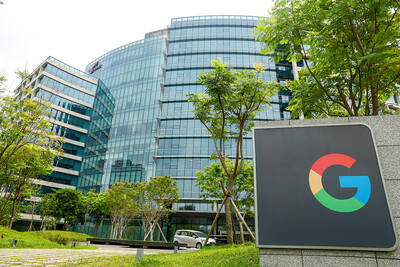
READJUSTMENT? Despite the rumors, a senior Google official said that the company plans to expand its AI research center in Taipei’s Shilin District Google Taiwan is reducing its workforce as the company continues to adjust operations to improve efficiency and focus resources on core goals, the Chinese-language Liberty Times (sister paper of the Taipei Times) reported yesterday. The Alphabet Inc unit said the organizational adjustments have begun and would continue, even though it did not put a figure on the number of potential job cuts or specify the affected departments in its Taiwan operations. The company’s response came after rumors circulated on social media about major job cuts at Google Taiwan. Some posts said the downsizing would target the company’s consumer electronics-related departments
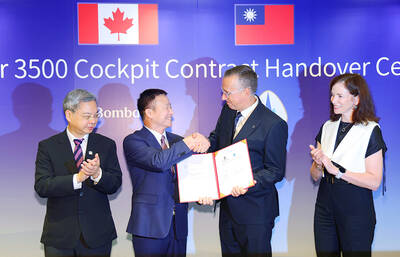
Taiwanese aircraft maker Aerospace Industrial Development Corp (AIDC, 漢翔航空) yesterday announced that it has secured a 20-year partnership agreement with Canada-based Bombardier Inc. The two companies held a ceremony in Taipei yesterday to exchange signed copies of the agreement, launching the 20-year partnership under which AIDC would supply cockpit and forward fuselage structural components for Bombardier’s super-midsize Challenger 3500 business jets, the Taiwanese company said. The agreement represents a new milestone in cooperation between the two companies, which dates back to 1999, with the Taiwanese supplier having provided rear fuselage structural components for more than 1,000 Challenger 3500 aircraft, it
FOUNDRY DATA: Demand pushed production on some TSMC lines to full utilization, while Samsung’s market share of 5.9 percent dropped, TrendForce said Taiwan Semiconductor Manufacturing Co’s (TSMC, 台積電) foundry market share edged up to 72.5 percent in the second quarter from 72.3 percent in the previous quarter, propelled by robust artificial intelligence (AI) and smartphone chip revenue, data compiled by market researcher TrendForce Corp (集邦科技) showed yesterday. TSMC’s revenue last quarter grew 12 percent sequentially to US$40.2 billion, outpacing the 11.5 percent average growth among the world’s top 10 foundry companies, the researcher said. Combined revenue of the top 10 is expected to grow further this quarter from US$53.49 billion last quarter, supported by strong demand and price hikes, it said. The increased demand has

Global notebook computer shipments are expected to fall 8 percent year-on-year to 167.9 million units this year, dragged by weak demand, high component prices and supply constraints, the Market Intelligence and Consulting Institute (MIC) said on Tuesday. Next year, shipments are expected to decline by a further 4.7 percent to 160 million units as higher retail prices weigh on consumption, MIC deputy director-general Edward Lin (林柏齊) told a news conference in Taipei. The downtrend is expected to extend into 2028, with replacement demand unlikely to recover before supplies of key components rebound and costs decline, Lin said. Surging demand for artificial intelligence (AI)


 RSS
RSS