


Electronics contract maker Wistron Corp (緯創) on Wednesday reported record second-quarter revenue of NT$895.44 billion (US$27.83 billion), up 62.4 percent from a year earlier, driven by strong artificial intelligence (AI) server shipments.
First-half revenue surged 94.1 percent year-on-year to a record NT$1.74 trillion, company data showed.
AI server revenue is expected to grow sequentially this quarter and continue rising throughout the rest of the year, a Wistron representative told the Taipei Times by telephone.
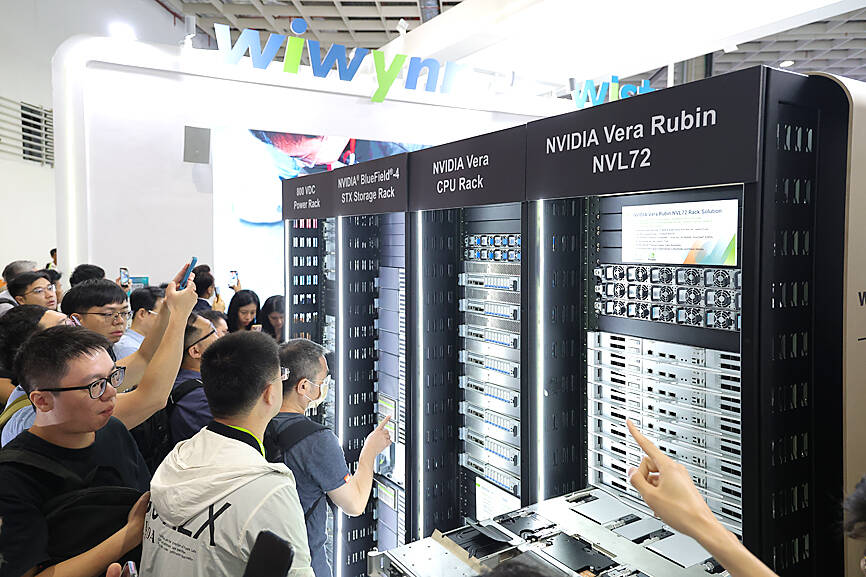
Photo: CNA
AI servers accounted for about 70 percent of Wistron’s revenue in the first two months of this year, the company said in March.
Wistron did not provide detailed AI server shipment data and guidance, but it said that general-purpose server revenue would grow by double-digit percentages annually and sequentially throughout the rest of the year.
Notebook computers are expected to decline this quarter from last quarter, as tight DRAM chip supply has pushed up production costs and notebook retail prices, weighing on end-market demand, the representative said.
Notebook computer shipments contracted 9.84 percent quarterly to 5.5 million units last quarter. Desktop computers and display shipments respectively dropped 6.4 and 3.6 percent sequentially to 2.2 million units and 2.85 million units last quarter.
Desktop computers and display shipments are expected to remain flat from the previous quarter, Wistron said.
Separately, Inventec Corp (英業達) reported second-quarter revenue of NT$269.87 billion, up 44.65 percent from a year earlier, driven by strong AI server demand.
Customers front-loaded AI server orders in the first half of the year, resulting in better-than-expected performances in the first and second quarters, an Inventec representative told the Taipei Times by telephone.
Inventec said it is optimistic about server demand outlook this quarter in expectation of a quarterly growth in shipments throughout the year, they said.
However, actual shipments would depend on the availability of key components, Inventec said.
The company expects AI server revenue contribution to make up more than 50 percent of the company’s total revenue this year, compared with more than 40 percent last year, it said.
Inventec mainly assembles AI servers powered by Nvidia Corp’s B300 platform, but it also ships servers running on application-specific integrated circuits as well as non-AI, or general-purpose, servers, it said.
Shipments of Nvidia Corp’s next-generation Vera Rubin server platform are expected to begin in small volumes next quarter, the Inventec representative said.
Inventec shipped 5.4 million notebook computers last quarter, flat from the previous quarter, exceeding the company’s guidance in April, as customers brought forward orders to minimize increases in key component prices, they said.
Inventec expects notebook shipments to decline by a high single-digit percentage this quarter from last quarter, as demand normalizes after customers front-loaded purchases in the first half of the year, they said.
The company has a relatively conservative outlook for notebook shipments in the second half, they added.

Their metallic frames covered in supple, lifelike skin, a posse of new Chinese robots meant for companionship can offer users artificial intelligence (AI)-generated conversation or a hand to hold, complete with manicured nails. The company UBTech says its U1 robot — equipped with eye cameras, chest sensors and listening microphones — is the world’s first full-sized, ultra-realistic humanoid designed for mass production. Touted as an antidote to loneliness, the robots are priced at 119,800 yuan (US$17,600) for the most basic type and 990,000 yuan (US$145,700) for an “ultra” version with more advanced features. “Our bionic robots can accompany you for a lifetime,” Michael
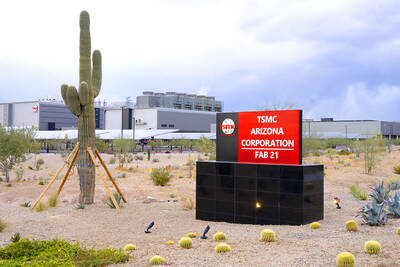
A growing nationwide shortage of high-skilled workers threatens to delay construction of billions of dollars in new semiconductor plants across the US and constrain future chip production unless the industry pools resources and the government keeps up funding, a new report said. The deficit is expected to be most acute in states such as Texas, California, Arizona, New York and Ohio, where many of the new facilities are being planned, according to new analysis including a survey of employers from McKinsey & Co, the chip industry group SEMI and the National Science Foundation. Altogether, the skilled labor deficit is projected to

Chinese start-up DeepSeek (深度求索) is developing its own artificial intelligence (AI) chip, according to three people familiar with the matter, a push that could reduce its reliance on Nvidia Corp and Huawei Technologies Co (華為) chips, which it has depended on to train and run its globally popular models. The chip is designed for inference — the stage of AI computing in which a trained model generates responses for users — rather than for training new models, the sources said. If successful, DeepSeek’s expansion into semiconductor development would mark a major strategic shift for a company widely hailed in China as the

SK Hynix Inc is considering paying about 0.5 percent of the proceeds from its US listing — one of the largest share sales ever — to banks working on the deal, people familiar with the matter said. While SK Hynix has indicated it would issue as much as 2.5 percent of its total shares, the final deal size — which would determine the fee amount — is not yet set, the people said. The company might also choose to pay discretionary incentives on top of the base fee, they said. Based on the company’s latest market capitalization of about US$1.1 trillion,


 RSS
RSS