


SK Hynix Inc is considering paying about 0.5 percent of the proceeds from its US listing — one of the largest share sales ever — to banks working on the deal, people familiar with the matter said.
While SK Hynix has indicated it would issue as much as 2.5 percent of its total shares, the final deal size — which would determine the fee amount — is not yet set, the people said. The company might also choose to pay discretionary incentives on top of the base fee, they said.
Based on the company’s latest market capitalization of about US$1.1 trillion, the offering could raise about US$26.5 billion, which would translate to more than US$130 million in total fees at the 0.5 percent payout rate.
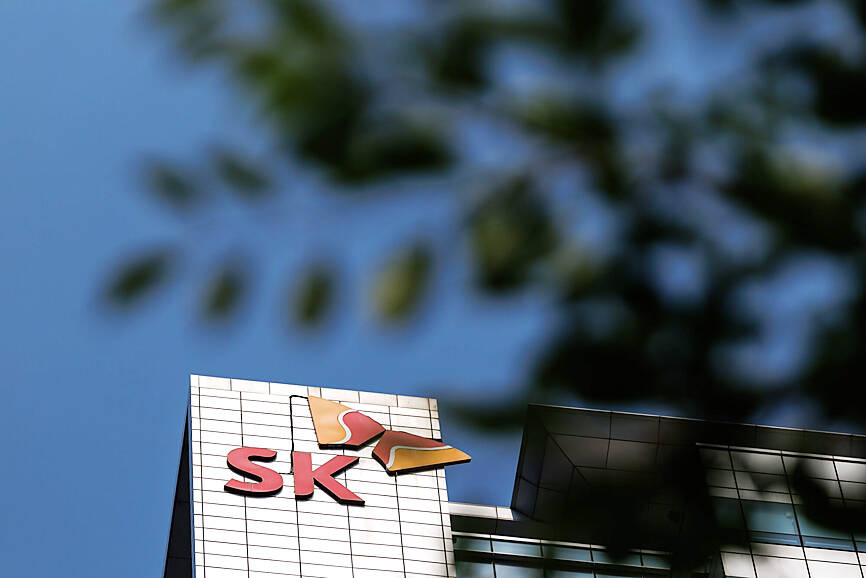
Photo: Bloomberg
Bank of America Corp, Citigroup Inc, Goldman Sachs Group Inc and JPMorgan Chase & Co are leading the share sale.
SK Hynix has been a beneficiary of the hype around artificial intelligence (AI) as investors bet that demand for memory and storage would be a long-term growth story. The company is the top supplier of high-bandwidth memory after becoming the go-to provider for Nvidia Corp, the dominant maker of AI processors.
In the SK Hynix offering, the job for bankers should be made easier by investor familiarity with a company that has long been listed in its home country and has been one of the hottest names among global technology stocks this year.
One of the sources of uncertainty is the volatility of SK Hynix shares listed in Seoul. The stock has gone through wild gyrations last week, falling as much as 15 percent on Thursday and rising up to 10 percent on Friday. Even with a drop of 20 percent from last month’s peak, SK Hynix is still up 770 percent in 12 months.
Separately, the Bank of Korea (BOK) warned that single-stock leveraged exchange-traded funds (ETFs) tied to SK Hynix and Samsung Electronics Co could deepen market concentration, amplify volatility and intensify one-way trading flows, a local report said.
“With Samsung and SK Hynix accounting for more than half of stock market capitalization and trading volume, expanding investment in single-stock leveraged ETFs could further intensify this concentration,” the central bank said in a written response submitted to People Power Party lawmaker Park Sung-hoon, Yonhap News reported.
The central bank said the products could amplify one-way trading as inflows and outflows grow in response to shifts in business conditions or market expectations. It also warned that, in the event of a correction, losses for retail investors could widen, while increased redemptions or portfolio rebalancing could add to share-price volatility.
The BOK plans to enhance monitoring of the impact of single-stock leveraged ETFs on the stock market and financial system, Yonhap News reported. Last month, South Korea’s Financial Supervisory Service Governor Lee Chan-jin said he regretted not blocking their launch, warning their negative side effects have grown significantly.

Their metallic frames covered in supple, lifelike skin, a posse of new Chinese robots meant for companionship can offer users artificial intelligence (AI)-generated conversation or a hand to hold, complete with manicured nails. The company UBTech says its U1 robot — equipped with eye cameras, chest sensors and listening microphones — is the world’s first full-sized, ultra-realistic humanoid designed for mass production. Touted as an antidote to loneliness, the robots are priced at 119,800 yuan (US$17,600) for the most basic type and 990,000 yuan (US$145,700) for an “ultra” version with more advanced features. “Our bionic robots can accompany you for a lifetime,” Michael
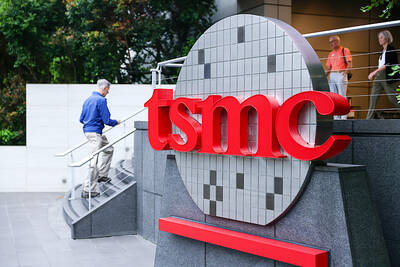
ARIZONA INVESTMENT: The Taiwanese semiconductor firm has gained approval for a US$20 billion capital injection into its its wholly owned US subsidiary The US is unlikely to match Taiwan Semiconductor Manufacturing Co’s (TSMC, 台積電) production capacity in Taiwan despite the chipmaker’s expansion in Arizona, Minister of Economic Affairs Kung Ming-hsin (龔明鑫) said yesterday. TSMC has already announced plans for a total of 16 fabrication plants and advanced chip-on-wafer-on-substrate packaging facilities in Taiwan, Kung said before a ministry meeting yesterday afternoon. “No matter how many fabs the US builds in the future, it won’t be that many,” Kung said. His remarks came after US President Donald Trump reportedly said on Wednesday that Taiwan was doubling the size of the chip plants under construction in Arizona and
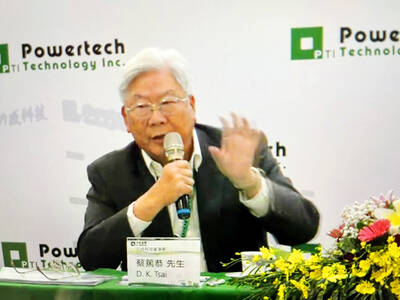
REGIONAL GAMBIT: Powertech’s subsidiary plans to acquire ON Semiconductor’s local operation for US$45m, adding Southeast Asian testing and packaging capacity Powertech Technology Inc (力成科技), the world’s largest memorychip testing and packaging service provider, yesterday said it plans to acquire the entire Philippine unit of ON Semiconductor Japan Holdings Ltd for US$45 million as part of efforts to navigate global supply chain realignment amid escalating geopolitical risks. The transaction will be conducted by its subsidiary Greatek Electronics Inc (超豐), a provider of logic chip packaging and testing services. Powertech holds a 43 percent stake in Greatek. “This move is a core component of the company’s mid-to-long-term growth strategy and directly aligns with major customers’ “Taiwan Plus One” approach to diversify their sourcing in
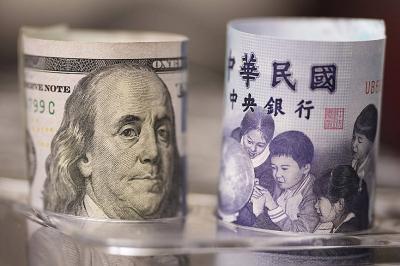
The New Taiwan dollar, which is on track for its first quarterly gain in a year, may face renewed pressure as the US currency strengthens and local companies boost dividend payouts to a record. Domestic firms are set to pay out more than NT$2.5 trillion (US$78.5 billion) in cash dividends this year, according to data from the Taiwan Stock Exchange, the largest amount ever in Bloomberg-compiled data going back to 1990. Foreign-exchange conversions by overseas investors repatriating the funds are expected to add to near-term volatility in the local currency. “The Taiwan dollar could hit a rough patch in the coming weeks,


 RSS
RSS