


The US is unlikely to match Taiwan Semiconductor Manufacturing Co’s (TSMC, 台積電) production capacity in Taiwan despite the chipmaker’s expansion in Arizona, Minister of Economic Affairs Kung Ming-hsin (龔明鑫) said yesterday.
TSMC has already announced plans for a total of 16 fabrication plants and advanced chip-on-wafer-on-substrate packaging facilities in Taiwan, Kung said before a ministry meeting yesterday afternoon.
“No matter how many fabs the US builds in the future, it won’t be that many,” Kung said.
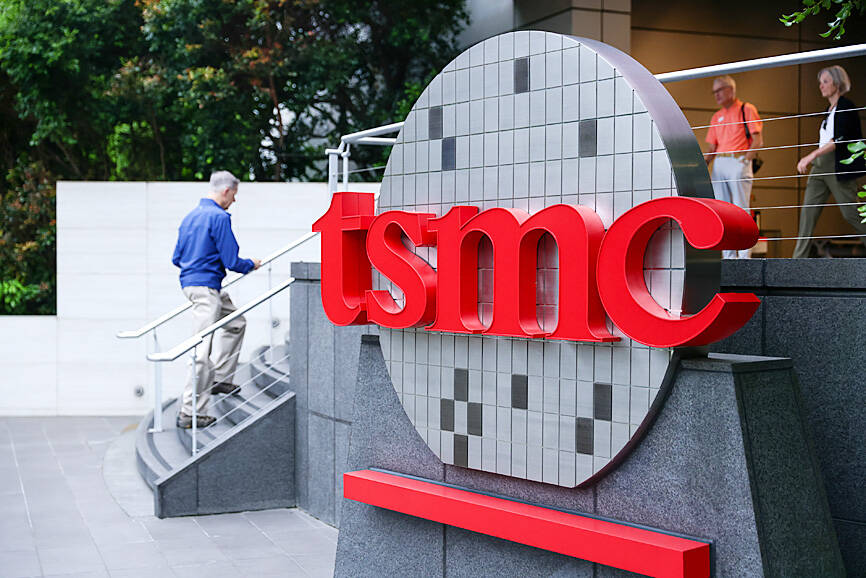
Photo: Ritchie B. Tongo, EPA
His remarks came after US President Donald Trump reportedly said on Wednesday that Taiwan was doubling the size of the chip plants under construction in Arizona and that Taiwanese chipmakers such as TSMC were increasing their investments in the US.
“The biggest company in the world, actually, the chipmaker. But they’re coming in, they’re building in Arizona, and they just announced they’re going to double the size,” Fox Business quoted Trump as saying.
“We could have 50 percent of the chip market by the time I leave office,” he added.
Asked whether TSMC’s US expansion could weaken its status as Taiwan’s “silicon shield,” Kung said that the company’s announced plans showed Taiwan would remain central to its manufacturing operations.
Asked whether Washington could pressure TSMC to invest more aggressively in the US if the company did not meet Trump’s expectations, Kung expressed confidence in TSMC chairman C.C. Wei (魏哲家).
“I believe chairman Wei is very wise and will be able to handle the matter appropriately,” Kung said.
Earlier yesterday, before attending a meeting of the legislature’s Economics Committee, Kung said that any plans for additional overseas fabs should be confirmed by TSMC itself.
“Whether TSMC has plans for additional fabs should be based on what the company says,” he told reporters.
Separately, the Ministry of Economic Affairs approved a US$20 billion capital injection by TSMC into its wholly owned US subsidiary, TSMC Arizona Corp.
The approval was one of nine major domestic and overseas investment projects cleared by the ministry’s Department of Investment Review at a meeting yesterday.
It marked the sixth time the department has approved TSMC investments in the US, bringing the total amount cleared for the company’s US operations to US$44 billion, the department said in a statement.
The latest funding would be used to build a 12-inch wafer fab and an advanced packaging plant in Arizona, with further details to be announced by TSMC, the department said.
In total, the department approved seven outbound investment projects worth about US$23.05 billion, with TSMC’s Arizona investment accounting for most of the total.


The US Federal Communications Commission (FCC) on Friday said it would ban the import of more equipment from a group of Chinese manufacturers, the latest move by Washington to crack down on Chinese-made electronic gear. The move expands an FCC ban imposed in 2022 on new models of telecommunications and video surveillance equipment made by Huawei Technologies Co (華為), ZTE Corp (中興通訊), Hytera Communications Corp (海能達通信), Hikvision Digital Technology Co (海康威視) and Dahua Technology Co (大華科技), citing national security risks. The expanded ban includes old models, not just those designed starting in late 2022, of equipment used for “public safety, security of
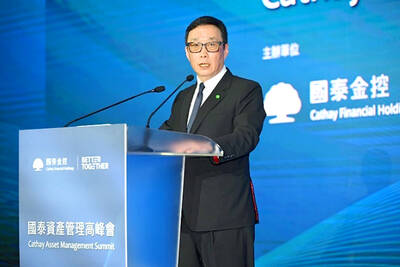
Cathay United Bank Co (國泰世華銀行) chairman Kuo Ming-jian (郭明鑑) has resigned following a regulatory breach at the lender’s asset management affiliate linked to his outside positions, an incident that culminated in a physical altercation with a member of Taiwan’s billionaire Tsai family. “Mr. Kuo voluntarily decided to resign in light of the differing public opinions arising in recent days regarding his outside appointments to avoid creating negative public perceptions and to safeguard the company’s reputation,” Cathay Financial Holding Co (國泰金控), parent of Cathay United Bank, said in a statement yesterday. The resignation followed discussions between Kuo and Cathay Financial chairman Tsai Hong-tu
UNSURPRISING LEADER: TSMC led in both net profit and revenue this year, followed by other big names in the Taiwanese sphere of tech as well as finance Taiwan’s 5,000 largest companies posted a record high in aggregate net profit last year, up more than 11 percent from a year earlier, with contract chipmaker Taiwan Semiconductor Manufacturing Co (TSMC, 台積電) holding on as the country’s most profitable company amid the artificial intelligence (AI) boom, credit information agency CRIF Taiwan (中華徵信所) said on Wednesday. Strong global demand for AI applications continued to benefit Taiwan’s top 5,000 enterprises last year, CRIF said in a report. Their combined net profit totaled NT$5.77 trillion (US$181.1 billion), up 11.01 percent from a year earlier, while aggregate revenue hit a record high of NT$48.50 trillion,
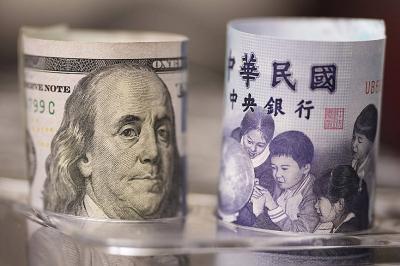
The New Taiwan dollar, which is on track for its first quarterly gain in a year, may face renewed pressure as the US currency strengthens and local companies boost dividend payouts to a record. Domestic firms are set to pay out more than NT$2.5 trillion (US$78.5 billion) in cash dividends this year, according to data from the Taiwan Stock Exchange, the largest amount ever in Bloomberg-compiled data going back to 1990. Foreign-exchange conversions by overseas investors repatriating the funds are expected to add to near-term volatility in the local currency. “The Taiwan dollar could hit a rough patch in the coming weeks,


 RSS
RSS