


After facing crisis upon crisis in the past few years, the world needs to build foundations that can withstand shocks that have become more frequent, IMF managing director Kristalina Georgieva said yesterday.
“I am worried that we are not completely internalizing yet that this is how the world is going to be,” Georgieva said on Bloomberg’s podcast Leaders with Francine Lacqua. “We are not going to get to a place where shocks are gone.”
Georgieva, who has been at the helm of the Washington-based lender since 2019, has been through the COVID-19 pandemic, the war in Ukraine, the tariffs turmoil and now the conflict in the Middle East.
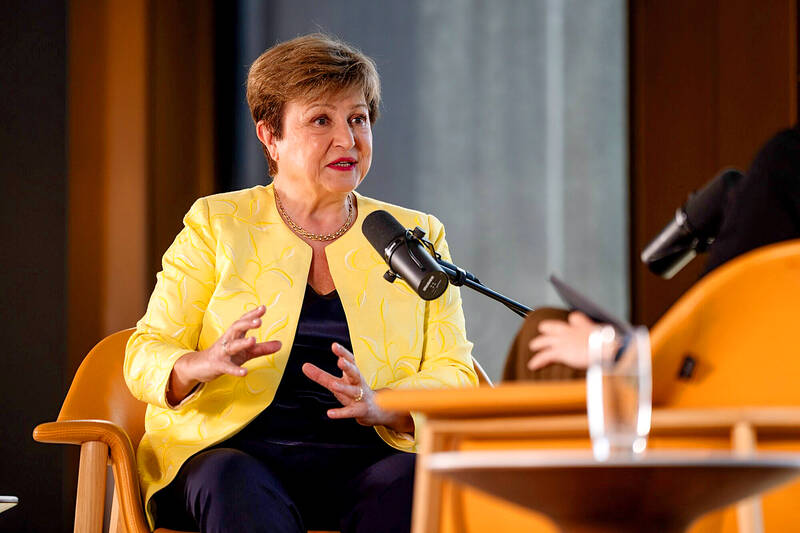
Photo: Bloomberg
One major transformation underway is the spread of artificial intelligence (AI), and its impact on labor markets and local economies.
Georgieva said organizations, including hers, failed to recognize inequalities arising from globalization and she wants to make sure it would not happen with AI.
“We collectively, including the fund, did not appreciate the backlash against globalization that came from the fact that, yes, the world economy is doing better as a whole, but many communities were hollowed out because their jobs disappeared and there was not enough attention to them,” she said. “I’ll tell you what I’m very keen not to see repeated is the same with artificial intelligence.”
Separately, HSBC Holdings PLC chief executive officer Georges Elhedery said people would remain central to banks even as AI becomes ubiquitous, as many CEO comments in have rattled staffers about the future of the industry.
“I need human judgement, I need human decisionmaking, I need human accountability at the core,” Elhedery said in an interview with Bloomberg TV.
While AI would allow for a revolution in the way banks served their clients with the potential for productivity gains and hyper-personalized services, Elhedery said that people were still key and that it could even mean more hiring in the future.
Bloomberg has reported that HSBC is weighing cutting as many as 20,000 roles, or about 10 percent of its workforce, in the coming years as a result of AI.
“The bank of the future means more capabilities,” Elhedery said. “I would like to be able to accelerate and bring forward a lot of ambitious deliverables we have for the future, and that requires investment, and that is job creation.”

Taiwanese firms have increased investment in the Philippines in recent years as Manila’s ties with Washington deepen and global supply chains continue to shift away from China, an expert at the Chung-Hua Institution for Economic Research (CIER, 中華經濟研究院) said yesterday. The Philippines had not been among Taiwanese investors’ top choices in Southeast Asia, CIER Taiwan ASEAN Studies Center director Kristy Hsu (徐遵慈) said at a seminar in Taipei. However, Taiwan’s investment in the country has grown significantly since the COVID-19 pandemic, reaching US $257 million last year, a high in recent years, she said. Although Taiwan’s total investment in the Philippines still lags
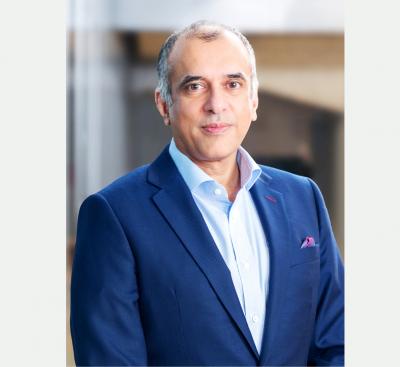
HSBC Holdings PLC is deepening its commitment to Taiwan as the economy emerges as one of the bank’s fastest-growing markets globally, driven by an artificial intelligence (AI) investment boom, expanding cross-border trade, and rising wealth creation. “The advantage that Taiwan has is a growth story linked to the semiconductor and broader AI industries, strong underlying corporate performance, and wealth creation,” said Surendra Rosha, HSBC’s co-chief executive for Asia and the Middle East, in an exclusive interview with the Taipei Times on June 2, during this year’s HSBC Taiwan Conference. That combination has helped HSBC cement its position as the most profitable international

Intel Corp regards Taiwan Semiconductor Manufacturing Co (TSMC, 台積電) as a longstanding partner, as the US chipmaker would continue outsourcing production of advanced chips to TSMC, Intel chief executive officer Lip-Bu Tan (陳立武) said yesterday. “I don’t look at people as competitors. I look at the collaboration... Nvidia is also, you know, a good friend,” Tan told a news conference following his keynote speech at the Computex trade show in Taipei. “It’s a very trusted partnership for us... We are a big, top customer for them, and we’re going to continue doing that,” he said, referring to TSMC, the world’s largest foundry
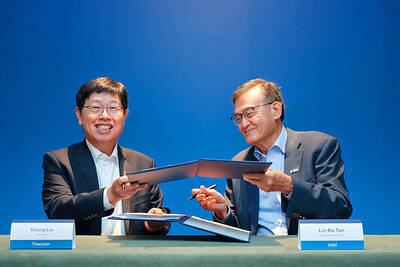
Hon Hai Precision Industry Co (鴻海精密) yesterday said it would work with US chipmaker Intel Corp to jointly develop and deploy next-generation artificial intelligence (AI) infrastructure and intelligent computing platforms in a move to capture booming demand for AI computing systems. Hon Hai, also known as Foxconn Technology Group (富士康), said in a statement that the partnership would combine its global manufacturing scale, system integration expertise and AI data center deployment capabilities with Intel’s strengths in processor architecture, silicon technologies and software ecosystem. The companies said they plan to work on equipment used in AI data centers, including server racks powered by


 RSS
RSS