


Nvidia Corp yesterday announced a series of deals in South Korea with tech giants including SK Hynix Inc and Naver Corp, as it looks to secure crucial memory chips to power its artificial intelligence (AI) ambitions and entice new customers.
The agreements come during a high-profile trip to South Korea by Nvidia chief executive officer Jensen Huang (黃仁勳) that began on Friday last week, and has seen him dine on grilled pork belly and local spirit soju with the nation’s top corporate bosses, throw a baseball pitch and meet with a well-known gamer.
Nvidia and its partners, which also include SK Telecom Co and conglomerate Doosan Group, did not disclose the value of the deals.
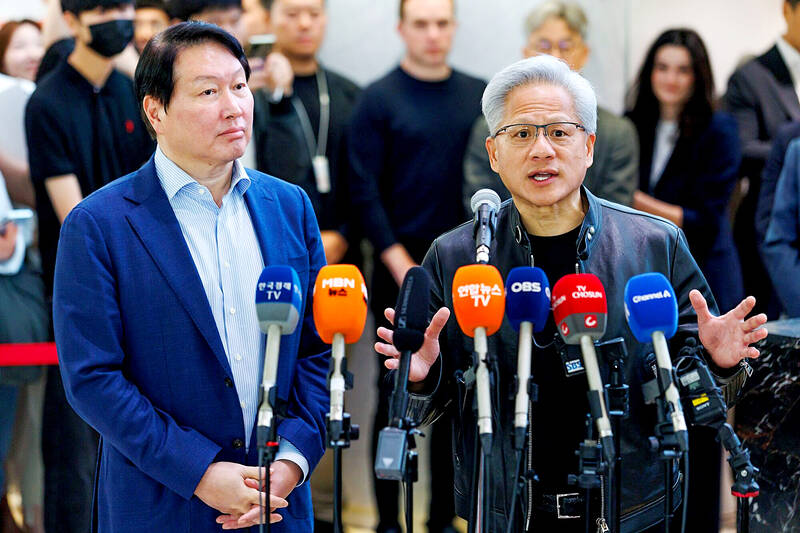
Photo: Bloomberg
SK Group, South Korea’s second-largest family-owned conglomerate, said its SK Hynix and SK Telecom arms had agreed deals with Nvidia.
SK Hynix signed a multi-year technology partnership that would see it commit to developing advanced types of memory chips for global AI data centers, SK Group said.
SK Hynix and Nvidia said the agreement would enable supply to keep pace with Nvidia’s plans, which have expanded to robotics, PCs and AI supercomputers.
“SK Hynix has been Nvidia’s largest memory partner. SK Hynix will continue to be Nvidia’s largest memory partner,” Huang said after a meeting with SK Group chairman Chey Tae-won at the headquarters of the chipmaker’s parent company.
Huang said the deal with SK Hynix, a rival to Samsung Electronics Co and US-based Micron Technology Inc, was for more than two years, with the option to keep extending.
“We already procure, and we buy from SK Hynix already billions and billions of dollars each year, and it’s going to grow substantially,” he said.
NH Investment & Securities Co senior analyst Ryu Young-ho said the SK Hynix-Nvidia partnership reinforced the view that memory chips are evolving from a commodity product into a more customer-specific business.
SK Telecom said it would build a gigawatt-scale AI cloud in South Korea using Nvidia technology, with the first AI data center to come online next year.
Nvidia said Internet giant Naver and conglomerate Doosan would also use its technology to build AI data centers.
Doosan, which is developing robots and makes materials used in Nvidia’s most powerful Blackwell chips, said it expected its energy solution to be used in Nvidia’s data center platforms and for it to use the US firm’s physical AI technology as well.
Nvidia is also partnering with LG Group on electronics, mechanical systems and AI for humanoid robots, Huang said after a meeting with the tech conglomerate’s chairman Koo Kwang-mo.
Huang said the pair were also working on the architecture of future data centers, including cooling, power delivery, and the entire design and building of data centers.
After a meeting with Hyundai Motor Group executive chairman Euisun Chung in the afternoon, Huang said Nvidia would deepen its partnership with Hyundai across a range of AI initiatives, including autonomous mobility, robotics and AI-powered manufacturing.
He also highlighted opportunities to accelerate the development of industrial robotics, saying Nvidia and Hyundai would work together to bring AI to “all forms of mobility” and deepen collaboration on robotics for practical industrial applications.
Huang referred to Hyundai Motor’s planned AI data center in Saemangeum as an “AI Valley” akin to California’s Silicon Valley and said he was “very happy to build Nvidia in Saemangeum.”
South Korea’s benchmark KOSPI index closed 8.3 percent lower yesterday after robust US jobs data fanned bets on a US Federal Reserve interest rate hike this year and sparked a rout of global tech stocks.
Shares of Samsung and SK Hynix closed down 10.2 percent and 7.7 percent respectively.
When asked about the global chip stock rout, Huang waved off concerns.
“Everybody should be very excited; they can now buy stock at a cheaper price and it’s absolutely true that the future of AI is very bright,” he said.

Taiwanese firms have increased investment in the Philippines in recent years as Manila’s ties with Washington deepen and global supply chains continue to shift away from China, an expert at the Chung-Hua Institution for Economic Research (CIER, 中華經濟研究院) said yesterday. The Philippines had not been among Taiwanese investors’ top choices in Southeast Asia, CIER Taiwan ASEAN Studies Center director Kristy Hsu (徐遵慈) said at a seminar in Taipei. However, Taiwan’s investment in the country has grown significantly since the COVID-19 pandemic, reaching US $257 million last year, a high in recent years, she said. Although Taiwan’s total investment in the Philippines still lags
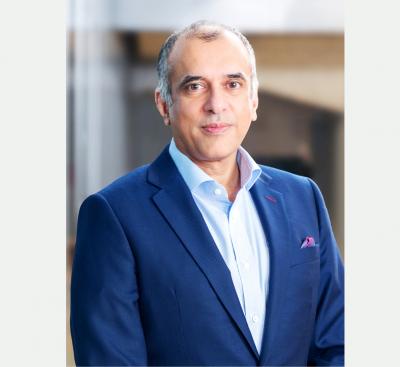
HSBC Holdings PLC is deepening its commitment to Taiwan as the economy emerges as one of the bank’s fastest-growing markets globally, driven by an artificial intelligence (AI) investment boom, expanding cross-border trade, and rising wealth creation. “The advantage that Taiwan has is a growth story linked to the semiconductor and broader AI industries, strong underlying corporate performance, and wealth creation,” said Surendra Rosha, HSBC’s co-chief executive for Asia and the Middle East, in an exclusive interview with the Taipei Times on June 2, during this year’s HSBC Taiwan Conference. That combination has helped HSBC cement its position as the most profitable international

Intel Corp regards Taiwan Semiconductor Manufacturing Co (TSMC, 台積電) as a longstanding partner, as the US chipmaker would continue outsourcing production of advanced chips to TSMC, Intel chief executive officer Lip-Bu Tan (陳立武) said yesterday. “I don’t look at people as competitors. I look at the collaboration... Nvidia is also, you know, a good friend,” Tan told a news conference following his keynote speech at the Computex trade show in Taipei. “It’s a very trusted partnership for us... We are a big, top customer for them, and we’re going to continue doing that,” he said, referring to TSMC, the world’s largest foundry
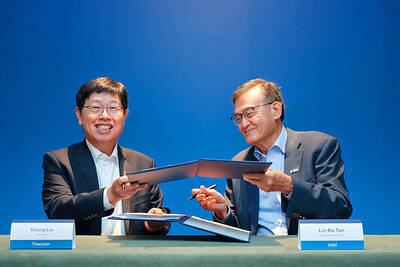
Hon Hai Precision Industry Co (鴻海精密) yesterday said it would work with US chipmaker Intel Corp to jointly develop and deploy next-generation artificial intelligence (AI) infrastructure and intelligent computing platforms in a move to capture booming demand for AI computing systems. Hon Hai, also known as Foxconn Technology Group (富士康), said in a statement that the partnership would combine its global manufacturing scale, system integration expertise and AI data center deployment capabilities with Intel’s strengths in processor architecture, silicon technologies and software ecosystem. The companies said they plan to work on equipment used in AI data centers, including server racks powered by


 RSS
RSS