


Fubon Financial Holding Co (富邦金控) yesterday signaled confidence earnings momentum could accelerate further this year, after its profit for the first four months surpassed its full-year performance last year, driven by a rally in Taiwanese and US equities, and strong contributions from its insurance, banking and brokerage businesses.
Fubon Financial president Jerry Harn (韓蔚廷) took a bullish tone on profitability and dividend prospects during the company’s earnings conference in Taipei, citing robust investment gains linked to Taiwan’s artificial intelligence (AI) supply chain, as well as improving recurring returns at its life insurance arm.
First-quarter net profit stood at NT$33.55 billion (US$1.07 billion), or earnings per share of NT$2.4. Cumulative adjusted profit — including gains from fair value through other comprehensive income — reached NT$121.46 billion in the first four months.
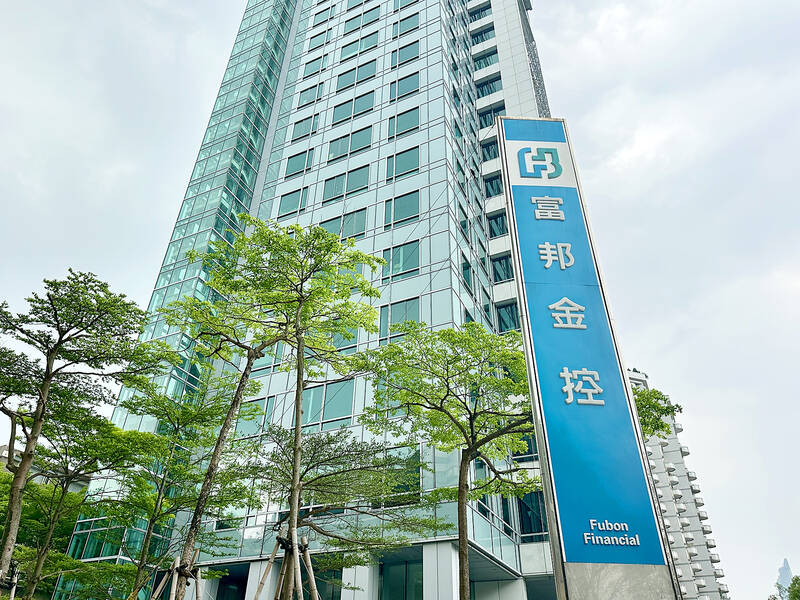
Photo: CNA
This implies earnings per share of NT$8.67, already exceeding last year’s performance and positioning the group as a sector leader in profitability, Harn said.
The standout driver was Fubon Life Insurance Co (富邦人壽), whose investment performance benefited significantly from the AI-driven rally in Taiwanese equities.
The life insurer’s domestic equity portfolio delivered a return of 40.18 percent year-on-year, lifting its overall first-quarter investment yield to 6.46 percent on total assets of NT$5.25 trillion.
Harn said Fubon Life’s investment strategy remains unchanged and reiterated strong confidence in Taiwan’s AI hardware supply chain.
At the same time, he highlighted improving hedging efficiency and a stronger recurring yield profile in the insurer’s operations.
The life unit is expected to have greater capacity to upstream profits to the holding company, supported by a solid capital position, he added.
Fubon Financial said its banking unit, Taipei Fubon Commercial Bank Co (台北富邦銀行), delivered record results in the first quarter, posting a net profit of NT$12.16 billion, up 20.2 percent annually and a record high.
The banking unit’s growth was driven by favorable Taiwan-US interest rate spreads, steady loan expansion — particularly in foreign currency and corporate lending — and continued strength in net interest income, the company said.
Wealth management fees, supported by strong demand for funds, structured products and overseas equities, provided an additional earnings engine, it said.a
Fubon Financial’s brokerage operations were equally robust amid a buoyant equity market.
In the first quarter, Fubon Securities Co (富邦證券) reported a 154.2 percent surge in net profit, driven by rising trading volumes, record margin lending balances and strong growth in cross-border brokerage services, it said.
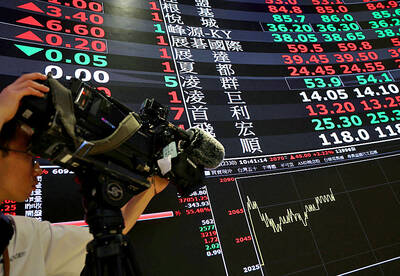
After several years flying high as Asia’s best Nvidia Corp proxy, Taiwan Semiconductor Manufacturing Co (TSMC, 台積電) is increasingly vying with other artificial intelligence (AI) stocks for investor attention. Stock traders are chasing a wider array of beneficiaries as mainstream usage of AI creates demand for hardware beyond the most-advanced chips TSMC makes for Nvidia. Subthemes from the deepening memory crunch to advances in robotics are also luring bids. At the same time, investment caps on single stocks are pushing funds to diversify, while retail investors long familiar with TSMC through its US depositary receipts are being offered a broader set of
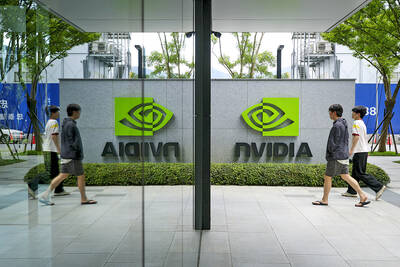
UNDER MICROSCOPE: Taiwan detained three people who allegedly conspired to buy servers in Taiwan and export them using fraudulent documentation, prosecutors said Nvidia Corp chief executive officer Jensen Huang (黃仁勳) on Saturday urged Super Micro Computer Inc to tighten up on compliance after Taiwan detained three people this week for allegedly making fraudulent declarations about artificial intelligence (AI) servers made by its US partner. The development marked the nation’s first crackdown on semiconductor smuggling, which grew after the US slapped restrictions on exports of high-end chips such as Nvidia AI accelerators to China. Nvidia is “rigorous” in explaining regulations to all of its partners, Huang told reporters after arriving in Taipei. “Ultimately Super Micro has to run their own company,” he said in response to

TECH RELIANCE: Growth is increasingly reflecting an unequal K-shaped distribution, where technology sectors outperform and other industries struggle, an expert said Standard Chartered Bank has significantly raised its forecast for Taiwan’s economic growth to 9.5 percent this year, up from 7.6 percent previously, citing surging artificial intelligence (AI) demand driving exports, semiconductor production and investment. The upgrade reflects a sustained AI supercycle that continues to fuel demand for advanced chips and technology infrastructure, which form the backbone of Taiwan’s exports, the bank said in a report this week. “We raise our 2026 growth forecast to reflect a much stronger-than-expected first-quarter GDP figure,” Standard Chartered senior economist for greater China and Asia Tommy Wu (胡東安) said in the report. Driven largely by a 35.3 percent

Two of Taiwan’s international carriers, Starlux Airlines Co (星宇航空) and EVA Airways Corp (長榮航空), have retained the five-star airline rating awarded by international airline review organization Skytrax. Starlux was awarded the distinction for a second consecutive year, while EVA Air received it for the 11th straight year, Skytrax said in statements released yesterday and on Thursday last week, respectively. The five-star rating is considered one of the airline industry's highest honors and is awarded following professional audits of airline product and frontline service standards, Skytrax said. The ratings are based on in-depth assessments using unified global quality standards rather than customer review scores


 RSS
RSS