


A new exhibition in central Taiwan is revisiting the rise of Taiwan’s comics culture in the late 1980s and early 1990s through the legacy of an ambitious weekly magazine that sought to build a local comics industry.
The exhibition, titled “1989, A Sunday Comics Dream,” centers on the weekly magazine Sunday Comics (星期漫畫), which published 80 issues between 1989 and 1993.
The magazine was a bold attempt to establish a Taiwanese comics series at a time when the local industry was still in its infancy, said Aho Huang (黃健和), who curated the exhibition.
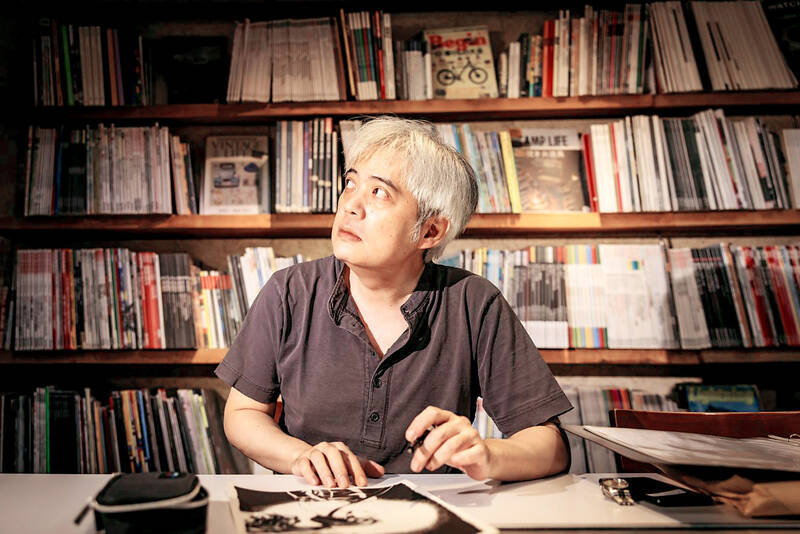
Photo: CNA
Although Sunday Comics initially printed 50,000 copies, circulation had wound down to about 5,000 copies by its final issue amid fierce competition from pirated Japanese manga magazines, according to Huang.
HOMEGROWN ART
Huang, a veteran comics editor who received the Special Contribution Award at the last year’s Golden Comics Awards, described the magazine as “a bold experiment” created by artists seeking to push Taiwan comics onto the international stage.
Huang said Sunday Comics reflected ambitions shared by Taiwanese comic artists at the time, including the dream of making comics professionally, establishing a weekly publication system similar to Japan’s manga magazines and eventually reaching international standards.
“Back then, not many people had been abroad. All they could do was read works imported from Japan, the US and France, and marvel at their creative standards,” Huang said.
The exhibition, held at the National Taiwan Museum of Comics in Taichung, features original manuscripts, recreated editorial offices and classroom spaces, and archival materials documenting the development of Taiwan comics during this period.
Among the exhibits are original manuscripts from six comic artists: Chen Uen (鄭問), Joe Tseng (曾正忠), Richard Metson (麥仁杰), Kid Jerry (傑利小子), Ren Zheng-hua (任正華) and Lin Cheng-te (林政德).
Other featured artists include Au Yao-hsing (敖幼祥), Hong Te-lin (洪德麟), Chen Kuan-chun (陳冠君), Chiu Rou-long (邱若龍), Pin Fan (平凡) and Loic Hsiao (蕭言中).
HEADWINDS
Taiwan lifted martial law just two years before Sunday Comics debuted.
“Thirty years ago, they took the first step without fear,” Huang said. “Only in the past few years have we begun to see the fruits of those efforts mature.”
Comparing the magazine to the nascent stage of Taiwan’s Chinese Professional Baseball League, Huang said such early efforts helped lay the groundwork for Taiwanese comics’ growing international recognition, such as Taiwanese comic artist Chang Sheng (常勝), who became the first Taiwanese artist to receive two nominations in the same year at this year’s Will Eisner Comic Industry Awards.
Huang encouraged the public to visit the exhibition, which opened on Wednesday and runs through Oct. 11, and learn more about an important chapter in Taiwan’s comic history.
“To look back at history is the only way to move toward the future,” he said.


Taiwanese firms have increased investment in the Philippines in recent years as Manila’s ties with Washington deepen and global supply chains continue to shift away from China, an expert at the Chung-Hua Institution for Economic Research (CIER, 中華經濟研究院) said yesterday. The Philippines had not been among Taiwanese investors’ top choices in Southeast Asia, CIER Taiwan ASEAN Studies Center director Kristy Hsu (徐遵慈) said at a seminar in Taipei. However, Taiwan’s investment in the country has grown significantly since the COVID-19 pandemic, reaching US $257 million last year, a high in recent years, she said. Although Taiwan’s total investment in the Philippines still lags

Intel Corp regards Taiwan Semiconductor Manufacturing Co (TSMC, 台積電) as a longstanding partner, as the US chipmaker would continue outsourcing production of advanced chips to TSMC, Intel chief executive officer Lip-Bu Tan (陳立武) said yesterday. “I don’t look at people as competitors. I look at the collaboration... Nvidia is also, you know, a good friend,” Tan told a news conference following his keynote speech at the Computex trade show in Taipei. “It’s a very trusted partnership for us... We are a big, top customer for them, and we’re going to continue doing that,” he said, referring to TSMC, the world’s largest foundry

Hon Hai Precision Industry Co (鴻海精密) yesterday said it would work with US chipmaker Intel Corp to jointly develop and deploy next-generation artificial intelligence (AI) infrastructure and intelligent computing platforms in a move to capture booming demand for AI computing systems. Hon Hai, also known as Foxconn Technology Group (富士康), said in a statement that the partnership would combine its global manufacturing scale, system integration expertise and AI data center deployment capabilities with Intel’s strengths in processor architecture, silicon technologies and software ecosystem. The companies said they plan to work on equipment used in AI data centers, including server racks powered by

Artificial intelligence (AI) agents would supplant smartphones as the center of people’s digital lives, fundamentally reshaping personal devices and driving a major computing upgrade cycle, Qualcomm Inc CEO Cristiano Amon said yesterday. In his keynote speech for this year’s Computex trade show in Taipei, Amon said that the rise of "agentic AI" — AI systems capable of reasoning, planning and carrying out tasks autonomously — would transform how people interact with technology across phones, PCs, vehicles and wearable devices. Describing the technology as the next major evolution in computing, Amon said that "2026 is the year of agents.” For decades, smartphones have sat


 RSS
RSS