


Taiwan’s property market weakened last month, with transaction volumes across the six major municipalities falling to their lowest level for the same month in years, as geopolitical tensions and a strong rally in local equities damped buying momentum.
Data compiled by local land administration offices showed that property transfers in Taipei, New Taipei City, Taoyuan, Taichung, Tainan and Kaohsiung totaled 15,685 units, down 14.2 percent from March and a retreat of 7.1 percent from a year earlier. The figure marked the weakest April performance in eight years.
Cumulative transfers for the first four months of this year in the six cities reached 62,688 units, down 3.4 percent year-on-year and the lowest for the same period in nine years, underscoring persistent cooling despite the traditional spring peak season.
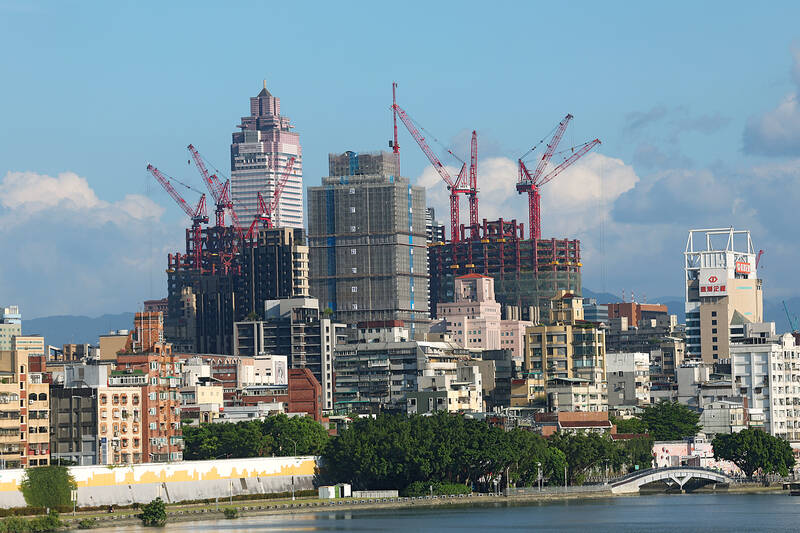
Photo: CNA
All six cities posted monthly declines, with transactions falling 17.9 percent in Taipei and 20.7 percent in New Taipei City, while Taoyuan dropped 15.3 percent and Taichung saw a milder 1.7 percent decrease. Tainan and Kaohsiung declined 13.7 percent and 14.1 percent respectively.
The data typically lag deals by about a month and largely reflect market conditions from March to early last month, when escalating tensions in the Middle East roiled global markets, Evertrust Rehouse Co (永慶房屋) deputy research manager Chen Chin-ping (陳金萍) said.
“Heightened uncertainty led prospective homebuyers to adopt a more cautious stance, which in turn suppressed transaction momentum,” Chen said.
Although financial markets began to stabilize this month and some end-user demand has started to return, particularly in the secondary market, a lack of large-scale new housing completions continued to weigh on overall volumes, she said.
The subdued performance is notable given that March and April are usually peak months for housing transactions, suggesting demand has been unusually restrained this year.
Chinatrust Real Estate Co (中信房屋) attributed part of the decline to fewer working days due to holidays and reduced handovers of new projects.
More significantly, a strong rally in Taiwan’s stock market drew investor attention and diverted capital away from the property market, it said, adding that prospective buyers have opted to remain in equities in search of higher returns, delaying home purchases.
The benchmark TAIEX continued to set new closing records yesterday, closing up 64.15 points, or 0.16 percent, at 40,769.29.
While the crowding-out effect from equities might persist in the near term, Chinatrust said medium to long-term fundamentals remain supportive.
A more accommodative stance by the central bank toward owner-occupiers, along with Taiwan’s stable economic backdrop, should help underpin confidence, it said.
Upcoming local elections, infrastructure projects and pent-up demand could also provide support, allowing transaction volumes to recover modestly later this year, it added.
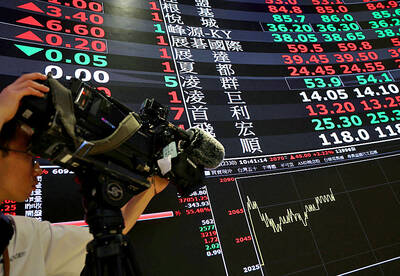
After several years flying high as Asia’s best Nvidia Corp proxy, Taiwan Semiconductor Manufacturing Co (TSMC, 台積電) is increasingly vying with other artificial intelligence (AI) stocks for investor attention. Stock traders are chasing a wider array of beneficiaries as mainstream usage of AI creates demand for hardware beyond the most-advanced chips TSMC makes for Nvidia. Subthemes from the deepening memory crunch to advances in robotics are also luring bids. At the same time, investment caps on single stocks are pushing funds to diversify, while retail investors long familiar with TSMC through its US depositary receipts are being offered a broader set of

UNDER MICROSCOPE: Taiwan detained three people who allegedly conspired to buy servers in Taiwan and export them using fraudulent documentation, prosecutors said Nvidia Corp chief executive officer Jensen Huang (黃仁勳) on Saturday urged Super Micro Computer Inc to tighten up on compliance after Taiwan detained three people this week for allegedly making fraudulent declarations about artificial intelligence (AI) servers made by its US partner. The development marked the nation’s first crackdown on semiconductor smuggling, which grew after the US slapped restrictions on exports of high-end chips such as Nvidia AI accelerators to China. Nvidia is “rigorous” in explaining regulations to all of its partners, Huang told reporters after arriving in Taipei. “Ultimately Super Micro has to run their own company,” he said in response to
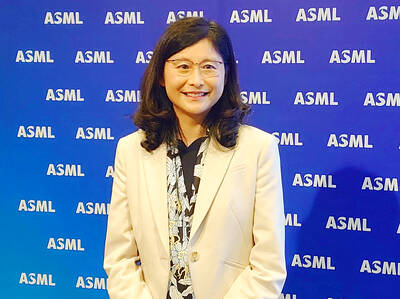
Netherlands-based semiconductor equipment supplier ASML Holding NV yesterday said that it is planning to hire an additional 1,000 people in Taiwan this year in response to growing demand from clients. ASML had previously planned to recruit 600 people this year, but that the plan has been adjusted upward, ASML vice president and ASML Taiwan general manager Grace Wang (汪佳慧) told reporters. ASML has a workforce of more than 4,500 in Taiwan, accounting for about 10 percent of its global total, Wang said. This year’s recruitment campaign would focus on adding people in the customer support, manufacturing and supply chain domains to assist ASML
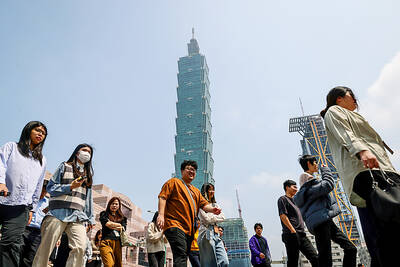
TECH RELIANCE: Growth is increasingly reflecting an unequal K-shaped distribution, where technology sectors outperform and other industries struggle, an expert said Standard Chartered Bank has significantly raised its forecast for Taiwan’s economic growth to 9.5 percent this year, up from 7.6 percent previously, citing surging artificial intelligence (AI) demand driving exports, semiconductor production and investment. The upgrade reflects a sustained AI supercycle that continues to fuel demand for advanced chips and technology infrastructure, which form the backbone of Taiwan’s exports, the bank said in a report this week. “We raise our 2026 growth forecast to reflect a much stronger-than-expected first-quarter GDP figure,” Standard Chartered senior economist for greater China and Asia Tommy Wu (胡東安) said in the report. Driven largely by a 35.3 percent


 RSS
RSS