


Taiwan has once again sent the largest foreign delegation to this year’s SelectUSA Investment Summit, with 113 Taiwanese companies and a record 207 representatives attending the annual US investment event, Minister of Economic Affairs Kung Ming-hsin (龔明鑫) said on Sunday.
This year’s summit, organized by the US Department of Commerce, opened on Sunday in Maryland and runs through tomorrow.
Speaking at a reception hosted by Taiwan’s representative office in Washington, Kung said Taiwan was the largest of the foreign delegations, as it has been for the past four years.
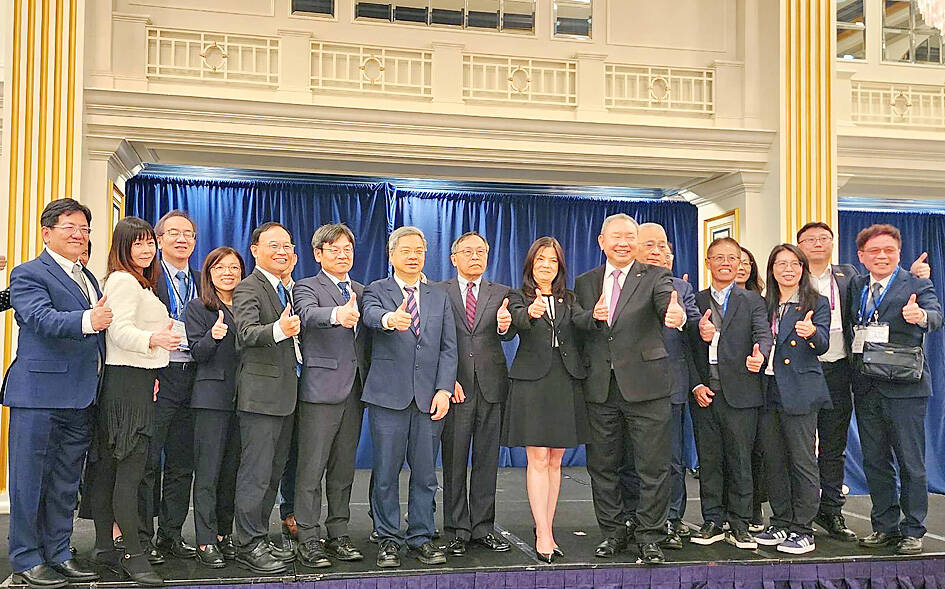
Photo courtesy of the National Development Council
US Undersecretary of Commerce for International Trade William Kimmitt, who attended the reception, praised Taiwan’s strategic role in global industry.
Kimmitt said a Taiwan-US investment cooperation memorandum signed in January was not simply a trade agreement, but one that reshaped bilateral strategic and economic ties based on trust and shared strengths.
“Taiwan knows how to build,” Kimmitt said.
Taiwan has built “a reputation for execution — not simply announcing plans, but delivering results. That is why this agreement is so important,” he said.
Under the pact, Taiwan would facilitate US$250 billion in private-sector investment in sectors such as semiconductors and artificial intelligence, while also providing up to US$250 billion in government-backed credit support.
Before the summit, Kung led a delegation to Arizona, where Taiwanese officials agreed with state and city officials to establish a trade and investment service center and a single-window mechanism to assist Taiwanese investors.
Kung visited Taiwan Semiconductor Manufacturing Co’s (台積電) Arizona facilities and said construction was progressing rapidly, with parts of the supply chain already taking shape.
Commenting on a US Supreme Court ruling limiting US President Donald Trump’s tariff authority, Kung said Taiwan remains in close contact with US trade officials and both sides hope to preserve already negotiated outcomes.
Kung said avoiding double taxation remains a key issue for Taiwanese firms investing in the US, adding that he would meet with US officials and senators to push for Senate consideration of a US-Taiwan double-tax relief bill already passed by the House.
Meanwhile, National Development Council Minister Yeh Chun-hsien (葉俊顯) said Taiwan’s National Development Fund would launch a financing guarantee program for Taiwanese firms investing in the US later this month, with an initial credit allocation of US$50 billion.
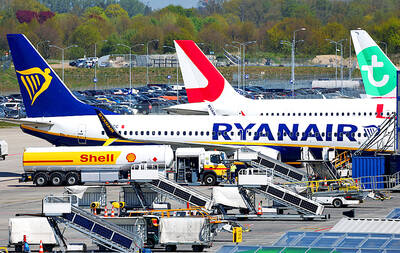
Ryanair, Transavia, Volotea and other low-cost airlines are feeling the financial pain from high jet fuel prices as a result of the Middle East war and are cutting flights. The closure of the Strait of Hormuz has taken a huge chunk of oil supplies off the market, sending the price of jet fuel soaring and triggering fears of shortages that could force airlines to cancel flights. Airlines are not waiting for a lack of supplies to react. “Travel alert: Airlines are cutting thousands of flights right now,” Travel Therapy host Karen Schaler said in an Instagram reel this past weekend.
MANAGING RISKS: Taiwan has secured LNG sufficient to cover 95 percent of electricity demand for next month, UBS said, describing the government’s approach as proactive UBS Group AG has raised its forecast for Taiwan’s economic growth this year to 8 percent, up from 6.9 percent previously, and said expansion could reach as high as 8.6 percent if external energy shocks are avoided. The upgrade reflects a stronger-than-expected first-quarter performance and sustained momentum in artificial intelligence (AI)-driven exports, which UBS said are providing a firm foundation for growth despite geopolitical and energy risks. Taiwan’s GDP expanded 13.69 percent year-on-year in the first quarter, the fastest growth since the second quarter of 1987, the Directorate-General of Budget, Accounting and Statistics (DGBAS) reported on Thursday. On a seasonally
Shares of Taiwan Semiconductor Manufacturing Co (TSMC, 台積電) have repeatedly hit new highs, but an equity analyst said the stock’s valuation remains within a reasonable range and any pullback would likely be technical. The contract chipmaker’s historical price-to-earnings (P/E) ratio has ranged between 20 and 30, Cathay Futures Consultant Co (國泰證期) analyst Tsai Ming-han (蔡明翰) told Central News Agency. With market consensus projecting that TSMC would post earnings per share of about NT$100 (US$3.17) this year, supported by strong global demand for artificial intelligence (AI) applications, and the stock currently trading at a P/E ratio of below 25, Tsai said the valuation
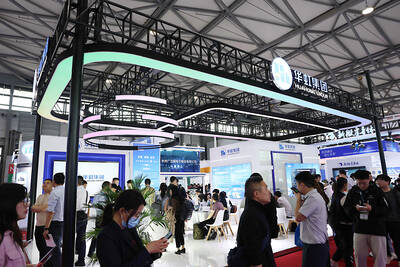
The US Department of Commerce last week ordered multiple chip equipment companies to halt shipments of certain tools to China’s second-largest chipmaker, Hua Hong Semiconductor Ltd (華虹半導體), its latest action to slow the country’s development of advanced chips, two people familiar with the matter said. The department sent letters to at least a handful of companies informing them of restrictions on tools and other materials destined for two Hua Hong facilities US officials believe make China’s most sophisticated chips, the people said. Top US chip equipment companies Lam Research Corp, Applied Materials Inc and KLA Corp, each of which has significant


 RSS
RSS