


Advantech Co (研華) expects its robotics-related business to grow rapidly this year after contributing more than 5 percent to the company’s total revenue last year, the company’s embedded Internet of Things president Miller Chang (張家豪) said in an exclusive interview with the Taipei Times on Thursday last week.
Advantech established a dedicated robotics unit about three years ago, concentrating on providing control platforms, artificial intelligence (AI) computing systems and relevant modules for robotics applications, including robotic arms, humanoid robots, autonomous mobile robots (AMRs) and inspection robots, Chang said.
Demand for the firm’s products supporting AMRs has been growing significantly since the adoption of AI technology, he added.
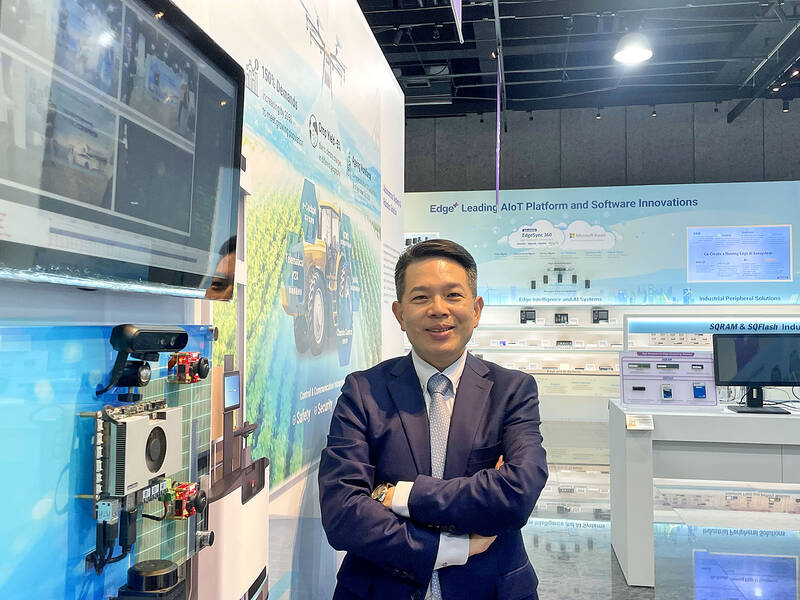
Photo: Meryl Kao, Taipei Times
Advantech has received 20 new robotics-related projects so far this year, the company said.
The world’s major robotic arms developers such as Japan’s Fanuc Corp and Yaskawa Electric Corp, Europe’s ABB Ltd and South Korea’s Hyundai Motor Group are all long-term clients of Advantech, Chang said.
While humanoid robots represent the most high-profile segment with major developers in the US and China, Advantech’s projects mostly remain at the proof-of-concept stage and contributed limited revenue so far, he said.
Meanwhile, demand for inspection robots and robotic dogs is also rising, particularly in North America, China and some semiconductor fabs in Taiwan, he added,
Robots require both a “brain” and a “cerebellum,” Chang said.
The former handles AI decisionmaking and high-level computing through edge AI platforms, and the latter is responsible for motion control and real-time response, he said.
Their functional operations also depend on a wide range of modules, including 2D and 3D cameras, light detection and ranging images, inertial measurement units, wireless communications modules and motion control components, he added.
Advantech previously focused on supplying core edge computing systems for robotics applications, but has increasingly integrated peripheral modules into its platforms, providing validation and compatibility support as applications diversify, Chang said.
The company has also stepped into the drone-related business, focusing on compact, low-power embedded modules, he said.
During the interview, Chang also said that Advantech completed the construction of a warehouse at its new Southern California site in December last year. It is looking to launch a new office building, which will serve as its US headquarters when completed in June.
The new site is to handle higher-value, high-performance edge computing applications, including semiconductor equipment, medical devices, defense and networking systems, Chang said.
The company’s existing operations in Milpitas, California, would continue to focus on general industrial and embedded computing assembly, he said.
US customers have demanded local assembly to meet “Made in USA” requirements and shorter delivery times, particularly in sectors such as healthcare, defense and semiconductors, where clients increasingly require complete systems rather than standalone modules, he added.
The company also plans to expand US production of industrial servers such as its SKY single-node rack series, as large rack systems are not suited for long-distance shipping from Taiwan, Chang said.
In the US market, key growth drivers include healthcare and industrial automation, as well as semiconductors, which have seen strong growth in the past two years amid US efforts to reshore chip manufacturing, he said.
Another fast-growing segment in the US is professional audio-video equipment for conferencing systems, and Advantech has built a solid presence in this segment in North America, he added.

SECOND-RATE: Models distilled from US products do not perform the same as the original and undo measures that ensure the systems are neutral, the US’ cable said The US Department of State has ordered a global push to bring attention to what it said are widespread efforts by Chinese companies, including artificial intelligence (AI) start-up DeepSeek (深度求索), to steal intellectual property from US AI labs, according to a diplomatic cable. The cable, dated Friday and sent to diplomatic and consular posts around the world, instructs diplomatic staff to speak to their foreign counterparts about “concerns over adversaries’ extraction and distillation of US AI models.” Distillation is the process of training smaller AI models using output from larger, more expensive ones to lower the costs of training a powerful new
Shares of Taiwan Semiconductor Manufacturing Co (TSMC, 台積電) have repeatedly hit new highs, but an equity analyst said the stock’s valuation remains within a reasonable range and any pullback would likely be technical. The contract chipmaker’s historical price-to-earnings (P/E) ratio has ranged between 20 and 30, Cathay Futures Consultant Co (國泰證期) analyst Tsai Ming-han (蔡明翰) told Central News Agency. With market consensus projecting that TSMC would post earnings per share of about NT$100 (US$3.17) this year, supported by strong global demand for artificial intelligence (AI) applications, and the stock currently trading at a P/E ratio of below 25, Tsai said the valuation
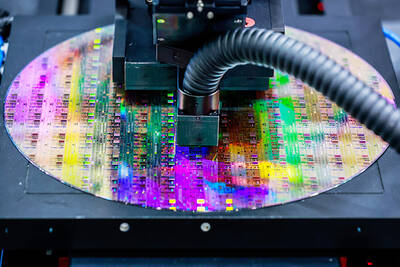
The artificial intelligence (AI) boom has triggered a seismic reshuffling of global equity markets, with Taiwan and South Korea muscling past European nations one by one. With its stock market now valued at nearly US$4.3 trillion, Taiwan surpassed the UK, Europe’s biggest market, earlier this month, data compiled by Bloomberg showed. South Korea is about US$140 billion away from doing the same. The tech-heavy Asian markets have shot past Germany and France in the past seven months. The shift is largely down to massive gains in shares of three companies that provide essential hardware for AI: Taiwan Semiconductor Manufacturing Co (TSMC, 台積電),
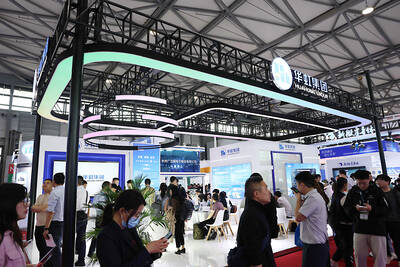
The US Department of Commerce last week ordered multiple chip equipment companies to halt shipments of certain tools to China’s second-largest chipmaker, Hua Hong Semiconductor Ltd (華虹半導體), its latest action to slow the country’s development of advanced chips, two people familiar with the matter said. The department sent letters to at least a handful of companies informing them of restrictions on tools and other materials destined for two Hua Hong facilities US officials believe make China’s most sophisticated chips, the people said. Top US chip equipment companies Lam Research Corp, Applied Materials Inc and KLA Corp, each of which has significant


 RSS
RSS