


Late every summer, hulking white bears gather outside a tiny Alaska native village on the edge of the continent, far above the arctic circle, to feast on whale carcasses left behind by hunters and to wait for the deep cold to freeze the sea.
It is a spectacle that once brought 1,000 or more tourists each year to Kaktovik, the only settlement in the Arctic National Wildlife Refuge, in a phenomenon sometimes called “last chance tourism” — a chance to see magnificent sights and creatures before climate change renders them extinct.
The COVID-19 pandemic and an order from the federal government halting boat tours to see the bears largely ended Kaktovik’s polar bear tourism amid concerns that the tiny village was being overrun by outsiders.
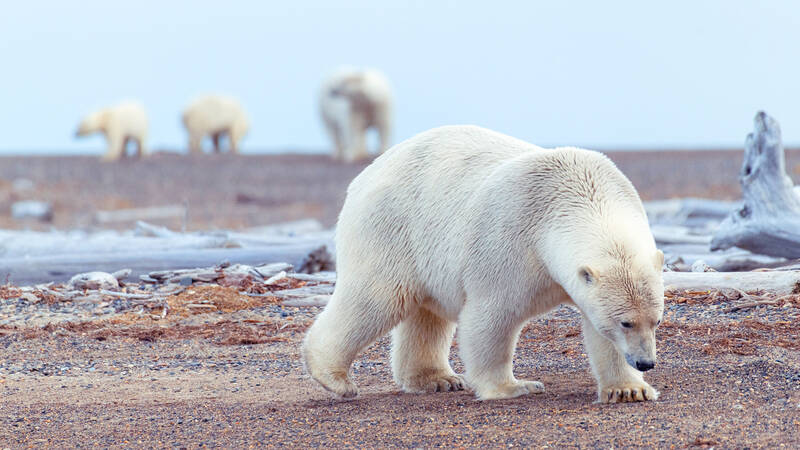
Photo: AP
However, Kaktovik leaders are now hoping to revive it, saying it could be worth millions to the local economy and give residents another source of income — provided the village can set guidelines that protect its way of life and the bears themselves.
“We definitely see the benefit for tourism,” said Charles Lampe, president of Kaktovik Inupiat Corp, which owns 373km2 of land. “The thing is, it can’t be run like it was before.”
As far back as the early 1980s, anyone in Kaktovik with a boat and knowledge of the waters could take a few tourists out to watch the bears as they lumbered across the flat, treeless barrier islands just off the coast or tore into the ribs of a bowhead whale left by subsistence hunters.
Tourism in Kaktovik soared in the years after federal officials declared polar bears a threatened species in 2008. The rapid warming of the arctic is melting the sea ice that the bears use to hunt seals.
Scientists have said that most polar bears could be wiped out by the end of the century.
As visitation rates boomed, the US federal government imposed regulations requiring tour operators to have permits and insurance and that began to squeeze locals out of the industry, Lampe said.
Larger out-of-town operators moved in, and before long, crowds of tourists were traveling to Kaktovik — a village of about 250 people — during the six-week viewing season.
The town’s two hotels and restaurants lost out on some business when large operators began flying tourists in from Fairbanks or Anchorage for day trips.
Locals complained that tourists gawked at them or traipsed through their yards.
Small plane capacity became an issue, with residents sometimes battling tourists to get on flights to or from larger cities for medical appointments, forcing those left stranded in the cities to get expensive hotel rooms for the night.
When the pandemic struck, Kaktovik paused visitation. In 2021, the federal government, which manages polar bears, halted boat tours, mostly over concerns about how tourists were affecting bear behavior and overrunning the town.
Alaska native leaders are now in talks with the US Fish and Wildlife Service to address those concerns and reignite the industry, perhaps as early as next year.
The agency told reporters in a statement that it is working with Kaktovik “to ensure that any future opportunities are managed in a way that prioritizes visitor safety, resource protection and community input.”
Among the changes Kaktovik leaders want to see is a limit on how long a boat can sit in the water near the bears.
Too long and the bears get used to humans — making for a dangerous situation when bears wander into town looking for food, Lampe said.
During the height of the tourism boom, it became tougher to haze the bears out of town, even with the town’s bear patrol shooting at them with nonlethal rounds.
The patrol had to kill about three or four bears per year, compared with maybe one per year before the boom, Lampe said.
“Our safety was at risk,” Lampe said.
In 2023, a 24-year-old woman and her one-year-old son were killed in a polar bear attack in Wales, in far western Alaska. It was the first fatal polar bear attack in nearly 30 years in Alaska, the only US state that is home to the species.
Since the boat tours in Kaktovik were halted, the bears once again seem more fearful of humans, Lampe said.
Polar bear tourism coincides with Kaktovik’s subsistence whaling season. When a crew lands a whale, it is usually butchered on a nearby beach.
While the community encourages visitors to watch or even help, some were recording or taking pictures without permission, which is considered disrespectful, Lampe said.
Sherry Rupert, chief executive officer of the American Indigenous Tourism Association, suggested that Kaktovik market itself as a two or three-day experience.
Native communities that are ready for tourists “want them to come and be educated, and walk away with a greater understanding of our people and our way of life and our culture,” Rupert said.
Roger and Sonia MacKertich of Australia were looking for the best spot on the planet to view polar bears in the wild when they traveled to Kaktovik in September 2019.
They spent several days in the village, took a walking tour led by an elder and bought souvenirs made by local artists, including a hoodie featuring a polar bear.
For Roger MacKertich, a professional wildlife photographer based in Sydney, the highlight was the boat tours to see bears roaming on the barrier islands or taking a dip in the water.
The bears paid them no attention.
“That’s nearly as good as it gets,” he said.

Taichung reported the steepest fall in completed home prices among the six special municipalities in the first quarter of this year, data compiled by Taiwan Realty Co (台灣房屋) showed yesterday. From January through last month, the average transaction price for completed homes in Taichung fell 8 percent from a year earlier to NT$299,000 (US$9,483) per ping (3.3m²), said Taiwan Realty, which compiled the data based on the government’s price registration platform. The decline could be attributed to many home buyers choosing relatively affordable used homes to live in themselves, instead of newly built homes in the city’s prime property market, Taiwan Realty

The government yesterday approved applications by Alphabet Inc’s Google to invest NT$27.08 billion (US$859.98 million) in Taiwan, the Ministry of Economic Affairs said in a statement. The Department of Investment Review approved two investments proposed by Google, with much of the funds to be used for data processing and electronic information supply services, as well as inventory procurement businesses in the semiconductor field, the ministry said. It marks the second consecutive year that Google has applied to increase its investment in Taiwan. Google plans to infuse NT$25.34 billion into Charter Investments Ltd (特許投資顧問) through its Singapore-based subsidiary Fructan Holdings Singapore Pte Ltd, and

JET JUICE: The war on Iran’s secondary effects have seen fuel prices skyrocket, knocking flight schedules down to earth in return as airlines struggle with costs Airline passengers should brace for more irritation in the next few months as carriers worldwide cancel flights and ground planes to cope with stratospheric increases in jet-fuel prices. Dutch flag carrier KLM is the latest company to cut its schedule, saying on Thursday that it would scrap 80 return flights at Amsterdam’s Schiphol Airport in the coming month. That puts it in the same league as United Airlines Holdings Inc, Deutsche Lufthansa AG and Cathay Pacific Airways Ltd, which have all pruned itineraries to mitigate costs. Global capacity for next month has been reduced by about 3 percentage points, with all

Micron Technology Inc is a driving force pushing the US Congress to pass legislation that would put new export restrictions on equipment its Chinese competitors use to make their chips, according to people familiar with the matter. A US House of Representatives panel yesterday was to vote on the “MATCH Act,” a bill designed to close gaps in restrictions on chipmaking equipment. It would also pressure foreign companies that sell equipment to Chinese chipmaking facilities to align with export curbs on US companies like Lam Research Corp and Applied Materials Inc. The bill targets facilities operated by China’s ChangXin Memory Technologies Inc


 RSS
RSS