


Contract chipmaker Powerchip Semiconductor Manufacturing Corp (力積電) expects significant improvement in gross margin and net profit this quarter on continued chip price hikes.
The company has raised prices for 12-inch display driver chips by 30 percent, image sensors by 20 percent and 8-inch display driver chips by 15 percent since January due to short supply, Powerchip president Martin Chu (朱憲國) said at an earnings conference on Tuesday.
“Such significant price hikes would boost the company’s business by a double-digit percentage,” Chu said, projecting a “jump” in gross margin and net profit this quarter.
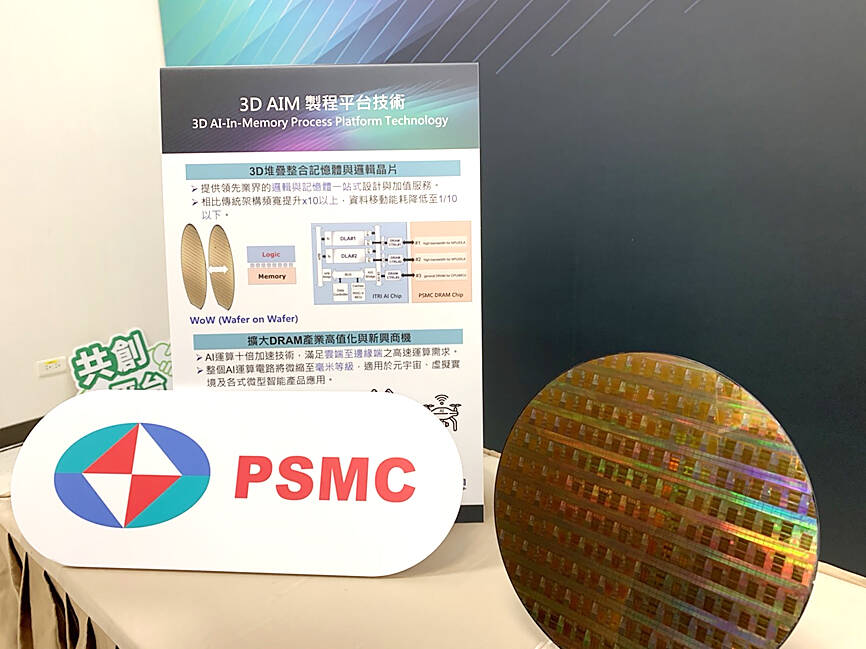
Photo: Grace Hung, Taipei Times
The memory supply crunch is expected to persist through the second half of this year at least, as launches of token-intensive artificial intelligence (AI) large language models, such as OpenClaw, are fueling demand for memory chips, he said.
Foundry services for memory chips, including DRAM and flash memory, accounted for 44 percent of the company’s revenue last quarter, while foundry services for power management chips and display driver chips made up 18 percent and 10 percent respectively, Powerchip said.
Thanks to massive asset disposal gains from selling a 12-inch fab to Micron Technology Inc, last quarter marked Powerchip’s first profitable quarter in the past nine quarters.
Net profit was NT$14.2 billion (US$450.2 million) last quarter, compared with a loss of NT$654 million in the previous quarter and a loss of NT$1.1 billion a year earlier, while gross margin improved to 10 percent from 6 percent in the previous quarter and minus-5 percent the previous year.
“Powerchip has entered a positive cycle. We are optimistic about our business outlook,” company spokesman Eric Tan (譚仲民) said at the conference.
The company’s factory utilization rate is forecast to move up to 100 percent this quarter, from about 88 percent last quarter, Tan said.
Powerchip this year plans US$512 million in capital expenditures in preparation for volume production of DRAM chips in the second half of 2028, the company said.
It would use new DRAM manufacturing process technology — called 1P — transferred from Micron for the production, it said.
The company would also provide advanced packaging services for the high-bandwidth memory (HBM) chips made by Micron, which has prepaid US$300 million to Powerchip for equipment purchases, it said.
HBM chips play an essential role in enhancing AI computing.
Powerchip is also collaborating with customers to supply integrated passive devices (IPDs) using advanced packaging technology from the second half of next year, the company said.
IPD integrates resistors, capacitors and inductors into a single substrate, suitable for 5G smartphones and high-performance computing devices, it said.
The advanced packaging technology — called embedded multi-die interconnect bridge — was developed by Intel Corp and viewed as an alternative to the chip-on-wafer-on-substrate technology developed by Taiwan Semiconductor Manufacturing Co (台積電) amid a prolonged supply crunch.
Powerchip aims to boost its new 3D AI foundry business that includes IPD, interposers for 2.5D packaging technology and 3D packaging wafer-on-wafer, Chu said.
The new business is to become a third pillar of Powerchip’s revenue growth engines within two to three years, in addition to the memory chip and logic chip foundry services, he said.
The new 3D AI foundry business accounted for about 3 percent of the company’s revenue last quarter, he added.

Cairo’s new monorail slices across the city skyline, running above the familiar chaos of blaring horns and aging buses’ exhaust fumes that mark rush hour below. The US$4.5 billion monorail, opened this month, is among Egypt’s most prominent new transport projects, part of a debt-funded infrastructure drive criticized for sapping state finances while bringing limited benefits to most of the country’s 109 million people. “It feels like you’re in a different country,” said Ramy Sayed, a restaurant manager, aboard a driverless Innovia 300 train. “No noise, no traffic, we’re not used to this.” The eastern line runs 56km from the bustling middle-class

Taiwanese firms have increased investment in the Philippines in recent years as Manila’s ties with Washington deepen and global supply chains continue to shift away from China, an expert at the Chung-Hua Institution for Economic Research (CIER, 中華經濟研究院) said yesterday. The Philippines had not been among Taiwanese investors’ top choices in Southeast Asia, CIER Taiwan ASEAN Studies Center director Kristy Hsu (徐遵慈) said at a seminar in Taipei. However, Taiwan’s investment in the country has grown significantly since the COVID-19 pandemic, reaching US $257 million last year, a high in recent years, she said. Although Taiwan’s total investment in the Philippines still lags

Intel Corp regards Taiwan Semiconductor Manufacturing Co (TSMC, 台積電) as a longstanding partner, as the US chipmaker would continue outsourcing production of advanced chips to TSMC, Intel chief executive officer Lip-Bu Tan (陳立武) said yesterday. “I don’t look at people as competitors. I look at the collaboration... Nvidia is also, you know, a good friend,” Tan told a news conference following his keynote speech at the Computex trade show in Taipei. “It’s a very trusted partnership for us... We are a big, top customer for them, and we’re going to continue doing that,” he said, referring to TSMC, the world’s largest foundry

Artificial intelligence (AI) agents would supplant smartphones as the center of people’s digital lives, fundamentally reshaping personal devices and driving a major computing upgrade cycle, Qualcomm Inc CEO Cristiano Amon said yesterday. In his keynote speech for this year’s Computex trade show in Taipei, Amon said that the rise of "agentic AI" — AI systems capable of reasoning, planning and carrying out tasks autonomously — would transform how people interact with technology across phones, PCs, vehicles and wearable devices. Describing the technology as the next major evolution in computing, Amon said that "2026 is the year of agents.” For decades, smartphones have sat


 RSS
RSS