


Time magazine has listed Taiwan Semiconductor Manufacturing Co (台積電, TSMC) chairman and CEO C.C. Wei (魏哲家) as one of the 100 most influential people in the world this year.
On the list published yesterday, Wei was featured in the Pioneers category, one of six groups that include Artists, Icons, Leaders, Titans and Innovators.
His entry features a profile written by Nvidia Corp founder and CEO Jensen Huang (黃仁勳), who lauded Wei's leadership in "one of the world's most consequential companies."
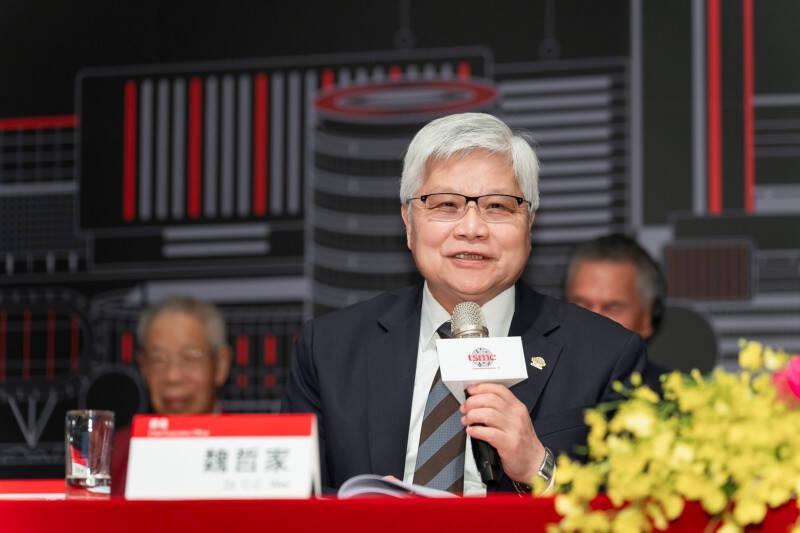
Photo: Taipei Times file photo
In the profile, Huang described Wei as a humble yet disciplined leader who has steered TSMC to become more than just a chipmaker.
Under Wei's stewardship, the company has evolved into a foundational technology platform for global industry, Huang said.
Wei is "a leader, partner, and friend I have known for over 20 years," Huang wrote.
Wei recognized early on that the global computing landscape was shifting from mobile-first to artificial intelligence (AI)-first computing, he said.
Wei's vision guided TSMC's transition from "only fabricating chips to also creating integrated systems of chips — assembled in complex 3D packages and soon connected with silicon photonics," Huang said.
These advances “made Nvidia’s AI supercomputers possible and helped ignite today’s AI revolution,” he said.
TSMC's pure foundry model, established by TSMC founder Morris Chang (張忠謀), is built on trust, excellence and partnership, and has been enhanced under Wei's leadership, Huang said.
Today, TSMC's consistent commitment to customers — from the personal computer era to the Internet, mobile devices and now AI — has made the company "indispensable," he added.
"C.C. Wei is truly one of the most influential people of our time," Huang said.
Other global figures listed this year include US President Donald Trump, Chinese President Xi Jinping (習近平), Japanese Prime Minister Sanae Takaichi, Israeli Prime Minister Benjamin Netanyahu and Pope Leo XIV.
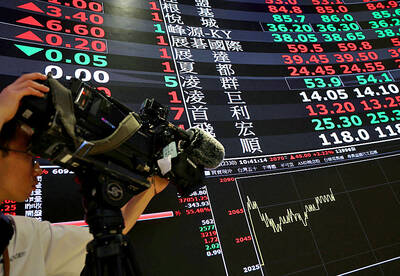
After several years flying high as Asia’s best Nvidia Corp proxy, Taiwan Semiconductor Manufacturing Co (TSMC, 台積電) is increasingly vying with other artificial intelligence (AI) stocks for investor attention. Stock traders are chasing a wider array of beneficiaries as mainstream usage of AI creates demand for hardware beyond the most-advanced chips TSMC makes for Nvidia. Subthemes from the deepening memory crunch to advances in robotics are also luring bids. At the same time, investment caps on single stocks are pushing funds to diversify, while retail investors long familiar with TSMC through its US depositary receipts are being offered a broader set of

Netherlands-based semiconductor equipment supplier ASML Holding NV yesterday said that it is planning to hire an additional 1,000 people in Taiwan this year in response to growing demand from clients. ASML had previously planned to recruit 600 people this year, but that the plan has been adjusted upward, ASML vice president and ASML Taiwan general manager Grace Wang (汪佳慧) told reporters. ASML has a workforce of more than 4,500 in Taiwan, accounting for about 10 percent of its global total, Wang said. This year’s recruitment campaign would focus on adding people in the customer support, manufacturing and supply chain domains to assist ASML

UNDER MICROSCOPE: Taiwan detained three people who allegedly conspired to buy servers in Taiwan and export them using fraudulent documentation, prosecutors said Nvidia Corp chief executive officer Jensen Huang (黃仁勳) on Saturday urged Super Micro Computer Inc to tighten up on compliance after Taiwan detained three people this week for allegedly making fraudulent declarations about artificial intelligence (AI) servers made by its US partner. The development marked the nation’s first crackdown on semiconductor smuggling, which grew after the US slapped restrictions on exports of high-end chips such as Nvidia AI accelerators to China. Nvidia is “rigorous” in explaining regulations to all of its partners, Huang told reporters after arriving in Taipei. “Ultimately Super Micro has to run their own company,” he said in response to

Nvidia Corp yesterday announced that CEO Jensen Huang (黃仁勳) would attend an employee meeting in Taipei tomorrow to celebrate the launch of the company’s Taiwan headquarters project. Huang would attend a gathering at the site of Nvidia’s planned headquarters in Beitou Shilin Technology Park (北投士林科技園區), the company said in a statement. After arriving in Taiwan on Saturday last week, Huang told reporters that he plans to meet with Quanta Computer Inc (廣達) chairman Barry Lam (林百里) and Taiwan Semiconductor Manufacturing Co (TSMC, 台積電) chairman C.C. Wei (魏哲家), and would attend the groundbreaking ceremony for Nvidia’s Taiwan headquarters tomorrow. Nvidia has not yet applied


 RSS
RSS