


Economic growth across Asia would likely slow even if oil prices stabilize in the coming months, as the impact of war in the Middle East ripples through industries from manufacturing to tourism, the Asian Development Bank (ADB) said.
The US and Israeli war on Iran is projected to halt developing Asia’s economic upswing, with the region’s GDP expansion seen moderating to 5.1 percent this year from 5.4 percent last year, the ADB said in its Asian Development Outlook report released yesterday.
The report’s projections were finalized more than a week into the Iran war, which started on Feb. 28, and assume a scenario where oil prices would gradually normalize and move toward pre-war levels by year-end.

Photo: EPA
The situation remains volatile, with oil prices whipsawing on daily developments in the conflict.
“Developing Asia and the Pacific’s economic ascent faces a formidable test,” ADB President Masato Kanda said in the report. “While the region’s direct exposure is limited, it remains vulnerable to rising prices for energy and other commodities, which fan inflation and tighten financial conditions.”
The Manila-based lender forecasted that China’s growth would ease to 4.6 percent this year from 5 percent last year, with private consumption remaining subdued in Asia’s largest economy.
India’s economic growth is also projected to decline to 6.9 percent this year from last year’s 7.6 percent due to external headwinds, although it should get support from resilient consumption.
Developing Southeast Asia’s expansion is forecast to be broadly steady, the ADB said, which reclassified some economies as advanced, instead of developing.
Growth in advanced economies in Asia and the Pacific region would ebb from 2.5 percent last year to 2.2 percent this year, due to slowdowns in Taiwan, Hong Kong, Japan and Singapore, it said.
Inflation in developing Asia would also accelerate to 3.6 percent this year from 3 percent last year, driven mainly by higher energy prices, the ADB said.
Farm production costs and food prices are expected to rise as the region relies on the Middle East for supplies of fertilizers and other related inputs, including urea and ammonia, it added.
The Iran war would also likely hit semiconductor output, amid disruptions in the shipments of key inputs for chip manufacturing such as helium, sulfur and petrochemical products, the ADB said.
Tourism-dependent economies would likewise feel the drag after the war upended global travel, it added.
Despite the war posing downside risks to Asian economies, the lender cautioned against aggressive monetary policy tightening and price controls.
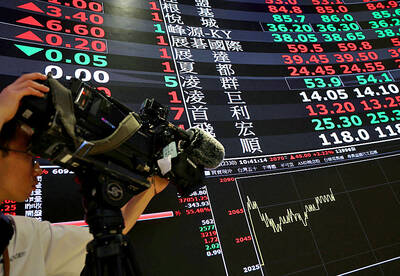
After several years flying high as Asia’s best Nvidia Corp proxy, Taiwan Semiconductor Manufacturing Co (TSMC, 台積電) is increasingly vying with other artificial intelligence (AI) stocks for investor attention. Stock traders are chasing a wider array of beneficiaries as mainstream usage of AI creates demand for hardware beyond the most-advanced chips TSMC makes for Nvidia. Subthemes from the deepening memory crunch to advances in robotics are also luring bids. At the same time, investment caps on single stocks are pushing funds to diversify, while retail investors long familiar with TSMC through its US depositary receipts are being offered a broader set of
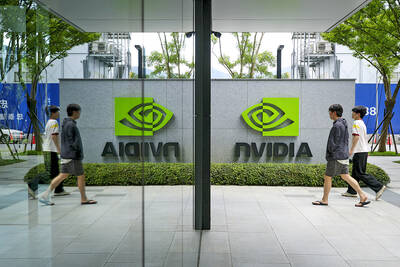
UNDER MICROSCOPE: Taiwan detained three people who allegedly conspired to buy servers in Taiwan and export them using fraudulent documentation, prosecutors said Nvidia Corp chief executive officer Jensen Huang (黃仁勳) on Saturday urged Super Micro Computer Inc to tighten up on compliance after Taiwan detained three people this week for allegedly making fraudulent declarations about artificial intelligence (AI) servers made by its US partner. The development marked the nation’s first crackdown on semiconductor smuggling, which grew after the US slapped restrictions on exports of high-end chips such as Nvidia AI accelerators to China. Nvidia is “rigorous” in explaining regulations to all of its partners, Huang told reporters after arriving in Taipei. “Ultimately Super Micro has to run their own company,” he said in response to
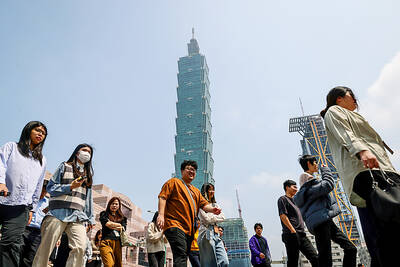
TECH RELIANCE: Growth is increasingly reflecting an unequal K-shaped distribution, where technology sectors outperform and other industries struggle, an expert said Standard Chartered Bank has significantly raised its forecast for Taiwan’s economic growth to 9.5 percent this year, up from 7.6 percent previously, citing surging artificial intelligence (AI) demand driving exports, semiconductor production and investment. The upgrade reflects a sustained AI supercycle that continues to fuel demand for advanced chips and technology infrastructure, which form the backbone of Taiwan’s exports, the bank said in a report this week. “We raise our 2026 growth forecast to reflect a much stronger-than-expected first-quarter GDP figure,” Standard Chartered senior economist for greater China and Asia Tommy Wu (胡東安) said in the report. Driven largely by a 35.3 percent
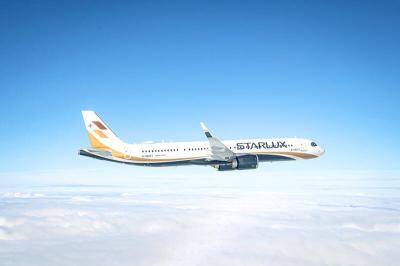
Two of Taiwan’s international carriers, Starlux Airlines Co (星宇航空) and EVA Airways Corp (長榮航空), have retained the five-star airline rating awarded by international airline review organization Skytrax. Starlux was awarded the distinction for a second consecutive year, while EVA Air received it for the 11th straight year, Skytrax said in statements released yesterday and on Thursday last week, respectively. The five-star rating is considered one of the airline industry's highest honors and is awarded following professional audits of airline product and frontline service standards, Skytrax said. The ratings are based on in-depth assessments using unified global quality standards rather than customer review scores


 RSS
RSS