


Space Exploration Technologies Corp (SpaceX) boosted its target initial public offering (IPO) valuation above US$2 trillion, according to people familiar with the matter, as the world’s most valuable start-up gears up to pitch potentially the biggest-ever market debut.
Billionaire Elon Musk’s rocket, satellite and artificial intelligence (AI) company and its advisers are floating the figure to prospective investors, the people said, ahead of meetings in the coming weeks.
At more than US$2 trillion, SpaceX’s valuation would increase by about two-thirds in a matter of months. The company’s acquisition of Musk’s xAI valued the combined company at US$1.25 trillion.
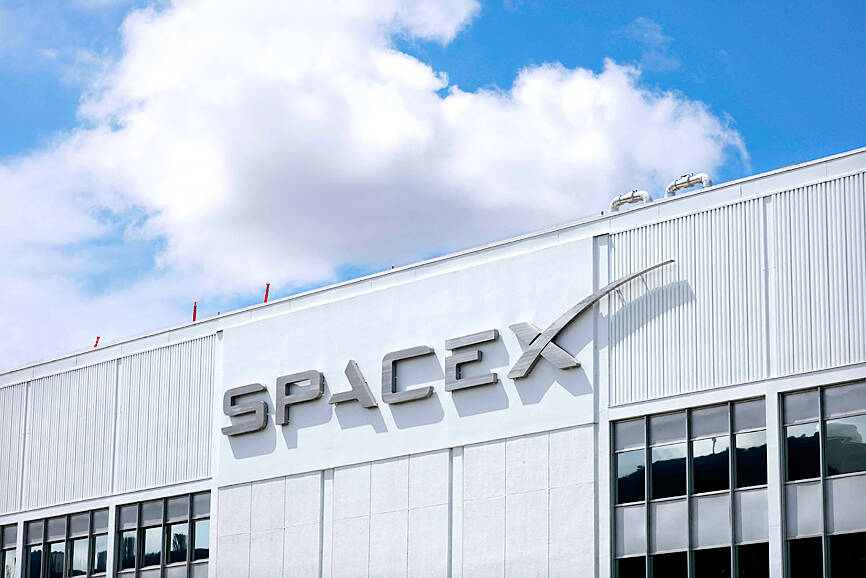
Photo: Getty Images via AFP
It would also be bigger than all but five of the companies in the S&P 500 Index — Nvidia Corp, Apple Inc, Alphabet Inc, Microsoft Corp and Amazon.com Inc. It would be larger by that metric than Meta Platforms Inc and Musk’s own Tesla Inc, the two other members of the so-called “Magnificent Seven” stocks.
SpaceX has filed confidentially for an IPO that could take place in June. The listing would make SpaceX the first of a potential trio of mega-IPOs, followed by OpenAI and Anthropic PBC, whose chatbots are rivals to SpaceX subsidiary xAI’s Grok.
Deliberations are ongoing and details of the offering could still change, the people said, asking not to be identified as the information is not public.
A representative for SpaceX did not immediately respond to a request for comment.
A listing for SpaceX would raise as much as US$75 billion. At that size, it would dwarf the biggest ever IPO — Saudi Arabian Oil Co’s US$29 billion debut in 2019. The company would use the funds to finance Musk’s vision of AI data centers in space and a factory on the moon.
The billionaire’s grand plans would require unprecedented amounts of capital, and resources that span several of the companies he controls.
Musk said last month that his Terafab project, which would eventually manufacture his own chips for robotics, AI and space data centers, would be jointly run by Tesla and SpaceX.
SpaceX has picked Bank of America Corp, Citigroup Inc, Goldman Sachs Group Inc, JPMorgan Chase & Co and Morgan Stanley for senior roles on the IPO, and has added more banks to the lineup, people familiar with the matter have said.
The company has lined up a call with the broader bank syndicate today, and there is expected to be an analyst briefing later this month, a person familiar with the matter said.

Taichung reported the steepest fall in completed home prices among the six special municipalities in the first quarter of this year, data compiled by Taiwan Realty Co (台灣房屋) showed yesterday. From January through last month, the average transaction price for completed homes in Taichung fell 8 percent from a year earlier to NT$299,000 (US$9,483) per ping (3.3m²), said Taiwan Realty, which compiled the data based on the government’s price registration platform. The decline could be attributed to many home buyers choosing relatively affordable used homes to live in themselves, instead of newly built homes in the city’s prime property market, Taiwan Realty
The government yesterday approved applications by Alphabet Inc’s Google to invest NT$27.08 billion (US$859.98 million) in Taiwan, the Ministry of Economic Affairs said in a statement. The Department of Investment Review approved two investments proposed by Google, with much of the funds to be used for data processing and electronic information supply services, as well as inventory procurement businesses in the semiconductor field, the ministry said. It marks the second consecutive year that Google has applied to increase its investment in Taiwan. Google plans to infuse NT$25.34 billion into Charter Investments Ltd (特許投資顧問) through its Singapore-based subsidiary Fructan Holdings Singapore Pte Ltd, and
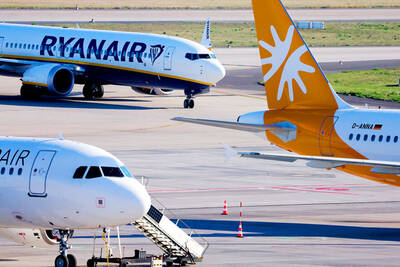
JET JUICE: The war on Iran’s secondary effects have seen fuel prices skyrocket, knocking flight schedules down to earth in return as airlines struggle with costs Airline passengers should brace for more irritation in the next few months as carriers worldwide cancel flights and ground planes to cope with stratospheric increases in jet-fuel prices. Dutch flag carrier KLM is the latest company to cut its schedule, saying on Thursday that it would scrap 80 return flights at Amsterdam’s Schiphol Airport in the coming month. That puts it in the same league as United Airlines Holdings Inc, Deutsche Lufthansa AG and Cathay Pacific Airways Ltd, which have all pruned itineraries to mitigate costs. Global capacity for next month has been reduced by about 3 percentage points, with all
Micron Technology Inc is a driving force pushing the US Congress to pass legislation that would put new export restrictions on equipment its Chinese competitors use to make their chips, according to people familiar with the matter. A US House of Representatives panel yesterday was to vote on the “MATCH Act,” a bill designed to close gaps in restrictions on chipmaking equipment. It would also pressure foreign companies that sell equipment to Chinese chipmaking facilities to align with export curbs on US companies like Lam Research Corp and Applied Materials Inc. The bill targets facilities operated by China’s ChangXin Memory Technologies Inc


 RSS
RSS