


The US’ and Israel’s war with Iran has highlighted the newfound alliance between the tech sector and the US military after decades of strained relations, displaying a synergy that investors see as a gold mine.
Military-industrial heavyweights such as Lockheed Martin and Boeing are being joined by rising tech giants Palantir, Anthropic and Anduril in helping to keep the US war machine going.
Tech firms are increasingly involved in helping the US Department of Defense with everything from cloud computing to artificial intelligence (AI) powered drones.
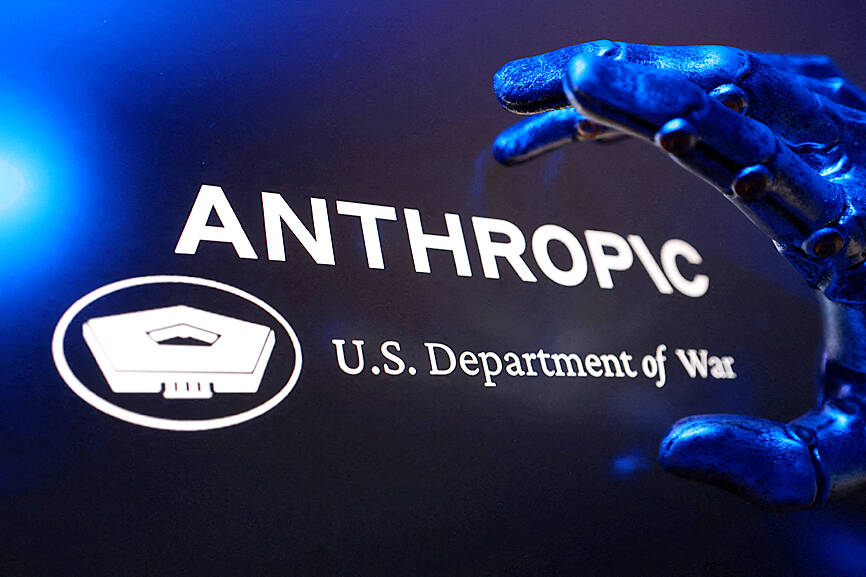
Photo: Reuters
Maven, Palantir’s data analytics platform, has been used extensively in the offensive against Iran, as has Anthropic’s AI.
Anduril president Matthew Steckman said Monday that it was providing “one of the main defense systems” against Iran’s low-cost, long-range Shahed drones. The company announced a 10-year, US$20 billion contract with the US military.
Palantir’s chief Alex Karp called the developments “a huge shift in Silicon Valley.”
“When we started Palantir,” he said this month, “we couldn’t get funding” because the company was still too focused on civilian applications for its technology.
Employee revolts at Microsoft, Amazon and Google in the late 2010s helped keep those giants out of the military market. Google ended up relinquishing the Maven contract in 2018, with Palantir getting onboard in 2024.
Times have changed.
Investors and tech companies have “moved from being hostile to skeptical to neutral, from neutral to positive on the idea that Silicon Valley, like every other part of industry, has to support the warfighter,” Karp said.
Last year, private equity invested a record US$49 billion in defense technology companies, nearly twice 2024’s US$27 billion, PitchBook said.
That shift relates to the Russian invasion of Ukraine and concerns about China’s ambition toward Taiwan, Silicon Valley Defense Group chief operating officer Merritt Ogle said, which promotes closer ties between the two sectors.
“When you start to think about protecting democracy and protecting freedom and protecting things that I think a lot of the countries that are allied with the US appreciate,” she said, the concept that “all defense is bad becomes a harder argument to make.”
However, generative AI has raised concerns.
Anthropic has refused to allow its systems to be used by the Pentagon for mass surveillance, prompting the Trump administration to brand the trailblazing company a “supply chain risk” — even as Anthropic’s AI systems continue to be used for fighting in the Middle East.
Behind the shift has been a wider recognition among military and political leaders that the US “needs to tap into a broader innovation base for national security,” Mark Valentine, head of defense strategy at Skydio, a drone manufacturer, said.
Funding has never been an issue for the US Department of Defense, which has the world’s largest defense budget by far — US$962 billion for this fiscal year.
Almost all of that funding has historically gone to the usual major suppliers. For about a decade, under both Republican and Democratic administrations, the Pentagon has launched numerous initiatives to foster the development and adoption of new technologies.
“There’s a broader understanding that maintaining a technological edge depends on integrating the best capabilities and doing it faster than we have in the past,” Valentine said.
Several programs have been initiated to strengthen ties with the private sector and “the government has seemingly shown a lot more appetite to support earlier stage companies,” Drew Wandzilak, principal of the strategic tech fund at the private equity firm Alumni Ventures, said.
Broad use of drones and missiles in the Ukrainian conflict and the war with Iran has shown that having “the most expensive, most exquisite system was no longer a differentiator,” Wandzilak said.
“There’s competition on volume, there’s competition on capacity. And I think ultimately it’s a mix of the two.”
Ogle said that signals sent by the government had encouraged technology companies to envision military uses for their products.
“It has allowed Americans and people who work in this ecosystem to feel more excited about it, and more open to the idea that we’re not just making bullets here,” she said.

Taiwanese firms have increased investment in the Philippines in recent years as Manila’s ties with Washington deepen and global supply chains continue to shift away from China, an expert at the Chung-Hua Institution for Economic Research (CIER, 中華經濟研究院) said yesterday. The Philippines had not been among Taiwanese investors’ top choices in Southeast Asia, CIER Taiwan ASEAN Studies Center director Kristy Hsu (徐遵慈) said at a seminar in Taipei. However, Taiwan’s investment in the country has grown significantly since the COVID-19 pandemic, reaching US $257 million last year, a high in recent years, she said. Although Taiwan’s total investment in the Philippines still lags
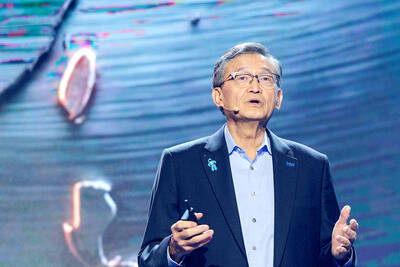
Intel Corp regards Taiwan Semiconductor Manufacturing Co (TSMC, 台積電) as a longstanding partner, as the US chipmaker would continue outsourcing production of advanced chips to TSMC, Intel chief executive officer Lip-Bu Tan (陳立武) said yesterday. “I don’t look at people as competitors. I look at the collaboration... Nvidia is also, you know, a good friend,” Tan told a news conference following his keynote speech at the Computex trade show in Taipei. “It’s a very trusted partnership for us... We are a big, top customer for them, and we’re going to continue doing that,” he said, referring to TSMC, the world’s largest foundry

Artificial intelligence (AI) agents would supplant smartphones as the center of people’s digital lives, fundamentally reshaping personal devices and driving a major computing upgrade cycle, Qualcomm Inc CEO Cristiano Amon said yesterday. In his keynote speech for this year’s Computex trade show in Taipei, Amon said that the rise of "agentic AI" — AI systems capable of reasoning, planning and carrying out tasks autonomously — would transform how people interact with technology across phones, PCs, vehicles and wearable devices. Describing the technology as the next major evolution in computing, Amon said that "2026 is the year of agents.” For decades, smartphones have sat

Hon Hai Precision Industry Co (鴻海精密) yesterday said it would work with US chipmaker Intel Corp to jointly develop and deploy next-generation artificial intelligence (AI) infrastructure and intelligent computing platforms in a move to capture booming demand for AI computing systems. Hon Hai, also known as Foxconn Technology Group (富士康), said in a statement that the partnership would combine its global manufacturing scale, system integration expertise and AI data center deployment capabilities with Intel’s strengths in processor architecture, silicon technologies and software ecosystem. The companies said they plan to work on equipment used in AI data centers, including server racks powered by


 RSS
RSS