


Hundreds of used sneakers arrive each week at a workshop east of Paris, where workers inspect them and ask a simple question: Can a shoe be saved?
Nonprofit SneakCoeurZ is in the business of sorting the shoes to check which ones can be resold or redistributed and which have to be rejected. It says it collected 30,000 pairs of used sneakers last year and resold 2,000 pairs and wants to scale up that process.
“Today, there is no project of this scale in the sneaker sector,” said Mohamed Boukhatem, the organization’s general director and cofounder. “We are the only ones able to industrialize both the processes and the collection of sneakers for reuse.”
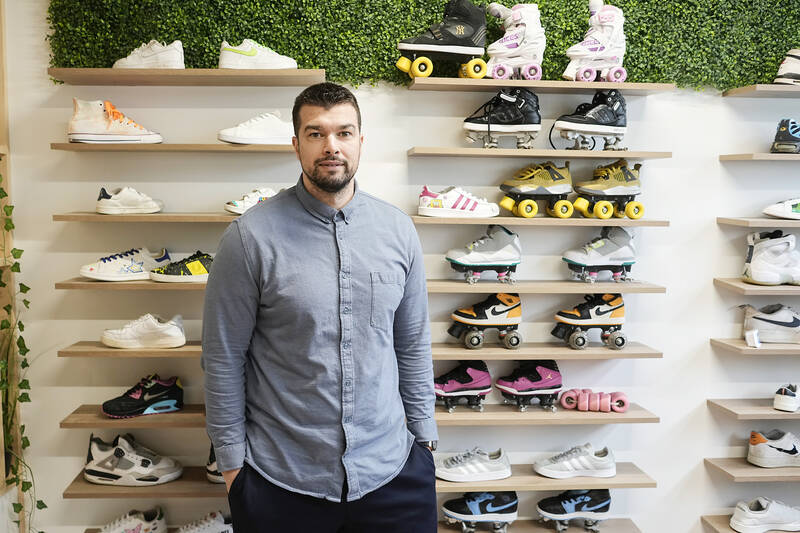
Photo: AP
The group’s work underscores a growing waste problem in France, where the capital has long been one of the world’s fashion and luxury hubs.
The stakes are huge: The textile industry is among the world’s most polluting and the fashion and textiles sector accounts for up to 8 percent of global greenhouse gas emissions, the UN says. The European Parliament has said textiles were the third-largest source of water degradation and land use in the EU in 2020.
Refashion, the French government-approved eco-organization for clothing, household linen and footwear, says 259 million pairs of shoes were sold in France in 2024.
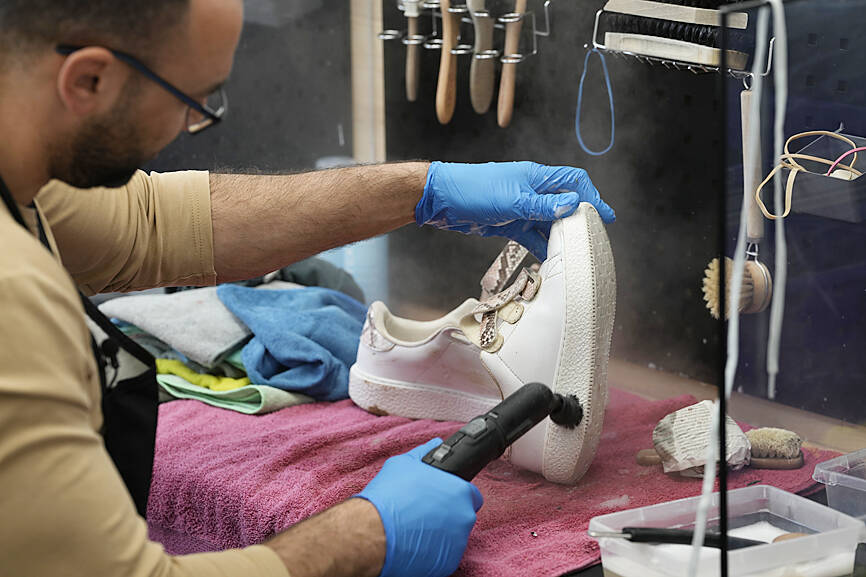
Photo: AP
It says only about a third of used textiles and footwear are separately collected, with much of the rest left in cupboards or thrown away with household waste.
At its workshop in Champs-sur-Marne, workers for SneakCoeurZ inspect the used shoes and check which can be salvaged.
“The structural elements of the shoe are what determine whether we can refurbish it or not,” workshop manager Paul Defawes Abadie said.
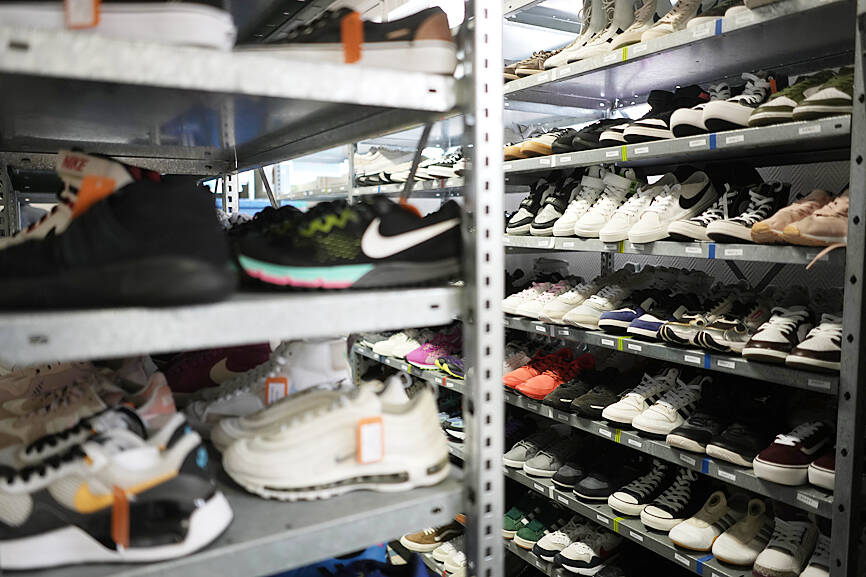
Photo: AP
“A damaged Velcro strap isn’t a deal breaker. A lace isn’t a deal breaker. Dirt is never a deal breaker,” he said. “What really matters is the wear of the structural materials, especially the outsole.”
Pairs that make the cut are cleaned from the sole upward, disinfected inside and, in some cases, whitened under UV light before being put back into circulation.
The nonprofit says it redistributed more than 7,000 pairs to people in need and helped create 19 jobs.
“Over the next three years, the goal is to triple or even quadruple these volumes and move to an industrial scale,” Boukhatem said.
France has tried to respond to the issue of fast-fashion waste with law as well as rhetoric.
Its 2020 anti-waste law requires unsold nonfood goods to be reused, donated or recycled instead of destroyed.
Authorities introduced a state-backed repair bonus for clothing and shoes in November 2023. Separately, lawmakers are still working on a bill aimed at reducing the textile industry’s environmental impact.
The bill passed the National Assembly in March 2024 and the Senate in June last year and the government said last month that it was still aiming for a joint parliamentary committee this spring.

Taichung reported the steepest fall in completed home prices among the six special municipalities in the first quarter of this year, data compiled by Taiwan Realty Co (台灣房屋) showed yesterday. From January through last month, the average transaction price for completed homes in Taichung fell 8 percent from a year earlier to NT$299,000 (US$9,483) per ping (3.3m²), said Taiwan Realty, which compiled the data based on the government’s price registration platform. The decline could be attributed to many home buyers choosing relatively affordable used homes to live in themselves, instead of newly built homes in the city’s prime property market, Taiwan Realty
The government yesterday approved applications by Alphabet Inc’s Google to invest NT$27.08 billion (US$859.98 million) in Taiwan, the Ministry of Economic Affairs said in a statement. The Department of Investment Review approved two investments proposed by Google, with much of the funds to be used for data processing and electronic information supply services, as well as inventory procurement businesses in the semiconductor field, the ministry said. It marks the second consecutive year that Google has applied to increase its investment in Taiwan. Google plans to infuse NT$25.34 billion into Charter Investments Ltd (特許投資顧問) through its Singapore-based subsidiary Fructan Holdings Singapore Pte Ltd, and

JET JUICE: The war on Iran’s secondary effects have seen fuel prices skyrocket, knocking flight schedules down to earth in return as airlines struggle with costs Airline passengers should brace for more irritation in the next few months as carriers worldwide cancel flights and ground planes to cope with stratospheric increases in jet-fuel prices. Dutch flag carrier KLM is the latest company to cut its schedule, saying on Thursday that it would scrap 80 return flights at Amsterdam’s Schiphol Airport in the coming month. That puts it in the same league as United Airlines Holdings Inc, Deutsche Lufthansa AG and Cathay Pacific Airways Ltd, which have all pruned itineraries to mitigate costs. Global capacity for next month has been reduced by about 3 percentage points, with all

The US said it plans to help build a first-of-its-kind industrial hub in the Philippines to boost production of inputs crucial to US supply chains. The 4,000-acre hub is intended to be “a purpose-built platform for allied manufacturing” and “an investment acceleration hub where the specific industrial activities are shaped by market demand,” the US Department of State said on Thursday. The project — touted as an “economic security zone” — would be within the Luzon Economic Corridor, a flagship economic project backed by the US and Japan on the main Philippine island. The project was also described as “the first artificial intelligence


 RSS
RSS