


Taiwan’s consumer confidence declined this month as escalating tensions in the Middle East weighed on sentiment and heightened concerns over inflation and economic risks, a survey released yesterday by National Central University (NCU) said.
The consumer confidence index dropped 4.28 points from the previous month to 62.3, the lowest level in three years and two months, the survey showed.
All six sub-indicators dropped, including expectations for prices, household finances, the domestic economic outlook, employment opportunities, stock investment interest and purchases of durable goods.
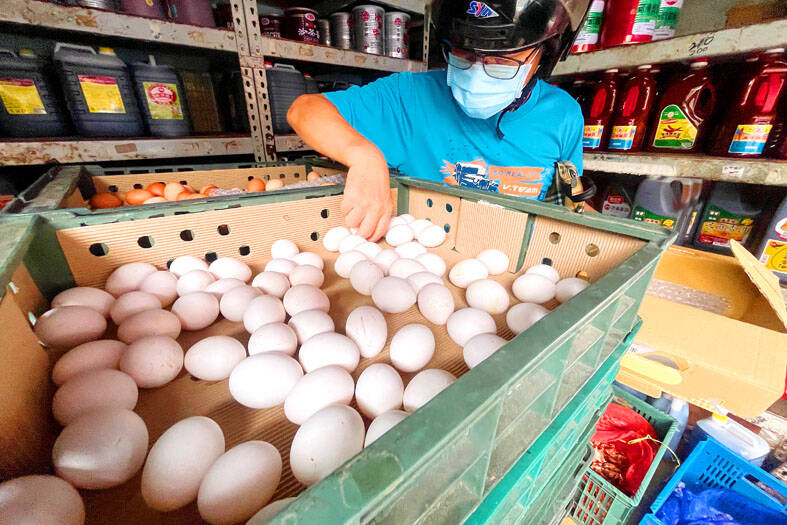
Photo: CNA
The retreat in sentiment reflects growing uncertainty linked to the ongoing conflict in the Middle East, which has raised concerns about global energy supplies and inflation pressures, the monthly survey said.
NCU Research Center for Taiwan Economic Development director Dachrahn Wu (吳大任) said that Taiwan is particularly vulnerable to energy disruptions, as about 95 percent of its energy supply is imported.
If the conflict drags on and affects shipping routes, inflation would be the most immediate risk, followed by broader economic repercussions, Wu said.
“The key concern lies in the security of the Strait of Hormuz, a critical corridor for global oil shipments. Even if military hostilities end soon, supply risks could persist for six months to a year,” he said.
Since many Asian economies — including Taiwan, Japan, South Korea and Vietnam — rely heavily on energy shipments passing through the waterway, any disruption could keep global oil prices elevated and intensify inflationary pressure across the region, Wu said.
Although the government has introduced measures to stabilize energy prices, those policies would delay inflation rather than resolve it altogether, Wu said. As a result, weak consumer sentiment could persist for some time.
Another potential consequence is slower economic activity if higher prices squeeze household budgets, he said. Rising living costs could crowd out spending on leisure and dining out.
If the conflict pushes up prices globally, it could also weigh on consumer spending in the US and other major economies. That could eventually reduce demand for artificial intelligence (AI) applications and equipment such as AI servers, undermining Taiwan’s technology supply chain, Wu said.
Among the index components, sentiment toward stock investment posted the steepest decline. The sub-index measuring interest in investing in stocks over the next six months fell 5.58 points to 22.88, a three-year-and-two-month low.
The TAIEX remains at elevated levels despite pullbacks and shrinking trading volumes, Wu said, warning that “high valuations themselves pose a risk.”
Meanwhile, the sub-index tracking willingness to purchase durable goods in the next six months fell 4.11 points to 93.01, marking a five-month low.
However, inflation concerns and the central bank’s easing of second-home mortgage restrictions could prompt investors to seek refuge in property, potentially helping the housing market recover, the survey said.
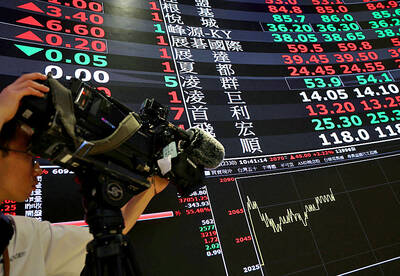
After several years flying high as Asia’s best Nvidia Corp proxy, Taiwan Semiconductor Manufacturing Co (TSMC, 台積電) is increasingly vying with other artificial intelligence (AI) stocks for investor attention. Stock traders are chasing a wider array of beneficiaries as mainstream usage of AI creates demand for hardware beyond the most-advanced chips TSMC makes for Nvidia. Subthemes from the deepening memory crunch to advances in robotics are also luring bids. At the same time, investment caps on single stocks are pushing funds to diversify, while retail investors long familiar with TSMC through its US depositary receipts are being offered a broader set of

Netherlands-based semiconductor equipment supplier ASML Holding NV yesterday said that it is planning to hire an additional 1,000 people in Taiwan this year in response to growing demand from clients. ASML had previously planned to recruit 600 people this year, but that the plan has been adjusted upward, ASML vice president and ASML Taiwan general manager Grace Wang (汪佳慧) told reporters. ASML has a workforce of more than 4,500 in Taiwan, accounting for about 10 percent of its global total, Wang said. This year’s recruitment campaign would focus on adding people in the customer support, manufacturing and supply chain domains to assist ASML

UNDER MICROSCOPE: Taiwan detained three people who allegedly conspired to buy servers in Taiwan and export them using fraudulent documentation, prosecutors said Nvidia Corp chief executive officer Jensen Huang (黃仁勳) on Saturday urged Super Micro Computer Inc to tighten up on compliance after Taiwan detained three people this week for allegedly making fraudulent declarations about artificial intelligence (AI) servers made by its US partner. The development marked the nation’s first crackdown on semiconductor smuggling, which grew after the US slapped restrictions on exports of high-end chips such as Nvidia AI accelerators to China. Nvidia is “rigorous” in explaining regulations to all of its partners, Huang told reporters after arriving in Taipei. “Ultimately Super Micro has to run their own company,” he said in response to

Nvidia Corp yesterday announced that CEO Jensen Huang (黃仁勳) would attend an employee meeting in Taipei tomorrow to celebrate the launch of the company’s Taiwan headquarters project. Huang would attend a gathering at the site of Nvidia’s planned headquarters in Beitou Shilin Technology Park (北投士林科技園區), the company said in a statement. After arriving in Taiwan on Saturday last week, Huang told reporters that he plans to meet with Quanta Computer Inc (廣達) chairman Barry Lam (林百里) and Taiwan Semiconductor Manufacturing Co (TSMC, 台積電) chairman C.C. Wei (魏哲家), and would attend the groundbreaking ceremony for Nvidia’s Taiwan headquarters tomorrow. Nvidia has not yet applied


 RSS
RSS