


It has been reported that Taiwan Semiconductor Manufacturing Co (TSMC) has triggered a battle for water between Chiayi and Yunlin counties, as the company is planning to build a factory in Chiayi County, but it has to transfer water from the Hushan Reservoir (湖山水庫) in Yunlin County, which has led to a backlash from Yunlin residents.
It was reported that even deep wells are failing to pump water in southern Taiwan, while Kaohsiung and Pingtung County are currently competing for water supply.
TSMC is often praised in Taiwan as the “sacred mountain protecting the country” and all local governments nationwide are eager for its investment.
LACK OF WATER
This highlights the predicament of insufficient water resources in many areas.
The Reclaimed Water Resources Development Act (再生水資源發展條例) and the Regulations on Governing the Developer’s Use of Reclaimed Water (開發單位使用再生水辦法) came into effect on Feb. 1, making it mandatory for an industrial water user with a planned water consumption of 20,000m3 or more per day, to reclaim at least half of the water used.
However, reclaimed water plants are unevenly distributed and they cannot supply enough water.
Even though the Cabinet has approved the construction of 11 reclaimed water plants, none of them are in Chiayi or Yunlin counties.
Chiayi County uses about 300,000 tonnes of water per day, including 110,000 tonnes from the Tsengwen Reservoir (曾文水庫) in the county and the Wushantou Reservoir (烏山頭水庫) in Tainan.
Yunlin County uses about 250,000 tonnes of water per day.
In addition to the Hushan Reservoir, Yunlin County also heavily relies on groundwater.
UNSUITABLE
Due to subsidence, the use of groundwater would have to be reduced, so both counties are not very suitable for large-scale users of water.
Water resources are considered national resources and water resource allocation has become the norm.
Since the authorities are facing difficulties opening new reservoirs, they have no choice but to strengthen such allocation.
TSMC is unable to use enough reclaimed water because the government does not have any reclaimed water source in the region, so it has no choice but to use water from the Hushan Reservoir, but the protests in Yunlin County should still be carefully responded to.
When the amount of available water is poor, the county’s own water use should be the priority.
DISSATISFACTION
As TSMC could have chosen either Chiayi County or Yunlin County, the losing county’s dissatisfaction is understandable, but all local governments need to speed up the planning and construction of reclaimed water plants, so they no longer have to wait for the Cabinet to favor them.
With sources of reclaimed water being an incentive, large-scale water users would surely then invest in the region.
Taking into account water safety and environmental justice, TSMC and other major profitable electronics companies should be required to build their own reclaimed water plants.
With the efficiency of the private sector, it would be possible to utilize reclaimed water much more quickly this way.
Chang Yen-ming is a former section head at the Water Resources Agency.
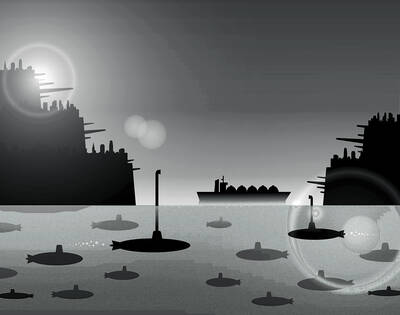
In the event of a war with China, Taiwan has some surprisingly tough defenses that could make it as difficult to tackle as a porcupine: A shoreline dotted with swamps, rocks and concrete barriers; conscription for all adult men; highways and airports that are built to double as hardened combat facilities. This porcupine has a soft underbelly, though, and the war in Iran is exposing it: energy. About 39,000 ships dock at Taiwan’s ports each year, more than the 30,000 that transit the Strait of Hormuz. About one-fifth of their inbound tonnage is coal, oil, refined fuels and liquefied natural gas (LNG),
On Monday, the day before Chinese Nationalist Party (KMT) Chairwoman Cheng Li-wun (鄭麗文) departed on her visit to China, the party released a promotional video titled “Only with peace can we ‘lie flat’” to highlight its desire to have peace across the Taiwan Strait. However, its use of the expression “lie flat” (tang ping, 躺平) drew sarcastic comments, with critics saying it sounded as if the party was “bowing down” to the Chinese Communist Party (CCP). Amid the controversy over the opposition parties blocking proposed defense budgets, Cheng departed for China after receiving an invitation from the CCP, with a meeting with
Chinese Nationalist Party (KMT) Chairwoman Cheng Li-wun (鄭麗文) is leading a delegation to China through Sunday. She is expected to meet with Chinese President Xi Jinping (習近平) in Beijing tomorrow. That date coincides with the anniversary of the signing of the Taiwan Relations Act (TRA), which marked a cornerstone of Taiwan-US relations. Staging their meeting on this date makes it clear that the Chinese Communist Party (CCP) intends to challenge the US and demonstrate its “authority” over Taiwan. Since the US severed official diplomatic relations with Taiwan in 1979, it has relied on the TRA as a legal basis for all
To counter the CCP’s escalating threats, Taiwan must build a national consensus and demonstrate the capability and the will to fight. The Chinese Communist Party (CCP) often leans on a seductive mantra to soften its threats, such as “Chinese do not kill Chinese.” The slogan is designed to frame territorial conquest (annexation) as a domestic family matter. A look at the historical ledger reveals a different truth. For the CCP, being labeled “family” has never been a guarantee of safety; it has been the primary prerequisite for state-sanctioned slaughter. From the forced starvation of 150,000 civilians at the Siege of Changchun


 RSS
RSS