


The conflict in the Middle East is reviving the specter of inflation and hobbling the global economy just as it was showing signs of strengthening at the start of the year, the OECD said yesterday.
In its updated outlook, the Paris-based organization sharply increased its inflation forecasts for major economies and now sees the average rate for the Group of 20 this year jumping to 4 percent — with an even higher pace in the US — rather than the 2.8 percent it predicted in December last year.
Downward adjustments to growth were less dramatic in the short term, but largely because the drag from the Iran war was offset by better-than-expected momentum at the start of the year.
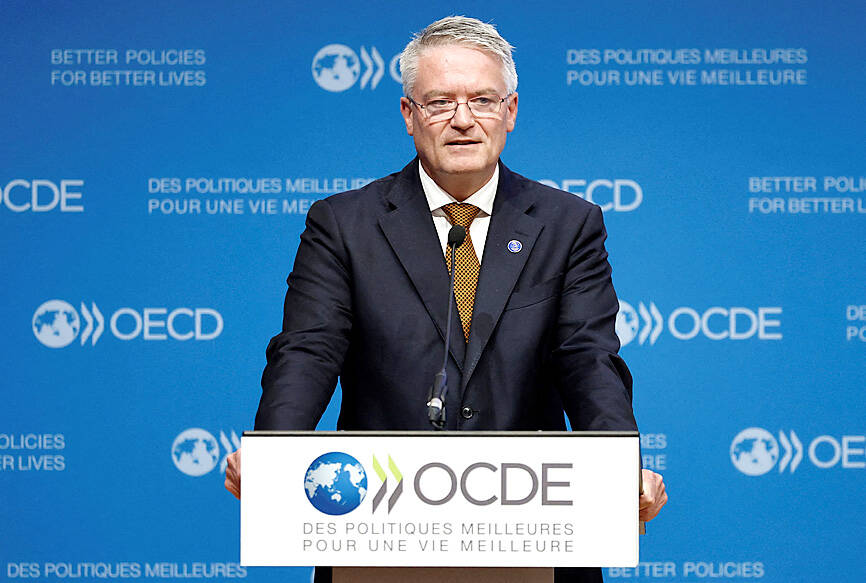
Photo: Benoit Tessier, Reuters
The OECD is the first of the major international economic institutions to formally update forecasts. Other indicators such as business surveys have already begun to point to a synchronized global shock of weaker activity and rising prices.
The organization also warned there is a “significant downside risk” to its projections from further disturbance of exports from the Middle East that would fuel inflation, reduce growth and potentially trigger repricing on financial markets.
“The breadth and duration of the conflict are very uncertain, but a prolonged period of higher energy prices will add markedly to business costs and raise consumer price inflation, with adverse consequences for growth,” the OECD said.
Disruption from the Iran war arrived just as the global economy was picking up tailwinds from investment in artificial intelligence, an easing of US tariff rates and supportive monetary and fiscal policies.
Without the conflict, the OECD said it could have revised up its global growth forecast by 0.3 point for this year. Instead, it left that prediction unchanged at 2.9 percent and trimmed its figure for next year by 0.1 point to 3 percent.
The sudden change of the economic backdrop is also forcing policymakers to change tack. Last week, the US Federal Reserve signaled that any cuts in US borrowing costs remain a long way off. European Central Bank (ECB) officials are considering a possible hike as soon as next month, while Norwegian central bank officials yesterday revealed that they had even discussed a move as soon as this week.
For the US, the OECD expects inflation to jump to 4.2 percent this year, from 2.6 percent last year. Its price outlook for this year is 1.2 percentage point higher than in December, also because the labor market remains tight with slowing net migration and tariffs are adding upward pressure.
“We do think there is a combination of factors that are likely to have a bearing on the inflation outlook in the US,” OECD Secretary-General Mathias Cormann said in an interview with Bloomberg Television.
The organization now expects policy rates to remain unchanged throughout this year in both the US and the UK, while it foresees that the ECB will hike once in the second quarter to ensure inflation expectations remain under control.
“Our current expectation is energy price effect will be temporary, and as such central banks would be able to take that into account,” Cormann said. “But in the end, what we are saying to central banks is that they need to continue to focus very closely on the data as it involves and be very prudent to ensure that inflation expectations are well anchored.”
The 38-member organization also urged governments still carrying large debts racked up through spending during previous crises to refrain from broad-based subsidies and transfers.
“Measures to cushion the impact of higher energy prices should be timely, well-targeted on households most in need and viable firms, preserve incentives to lower energy use and have clear expiry mechanisms,” the OECD said.
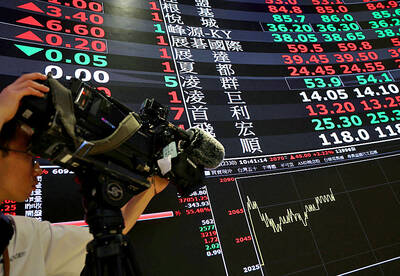
After several years flying high as Asia’s best Nvidia Corp proxy, Taiwan Semiconductor Manufacturing Co (TSMC, 台積電) is increasingly vying with other artificial intelligence (AI) stocks for investor attention. Stock traders are chasing a wider array of beneficiaries as mainstream usage of AI creates demand for hardware beyond the most-advanced chips TSMC makes for Nvidia. Subthemes from the deepening memory crunch to advances in robotics are also luring bids. At the same time, investment caps on single stocks are pushing funds to diversify, while retail investors long familiar with TSMC through its US depositary receipts are being offered a broader set of

UNDER MICROSCOPE: Taiwan detained three people who allegedly conspired to buy servers in Taiwan and export them using fraudulent documentation, prosecutors said Nvidia Corp chief executive officer Jensen Huang (黃仁勳) on Saturday urged Super Micro Computer Inc to tighten up on compliance after Taiwan detained three people this week for allegedly making fraudulent declarations about artificial intelligence (AI) servers made by its US partner. The development marked the nation’s first crackdown on semiconductor smuggling, which grew after the US slapped restrictions on exports of high-end chips such as Nvidia AI accelerators to China. Nvidia is “rigorous” in explaining regulations to all of its partners, Huang told reporters after arriving in Taipei. “Ultimately Super Micro has to run their own company,” he said in response to

Netherlands-based semiconductor equipment supplier ASML Holding NV yesterday said that it is planning to hire an additional 1,000 people in Taiwan this year in response to growing demand from clients. ASML had previously planned to recruit 600 people this year, but that the plan has been adjusted upward, ASML vice president and ASML Taiwan general manager Grace Wang (汪佳慧) told reporters. ASML has a workforce of more than 4,500 in Taiwan, accounting for about 10 percent of its global total, Wang said. This year’s recruitment campaign would focus on adding people in the customer support, manufacturing and supply chain domains to assist ASML
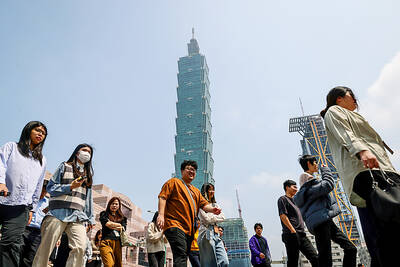
TECH RELIANCE: Growth is increasingly reflecting an unequal K-shaped distribution, where technology sectors outperform and other industries struggle, an expert said Standard Chartered Bank has significantly raised its forecast for Taiwan’s economic growth to 9.5 percent this year, up from 7.6 percent previously, citing surging artificial intelligence (AI) demand driving exports, semiconductor production and investment. The upgrade reflects a sustained AI supercycle that continues to fuel demand for advanced chips and technology infrastructure, which form the backbone of Taiwan’s exports, the bank said in a report this week. “We raise our 2026 growth forecast to reflect a much stronger-than-expected first-quarter GDP figure,” Standard Chartered senior economist for greater China and Asia Tommy Wu (胡東安) said in the report. Driven largely by a 35.3 percent


 RSS
RSS