


Sales in the retail, and the food and beverage sectors in the first two months of this year reached the highest levels for the period on record, as extended holidays boosted consumer traffic at physical stores and businesses promoted sales during the Lunar New Year holiday, data released yesterday by the Ministry of Economic Affairs showed.
The ministry said in a report that retail sales climbed 1.5 percent from a year earlier to NT$813.7 billion (US$25.41 billion) in the first two months, meeting its forecast of a 0.6 to 1.9 percent increase.
Department stores, big-box stores and convenience stores, as well as e-commerce and mail-order operators, drink and tobacco retailers, and fabric and clothing stores were the main drivers in sales during the period, rising from 5.3 to 8.1 percent.
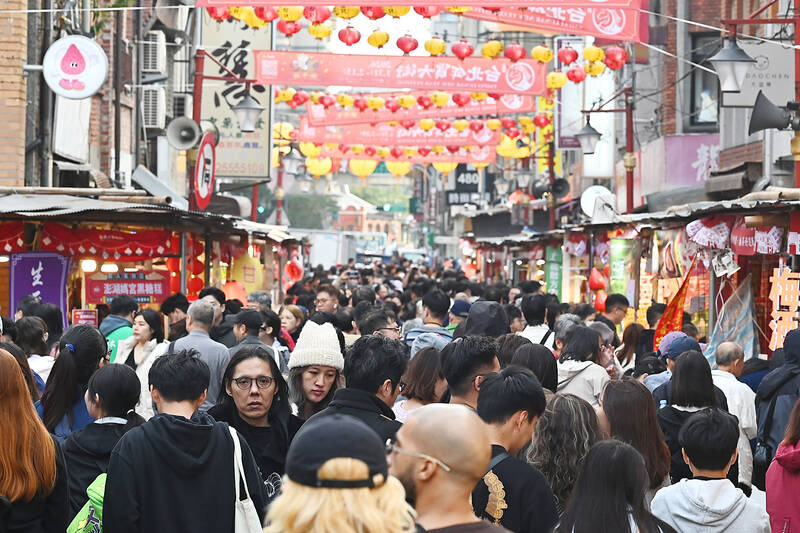
Photo: Wang Yi-sung, Taipei Times
However, sales of cars, motorcycles and auto parts fell 15 percent as many consumers still maintained a wait-and-see attitude on large purchases, while retail fuel sales also dropped 8.4 percent due to falling crude oil prices, the report said.
Food and beverage sales grew 4.6 percent in the period to NT$197 billion on across-the-board growth at restaurants, beverage outlets and catering service providers, exceeding the ministry’s prediction of a 2.1 to 3.4 percent growth, it said.
Meanwhile, sales in the wholesale sector in the first two months increased 20.1 percent from a year earlier to NT$2.57 trillion, also the highest for the period, as strong demand for artificial intelligence (AI) and high-performance computing devices boosted shipments of servers, memory chips and related electronic components, the ministry said.
However, aside from industries benefiting from the AI boom, many wholesale businesses are still facing challenges, with wholesale revenue of the automotive industry down 10.9 percent due to conservative market sentiment and that of building materials declining 9.5 percent amid weak steel demand, it said.
The ministry released the data for the first two months to factor out the effects of the week-long Lunar New Year holiday — which was in February this year, but fell mostly in January last year — when many businesses were closed.
For this month, the ministry forecast retail sales would show between a 0.9 percent drop to a 2.1 percent gain from March last year to range between NT$389.4 billion and NT$401.2 billion, while food and beverage sales are predicted to increase 2.2 to 5.2 percent to between NT$87.6 billion and NT$90.1 billion.
Sales in the wholesale sector this month are projected to rise 16.1 to 19.1 percent year-on-year to between NT$1.38 trillion and NT$1.41 trillion, driven by robust AI and cloud services-related demand, the ministry said.
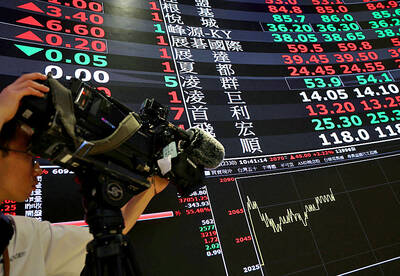
After several years flying high as Asia’s best Nvidia Corp proxy, Taiwan Semiconductor Manufacturing Co (TSMC, 台積電) is increasingly vying with other artificial intelligence (AI) stocks for investor attention. Stock traders are chasing a wider array of beneficiaries as mainstream usage of AI creates demand for hardware beyond the most-advanced chips TSMC makes for Nvidia. Subthemes from the deepening memory crunch to advances in robotics are also luring bids. At the same time, investment caps on single stocks are pushing funds to diversify, while retail investors long familiar with TSMC through its US depositary receipts are being offered a broader set of

Netherlands-based semiconductor equipment supplier ASML Holding NV yesterday said that it is planning to hire an additional 1,000 people in Taiwan this year in response to growing demand from clients. ASML had previously planned to recruit 600 people this year, but that the plan has been adjusted upward, ASML vice president and ASML Taiwan general manager Grace Wang (汪佳慧) told reporters. ASML has a workforce of more than 4,500 in Taiwan, accounting for about 10 percent of its global total, Wang said. This year’s recruitment campaign would focus on adding people in the customer support, manufacturing and supply chain domains to assist ASML

UNDER MICROSCOPE: Taiwan detained three people who allegedly conspired to buy servers in Taiwan and export them using fraudulent documentation, prosecutors said Nvidia Corp chief executive officer Jensen Huang (黃仁勳) on Saturday urged Super Micro Computer Inc to tighten up on compliance after Taiwan detained three people this week for allegedly making fraudulent declarations about artificial intelligence (AI) servers made by its US partner. The development marked the nation’s first crackdown on semiconductor smuggling, which grew after the US slapped restrictions on exports of high-end chips such as Nvidia AI accelerators to China. Nvidia is “rigorous” in explaining regulations to all of its partners, Huang told reporters after arriving in Taipei. “Ultimately Super Micro has to run their own company,” he said in response to

Nvidia Corp yesterday announced that CEO Jensen Huang (黃仁勳) would attend an employee meeting in Taipei tomorrow to celebrate the launch of the company’s Taiwan headquarters project. Huang would attend a gathering at the site of Nvidia’s planned headquarters in Beitou Shilin Technology Park (北投士林科技園區), the company said in a statement. After arriving in Taiwan on Saturday last week, Huang told reporters that he plans to meet with Quanta Computer Inc (廣達) chairman Barry Lam (林百里) and Taiwan Semiconductor Manufacturing Co (TSMC, 台積電) chairman C.C. Wei (魏哲家), and would attend the groundbreaking ceremony for Nvidia’s Taiwan headquarters tomorrow. Nvidia has not yet applied


 RSS
RSS